Principle of Plasma Spraying
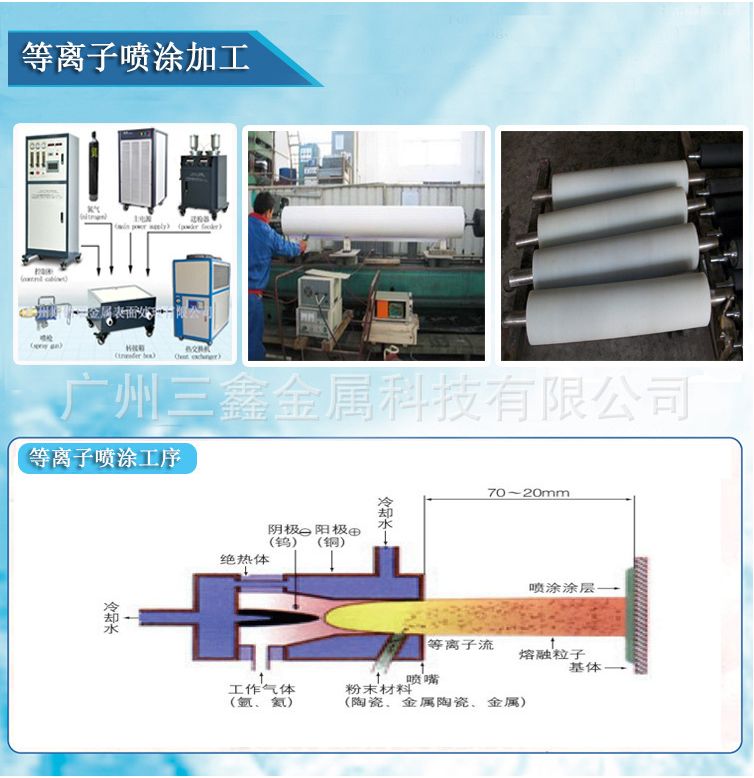
A plasma flame jet is generated by a plasma torch (also known as a plasma arc generator). The tungsten electrode (cathode) and the nozzle (anode) of the torch are connected to the negative and positive terminals of the power supply respectively, while the workpiece remains electrically neutral. A high-frequency spark ignites an arc, causing the working gas supplied to the torch — either Ar or N2 — to become ionised into a plasma under the influence of the arc.
Under the combined effects of mechanical compression, self-magnetic compression and thermal compression, the arc is compressed, forming a non-transferred plasma arc. Powder feed streams deliver the coating material into the plasma arc, where it is rapidly heated to a molten or semi-molten state. The molten powder is then propelled at high velocity by the plasma jet and violently impacts the pre-treated substrate surface, forming a strong and durable coating.
As a result, the coated surface acquires special physicochemical properties such as hardness, wear resistance, heat resistance, corrosion resistance, insulation, thermal insulation and lubricity — meeting the diverse performance requirements of parts under different operating conditions.
Selecting the Plasma Gas
From the perspective of availability and cost-effectiveness, N2 is a suitable choice: it is inexpensive, and its ionised flame has a relatively high heat output and transfers heat quickly. However, for materials prone to nitriding reactions N2 is not appropriate, and the slightly more expensive Ar is used instead.
Controlling Arc Power
Arc power requirements are strict — neither too high nor too low. If arc power is too high, arc temperature rises and the plasma flame temperature increases with it, potentially changing the properties of the coating. If arc power is too low, the plasma temperature drops excessively, which can alter coating properties in the same way.
Materials, Equipment, Processes and Solutions
We have accumulated extensive experience in coating applications and are now replicating these successful cases. We guide you through the entire coating manufacturing transformation process, ensuring rapid production start-up; a reliable supply solution covering everything from materials and equipment to processes; coating trials conducted either on-site at your facility or at our technical centre; and consistently high coating quality and efficiency.
Process window
| Parameter | Typical range | Effect if wrong |
|---|---|---|
| Arc current | 400-700 A | Low: unmelted particles, high porosity. High: vaporisation, lower efficiency |
| Arc voltage | 30-70 V | Sets plume enthalpy together with current |
| Primary gas (Ar) | 35-60 NL/min | Low flow overheats the nozzle |
| Secondary gas (H2 or He) | 5-15 NL/min | Raises enthalpy; too much overheats the powder |
| Carrier gas | 3-6 NL/min | Off-nominal feed drifts the deposition point |
| Spray distance | 80-150 mm | Short: substrate overheating. Long: semi-molten particles |
| Gun traverse speed | 300-800 mm/s | Slow: heat build-up and cracking |
| Substrate temperature | 100-200 °C | Above 300 °C: oxidation and residual stress |
Why the gas choice matters more than the power setting
Argon alone produces a relatively low-enthalpy plume that is gentle on the nozzle but struggles with coarse or high-melting powders. Adding hydrogen raises the enthalpy sharply and improves melting of alumina and zirconia, at the cost of a hotter, faster plume that needs more cooling on thin parts. Helium achieves a similar effect without the hydrogen embrittlement risk on some substrates, but costs more.
Frequently asked questions
What porosity should a plasma ceramic have?
1-5% is normal. Below 1% requires high-energy parameters and is often unnecessary - for insulation, sealing matters more than the porosity number; for wear, lower porosity does help.
Why does my coating crack after spraying?
Almost always heat: substrate above roughly 300 °C, or too slow a traverse. Thick layers also crack from residual stress unless a bond coat and graded transition are used.
How far can the gun be from the part?
80-150 mm for most ceramics. Internal bores require shorter distances and longer nozzles, which is a different gun setup entirely.
Further reading: HVOF vs plasma spraying.