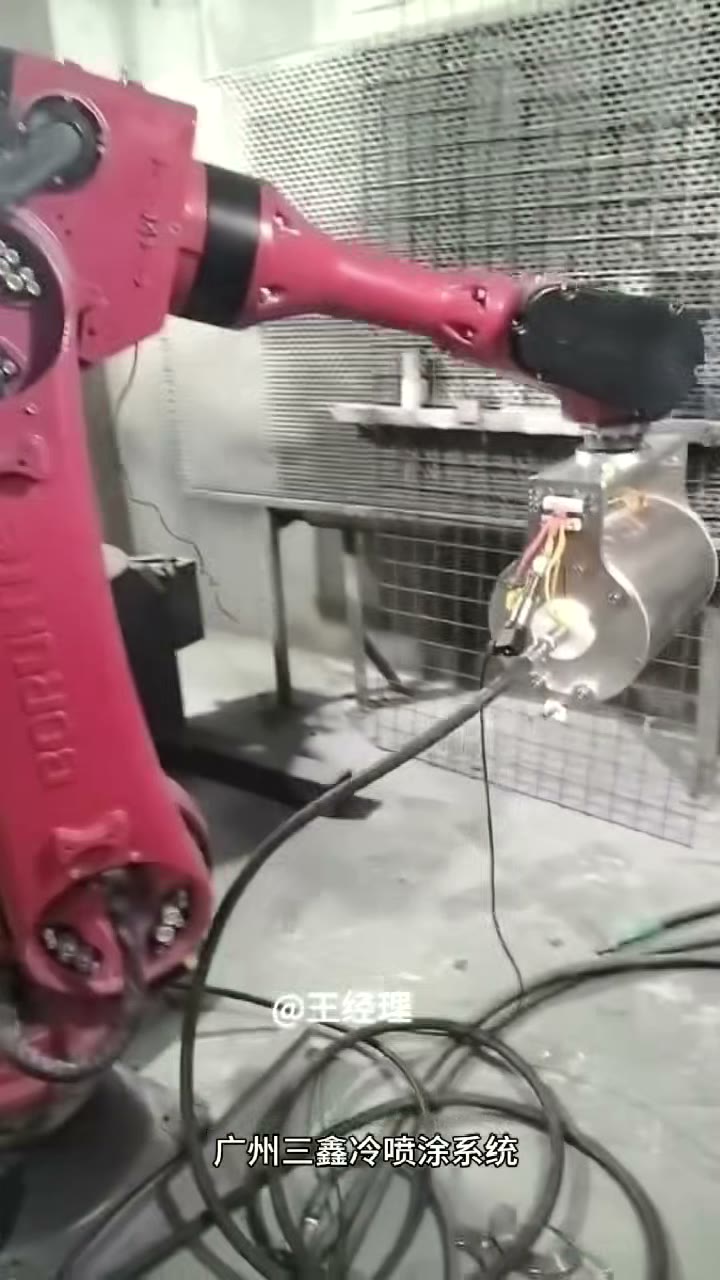
Why put a robot in a spray cell
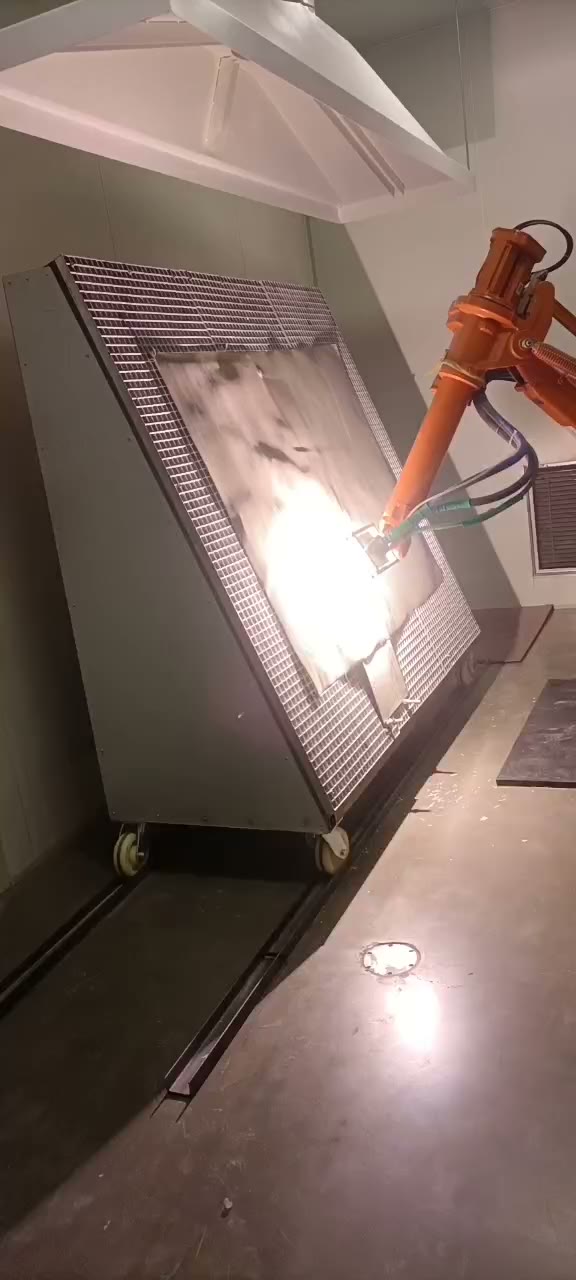
Manual spraying produces acceptable coatings in the hands of a good operator and unacceptable ones when that operator is on holiday. The variables a robot removes are the ones that decide coating thickness distribution: gun angle, standoff, traverse speed and the overlap between passes. On a part that has to hold a thickness tolerance across a large area, the robot is not a labour-saving device, it is a process-capability device.
The second reason appears later. Once the path is a program, coating parameters can be tied to the program revision, and a part sprayed in three years' time can be reproduced from the same file. That is what makes thermal spray auditable for aerospace, oil and gas, and medical work.
The IRB 2600 at a glance
| Item | Value |
|---|---|
| Payload / reach | 20 kg / 1.65 m |
| Protection | IP67 base and lower arm, IP54 upper arm |
| Mounting | Floor, wall, pedestal, inclined or inverted |
| Controller | IRC5 single or dual cabinet |
| Typical processes | Plasma, arc spray, HVOF and HVAF with an appropriate gun |
The compact base is worth noting for cell layout: the robot can stand close to the positioner without the base fouling the part, and the arm is designed to work below its own base, which lets a turntable sit under the robot rather than beside it.
Payload budget, honestly
A plasma gun weighs 3 to 6 kg. The hose package hanging off the wrist adds apparent weight and, more importantly, stiffness: a bundle that does not want to bend acts like a spring on the wrist and can dominate the dynamic load even though it weighs little. Add the fixture, any sensor, and the powder line, and a gun that looked like half the payload turns into 70% of it. We calculate the wrist load including hose stiffness before promising a cycle time, because a robot programmed at the edge of its envelope is a robot that vibrates and lays down an uneven pass.
Dress pack: the detail that decides uptime
- Integrated routing (ID) carries powder, cooling water, gas and signal inside the arm and wrist instead of around them.
- Two ID variants exist: 2.05 m reach with 12 kg payload, and 1.85 m reach with 15 kg payload. The longer one suits integrated arc spraying, the shorter one general handling.
- Because the lines are inside the arm they are not exposed to spatter or coolant, which is what normally destroys an external bundle.
- Off-line programming becomes practical: the dress pack is simulated with the robot, so the first program does not have to be debugged on the machine with the gun live.
Reach and layout
Reach is measured to the wrist flange, not to the gun tip, and the flame cone extends a further 100 to 150 mm. A part that is 1.6 m from the base is therefore at the limit of the envelope before the gun is considered. The practical rule is to lay out the cell so that the working area sits at 70 to 80% of nominal reach, which keeps the arm out of its fully extended, least accurate posture. Where the part is longer than the envelope, a seventh-axis rail moves the robot instead of asking it to stretch.
Programming
Two routes are used. Teach-pendant programming is fast for simple, repetitive parts and needs no CAD. Off-line programming is used where the part geometry exists as a model, where the surface is curved, or where the same family of parts differs only in size: the path is generated against the model, the spray parameters are attached to the path, and the file is downloaded to the IRC5. For thermal spray, off-line programming also solves a safety problem, because the first run happens in simulation rather than with a live flame in a confined cell.
Safety zoning
A spray robot cannot be fenced like a pick-and-place cell because the operator needs to load parts and check coating. The arrangement we use is a light curtain or safety scanner on the load side, an interlocked door on the maintenance side, and a controller-level zone switch that limits speed and reach when a person is inside the cell. Gas and powder are shut off by the same interlock, not by a separate switch, because the failure mode to design against is a robot moving while the gun is live.
What we supply and what we do not
We supply the robot, the positioner or rail, the gun and its services, the cell and extraction, the programs, and the commissioning with a first-article part. We do not replace the robot manufacturer's warranty or their preventive-maintenance contract, and we do not certify a coating process to a customer's specification - that requires their witness coupons and their approval, and we support it with parameter records rather than claims.
Frequently asked questions
Is the IRB 2600 big enough for a plasma gun?
The 20 kg payload of the IRB 2600-20/1.65 is comfortable for a plasma or arc gun with its hose package, but payload is not the only number that matters. The moment of inertia of a gun with stiff hoses hanging off the wrist, and the reaction force of the jet, both reduce the acceleration the robot can use. We calculate the actual wrist load rather than comparing against the catalogue payload.
Why does the dress pack matter so much in a spray cell?
Because it is what fails. Hoses carrying powder, water, gas and power run to a wrist that rotates thousands of times a day. Externally routed lines rub, kink at the wrist and get consumed by spatter. Integrated routing keeps the lines inside the arm, which on the IRB 2600ID reduces cycle time by up to 15% and cuts replacement cost by about 75%, mostly by removing the wear mechanism rather than by making the hose better.
Can you integrate a robot we already own?
Yes. We integrate ABB, FANUC and other six-axis machines onto our positioners, booths and extraction, and we write the spray programs against the gun we supply. What we do not do is take over the robot manufacturer's service contract or warranty; that stays with them, and we say so before the order rather than after.