Air is a process utility in a spray cell, not a shop utility
In most factories compressed air is treated as a generic service: a receiver in the corner and a ring main around the building. In a thermal spray cell it is a process gas. It carries the powder, it forms the plasma, it is the oxidiser in an HVAF gun, and it pulses the dust collector. A pressure fluctuation of 0.05 MPa changes the plume, and a drop of dew point turns a dense coating porous. Sizing the compressor from the number of tools on the floor is the usual reason a new cell "does not repeat".
How much air each process needs
| Process | Pressure | Flow | Notes |
|---|---|---|---|
| Plasma, 80 kW class | 0.5-0.7 MPa | 3-6 m3/min | Plasma gas plus carrier; argon or nitrogen often used for the plasma itself |
| Twin-wire arc | 0.5-0.6 MPa | 1.5-3 m3/min | Atomising air only; the cheapest process to supply |
| HVOF, kerosene | 0.6-0.8 MPa | 3-8 m3/min | Oxygen is separate; air is used for cooling and carrier |
| HVAF | 0.6-0.8 MPa | 8-15 m3/min | Air is the oxidiser, so the flow is the process itself |
| Dust collector pulse valves | 0.5-0.7 MPa | 0.5-1.5 m3/min average | Intermittent; needs receiver volume, not compressor size |
Add 20% to the total for leakage and for whatever gets added later. A cell that is specified to the exact figure is a cell that runs at reduced pressure as soon as a second gun is installed.
Why variable displacement matters
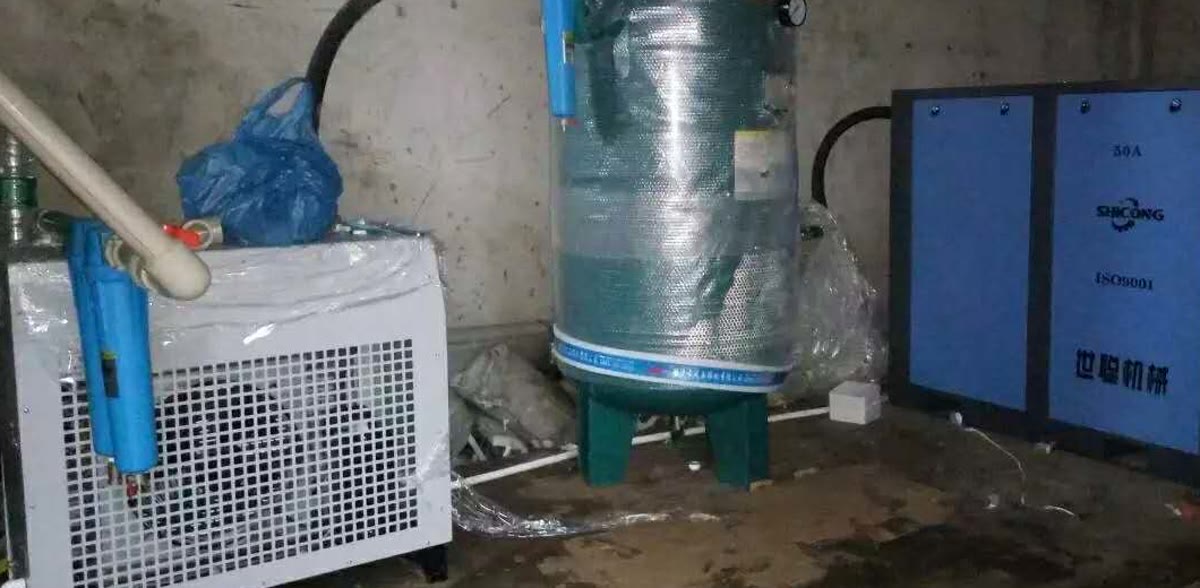
A spray cell rarely draws its rated flow continuously. It sprays in bursts between load and unload, and the pulse valves fire intermittently. A fixed-speed screw compressor loads and unloads against a pressure band, which wastes power and puts a pressure wave through the system every cycle. The screw compressors we supply allow displacement to be adjusted continuously from 0 to 100%, so as air consumption falls the motor current falls with it and the pressure stays flat. Flat pressure is the property the process cares about; the energy saving is the second benefit.
Cooling in a hot climate
A screw compressor rejects almost all of its shaft power as heat, and in a workshop at 35 degrees C with high humidity that heat has to go somewhere. Units intended for Asian conditions use an oversized cooling package and a wider ambient rating, plus vibration isolation and enclosure treatment so the machine can stand inside the production hall rather than in a separate plant room. If the compressor is installed in a closed room without ventilation, it will run hot, derate, and eventually trip - and the spray cell will be blamed.
Drying and filtration
- Coalescing filter after the compressor removes oil aerosol and bulk water.
- Refrigerated dryer holds a pressure dew point near 3 degrees C, adequate for indoor pipework in a conditioned shop.
- Desiccant dryer where pipework runs outdoors or through a cold area, or where the process cannot tolerate any condensate.
- Point-of-use filter at the gun, because the last metre of hose is where dirt collects.
Sizing and layout rules that avoid trouble
Put the receiver close to the cell rather than close to the compressor, so that the pulse valves draw from stored volume instead of from the compressor. Slope the ring main away from the cell with drain legs at the low points. Take the cell's supply from the top of the main, not the bottom, so that condensate does not run into the drop. These three details cost almost nothing at installation and solve most of the water-in-the-gun complaints we see.
Maintenance that actually gets done
Air filter, oil filter, separator and oil analysis at the intervals the manufacturer specifies; dryer condenser cleaning in dusty shops; and a weekly walk of the ring main listening for leaks. A 3 mm hole in a fitting costs roughly 1 kW continuously - which is small per leak and significant across a plant, and it usually sits right next to the cell that is short of air.
Frequently asked questions
How much air does a plasma cell need?
Typically 3 to 6 cubic metres per minute at 0.5 to 0.7 MPa for the plasma gas and powder carrier combined, depending on gun size and whether the cell also drives a dust collector pulse valve and a booth. HVAF is the hungry process: 8 to 15 m3/min at 0.6 to 0.8 MPa is normal. Size from the gun data sheet, then add 20% for leakage and future growth.
Does the air have to be oil-free?
For plasma and HVAF, yes in practice. Oil aerosol that reaches the gun is cracked in the arc or the flame and ends up in the coating as inclusions, and it attacks the seals in the gas train. A lubricated compressor can be used with a coalescing filter and a carbon tower, but the maintenance discipline has to be real; an oil-free machine removes the failure mode rather than filtering it.
Why does my coating change when the weather changes?
Because the dew point of the supply air changed. Humid air cools in the pipe and in the gun, water reaches the powder feeder or the plasma gas, and the coating goes porous or the feed becomes erratic. A refrigerated dryer holds a pressure dew point around 3 degrees C, which is adequate for most shops; a desiccant dryer is needed where the pipework runs cold or outdoors.