Two arm sizes, one control philosophy
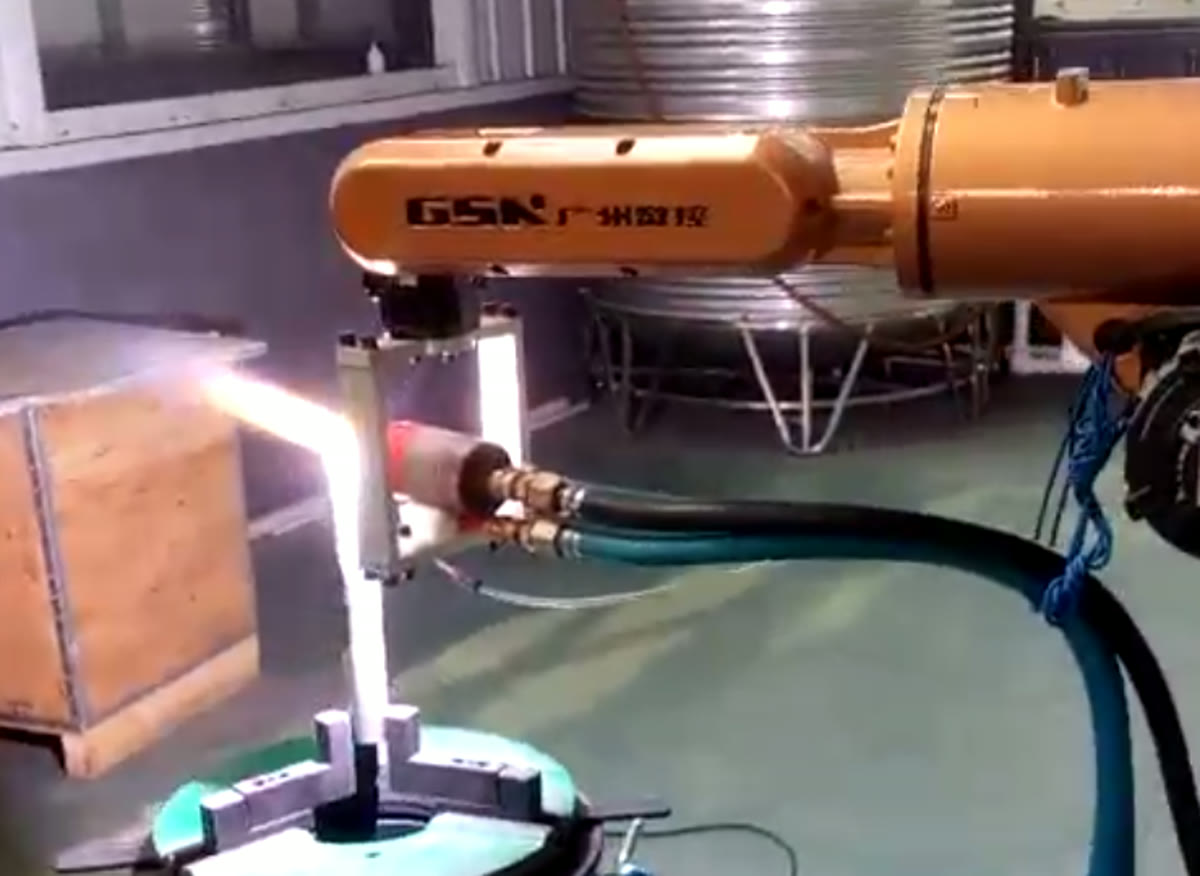
The SX210A and SX1510A are six-axis industrial painting robots built for the same job: moving a spray gun over a part at a controlled angle, standoff and speed, all day, without variation. They differ in arm length and therefore in the size of part envelope they can reach from a fixed base. Both are general-purpose machines rather than a special-purpose spray mechanism, which matters because it means a cell built around one can be reprogrammed for a different part instead of being rebuilt.
The mechanical train
The external structure is deliberately tight, with high-precision reducers on every joint. That choice drives most of the performance:
- Large reduction ratio. Single-stage harmonic gearing covers ratios from 70 to 320, which lets a small, fast servo move a heavy arm slowly and precisely.
- High transmission accuracy. Transmission error is roughly one quarter of a conventional cylindrical gear train, with backlash-free meshing and minimal lost motion - the property that lets the same program produce the same coating after thousands of cycles.
- Compact joints. Hollow-shaft gearing keeps the wrist small enough to follow a part contour without the arm colliding with it.
Servo performance
- Closed-loop control of position, velocity and torque, which removes the step-loss failure mode of open-loop drives.
- Rated speeds in the 2,000 to 3,000 rpm range, giving fast traverse between passes and short non-productive time.
- Overload tolerance of about three times rated torque, which is what allows a rapid start without derating the joint.
- Smooth low-speed running, needed because the spray pass is often the slowest motion in the cycle.
Comparison
| Item | SX210A | SX1510A |
|---|---|---|
| Axes | 6 | 6 |
| Joint reducers | High-precision, all joints | High-precision, all joints |
| Controller | Bolante control system | Bolante control system |
| Interface | RS-485, USB | RS-485, USB |
| External axis | Optional seventh-axis rail | Optional seventh-axis rail |
| Best for | Larger part envelope from a fixed base | Compact cells, shorter reach, stiffer arm |
Robot, turntable or manual?
| Situation | Reasonable choice |
|---|---|
| Round or symmetric parts, high volume | Turntable with a fixed gun; a robot adds cost without adding capability |
| Flat panels, simple passes | Gantry or linear axis with a fixed gun |
| Complex geometry, mixed part family, thickness tolerance | Six-axis robot, usually with a positioner |
| One-off repair work, awkward access | Manual, with the robot cell reserved for production |
The mistake we see most often is a robot bought for a part that a turntable would have sprayed better and faster. A robot earns its cost when the path is not a simple rotation.
Commissioning sequence
Mechanical installation and levelling, then gun and service connection, then dry runs to confirm reach and clearance, then spray trials on scrap to set standoff, traverse speed and step-over, then a first-article part measured for thickness at a grid of points, then program release. Skipping the dry-run step is how wrists get broken: a program that looks fine in simulation can put the gun through the fixture when the real hose package resists the wrist.
What decides accuracy after two years
Repeatability figures published for a new robot mean little once the machine has run for a year in a spray cell. The three things that move are the reducer wear in the wrist, the gun mount, and the fixture. Reducer wear shows as a slow drift in thickness on one side of the part; a loose gun mount shows as a random scatter; a worn fixture shows as a consistent offset that the operator corrects by nudging the program, which hides the cause. Checking a first-article part on a fixed interval - not only at commissioning - is what catches all three before they become scrap.
What we need to quote
Part drawings with the spray area marked, the largest and smallest parts in the family, the required thickness tolerance, the process and gun, and the shift pattern. Those determine arm size, positioner type, cell dimensions and whether a seventh axis is cheaper than a longer arm.
Frequently asked questions
Which model do I need, SX210A or SX1510A?
It depends on the distance from the robot base to the furthest point of the part, plus the gun length. Send a drawing with the part envelope marked and we will tell you which arm covers it at 70 to 80% of reach. Choosing the smaller arm when it fits is better than choosing the larger one for headroom, because a shorter arm is stiffer at the same payload.
What controller does it use?
The motion controller and operating system are supplied by Bolante Control Systems, with an RS-485 communication interface and USB, and a teach pendant for manual programming. Programs can also be prepared off-line against a part model and downloaded.
Can it work with a turntable?
Yes, and that is the usual configuration. The robot sprays while the positioner indexes the part, and the two are coordinated so that the surface speed under the gun stays constant. Coordinated motion is what keeps thickness uniform on a rotating part; a robot spraying a stationary round part produces a stripe.