Why a spray cell needs an acoustic enclosure
The operating noise of thermal spraying equipment is about 110 dB, and the spectrum is dominated by medium and high frequency energy from the supersonic jet. High frequency sound is easier to absorb than low frequency, which is good news, but 110 dB is still far above the 85 dB(A) eight-hour exposure limit used in most markets. A cell without an enclosure is a hearing-protection zone that nobody actually polices, and the neighbours hear it too.
There is a second reason that has nothing to do with ears. The enclosure is also the boundary that keeps overspray, fume and ultraviolet radiation inside the cell, and it carries the extraction connection and the fire detection. Designing the acoustics and the ventilation as one system is what separates a usable cell from a box that has to be left open.
How the enclosure is built
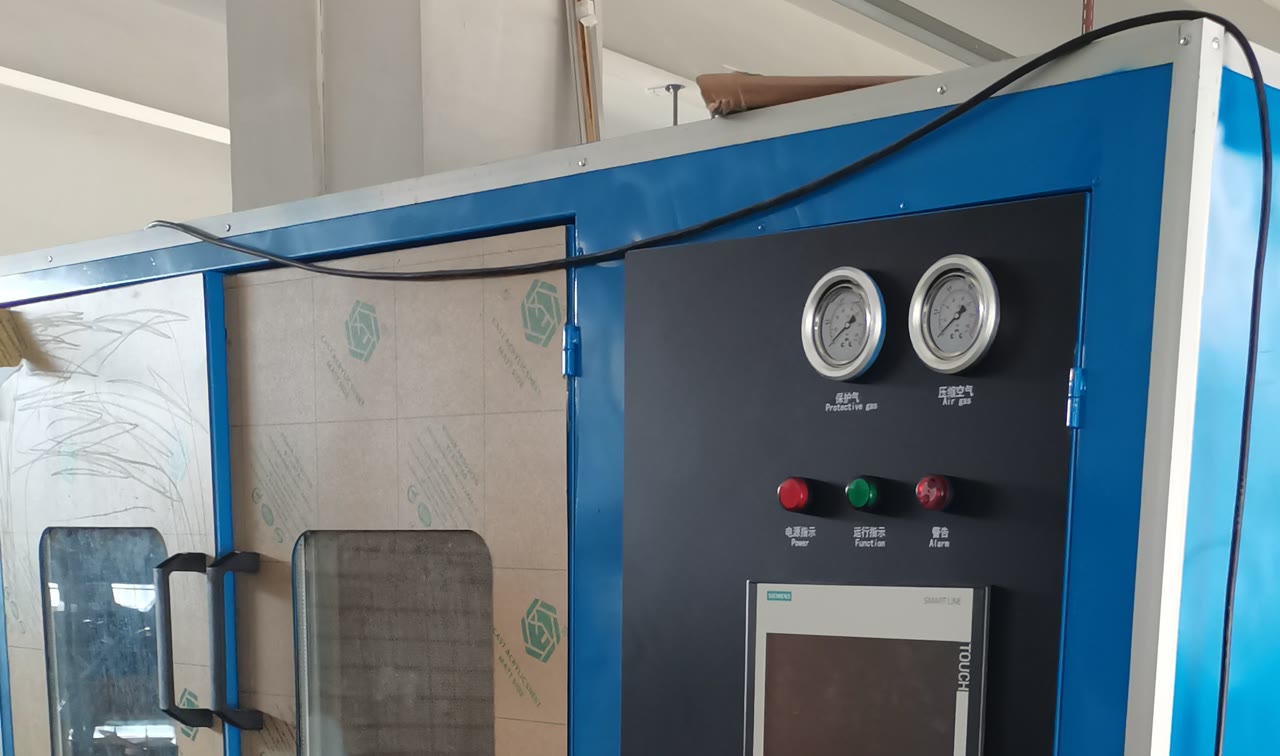
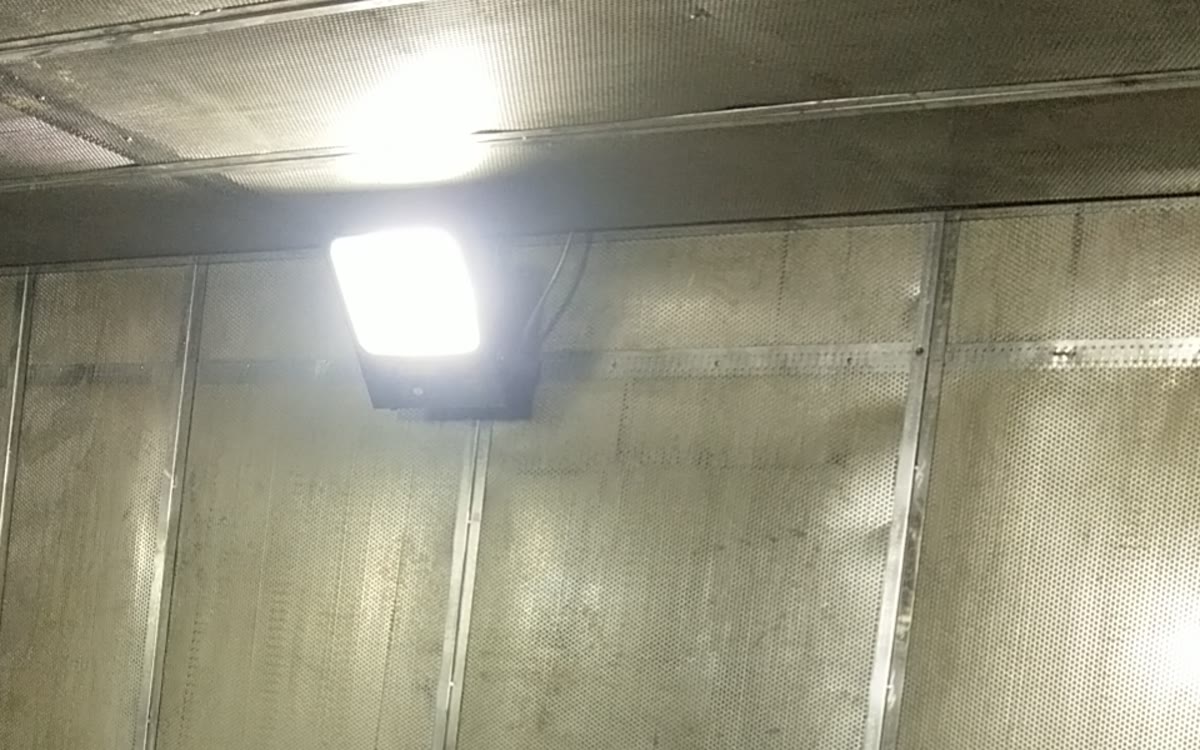
The system has two parts: the structure and the interior finish. Perimeter walls are modular panels of cold-rolled steel plate with a galvanised steel face, bolted to a steel frame so that the whole room can be dismantled and re-erected. Inside, a high-performance ladder-shaped absorption layer dissipates acoustic energy instead of reflecting it back into the cell, which matters because a reflective interior raises the level at the operator's position even while the outside is quiet.
| Element | Typical performance | What decides it |
|---|---|---|
| Panel, 100 mm mineral wool core | Rw 35-45 dB | Mass-spring-mass construction, no rigid bridges between faces |
| Door with labyrinth seal | Rw 30-35 dB | Seal compression and gap tolerance, not door thickness |
| Double laminated glazing | Rw 33-38 dB | Air gap and dissimilar glass thickness |
| Ventilation silencer | 15-25 dB insertion loss | Baffle length and free area |
The numbers above are typical of good industrial practice rather than guaranteed values for every configuration. The point of the table is that the door and the ventilation path usually set the overall performance: a room built from excellent panels with an unsealed door performs like a mediocre room.
Ventilation
Ventilation rate is 40 to 90 cubic metres per minute, selected from the room volume and cross-sectional area and following the approach used in international practice for spray rooms. Three rules matter more than the headline figure:
- Cross-draft, not turbulence. Air enters low on one side and leaves through the extraction plenum on the opposite side, so the plume is carried away rather than mixed into the room.
- Make-up air is part of the design. If the enclosure pulls 60 m3/min and the workshop cannot supply it, the booth will pull air through every cable gland and door gap, and the acoustics fail at the same time.
- Balance against the dust collector. The extraction fan and the booth supply fan have to be trimmed together so the cell stays a few pascals negative to the workshop. Positive pressure pushes fume out; excessive negative pressure pulls in unheated or humid air and upsets the coating.
Access, visibility and layout
A spray cell is entered several times an hour: to load, to check thickness, to change a gun. Doors are therefore sized for the part and for a person carrying a gun, with vision panels at operator height so that the process can be watched without opening the door. Internal lighting is mounted behind sealed glazing and aimed at the part rather than the floor, because the operator judges coating build-up by eye and shadow makes that judgement unreliable.
Fire safety and extraction integration
Metal fume is not usually the fire risk; the risk is accumulated overspray on surfaces, hot particles from the gun, and solvent from any pre-clean. Detection inside the enclosure, a cleanable interior finish and an extraction connection that can be isolated from outside the cell are the three practical measures. The enclosure should never be the only extraction: it contains noise, the collector removes the dust.
What an enclosure cannot fix
An enclosure reduces the level at the boundary; it does not remove the need for hearing protection close to the gun, and it cannot compensate for a machine that is mechanically noisy. If a fan bearing or a gun resonator is screaming, the enclosure will simply make the cell hot and quiet while the fault continues. Fix the source first, then enclose it.
What we need to quote
The equipment going inside (plasma, HVOF, HVAF, arc), the part envelope, the required internal height for crane or hoist access, the noise limit at the site boundary, and the available footprint. From those we propose panel thickness, door arrangement, ventilation rate and the extraction interface - and we tell you which element will set the achievable attenuation before you order.
Frequently asked questions
How much noise does a thermal spray cell actually make?
Around 110 dB at the gun, dominated by medium and high frequency content from the supersonic jet. That is roughly the level of a chainsaw at one metre and well above the 85 dB(A) eight-hour exposure limit, so an enclosure is a compliance item rather than a comfort item in most jurisdictions.
Will an enclosure overheat the cell?
Not if the ventilation is designed with the enclosure. A sealed box around a plasma or HVAF gun becomes an oven within minutes. We size the ventilation at 40 to 90 cubic metres per minute depending on room volume, and balance the make-up air against the dust extraction so the booth stays under slight negative pressure instead of pushing fume into the workshop.
Can the enclosure be taken apart and moved?
Yes. The walls are modular panels of cold-rolled steel with a galvanised finish, bolted to a frame rather than welded, so a cell can be dismantled, moved and rebuilt on a new site. The panels are also the reason lead times are short compared with a built-in-place masonry room.