Why blasting sits in front of every coating job
Thermal spray coatings bond by mechanical keying and by the metallurgical contact that forms when a molten or semi-molten particle flattens against a rough surface. Both depend on the substrate being clean and profiled. Grease, oxide, paint and machining marks all sit between the coating and the metal, and every one of them becomes a delamination site.
This is why a blasting cabinet is not an accessory to a spray cell; it is the first process step. A shop that sprays well and blasts badly produces coatings that pass a visual check and fail in service, and the failure is always blamed on the spray parameters.
How suction blasting works
The machine uses an inhalation, or venturi, principle. Compressed air flows at high speed through the blast gun and creates a negative pressure at the abrasive inlet; that suction draws abrasive from the hopper into the air stream, where it is accelerated and thrown at the part. Because the abrasive is entrained by the air rather than pushed by it, suction blasting is gentler and less efficient than pressure blasting - it is the right choice for a cabinet where an operator works close to the nozzle all day.
Machine description
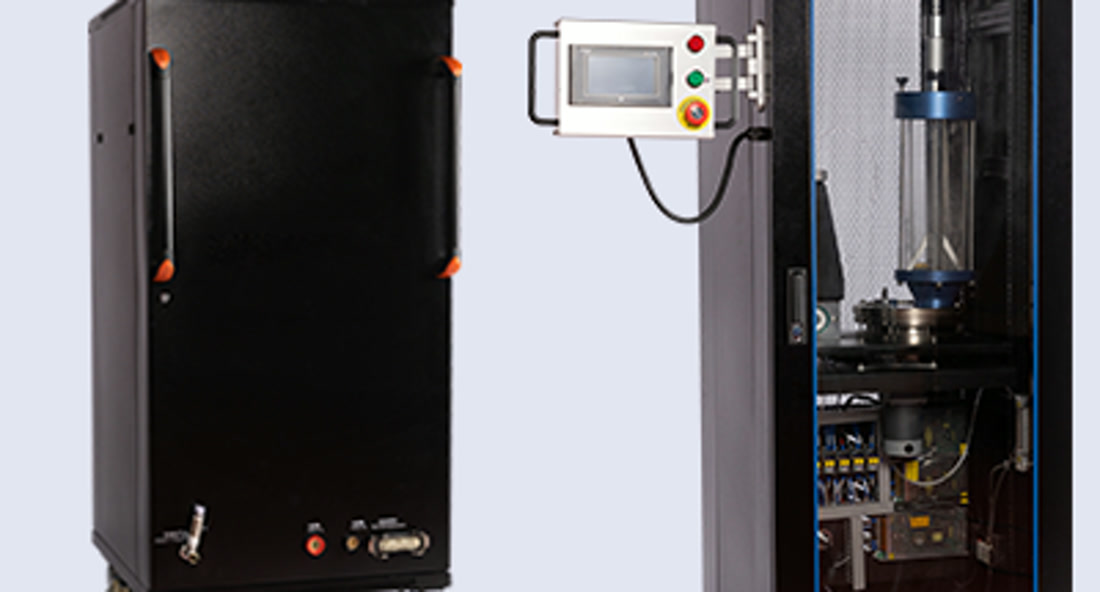
- Welded cabinet with a sealed door and gloved access, so the operator works outside the dust.
- Adjustable cyclone separator that takes fine dust out of the circulating abrasive before it reaches the gun, so the vacuum only handles waste rather than re-circulating fines that would dull the cut.
- Baghouse dust collector with a push-pull vibration valve for cleaning; the operator periodically shakes the bags and empties the drawer, and the collector handles both primary dust from blasting and secondary dust from the room.
- Key components in imported wear-resistant parts, since the nozzle, the venturi and the hose are what actually wear out.
- Simple, low-energy construction: the machine has few moving parts and the only consumable is abrasive and nozzle wear.
What it is used for
Surface cleaning, roughening and finishing of forged and cast parts, welded components, heat-treated parts, stamped parts, machined parts and moulds. It removes scale, heat-tint, residual sand, old coating and light rust, and it produces the uniform matte finish that a coating inspector expects to see before the gun is allowed to start.
Abrasive selection
| Abrasive | Typical size | Result | Use when |
|---|---|---|---|
| Brown fused alumina | 36-80 mesh | Sharp angular profile, high roughness | Steel parts going to arc or HVOF spray |
| Glass bead | 80-220 mesh | Peened, low roughness | Fatigue-critical parts, cosmetic finishing |
| Steel grit | G25-G50 | Dense profile, long life | Heavy castings, recycling economics matter |
| Ceramic bead | 60-120 mesh | Long life, low contamination | Stainless and titanium where iron contamination is a concern |
Whatever is chosen, it has to be clean and dry. Abrasive stored in a damp corner carries moisture into the cabinet and leaves a film on the part that the coating will not tolerate.
What a cabinet cannot do
It cannot take a part that does not fit through the door, it cannot reach inside a long bore, and it cannot provide the coverage rate of a blast room. Parts outside those limits need a walk-in room or an open nozzle with a supplied-air hood. Being clear about that boundary saves a customer from buying a machine that solves half their problem.
Safety and housekeeping
Silica sand must not be used: the respirable crystalline silica it generates is a serious health hazard and is banned for blasting in most markets. The cabinet must be earthed and the dust collector bonded, because dry abrasive and fine metal or oxide dust can accumulate static. Gloves, a window that can be replaced when it frosts over, and a dust drawer emptied before it overfills are the three things that keep a cabinet usable for years.
What we need to quote
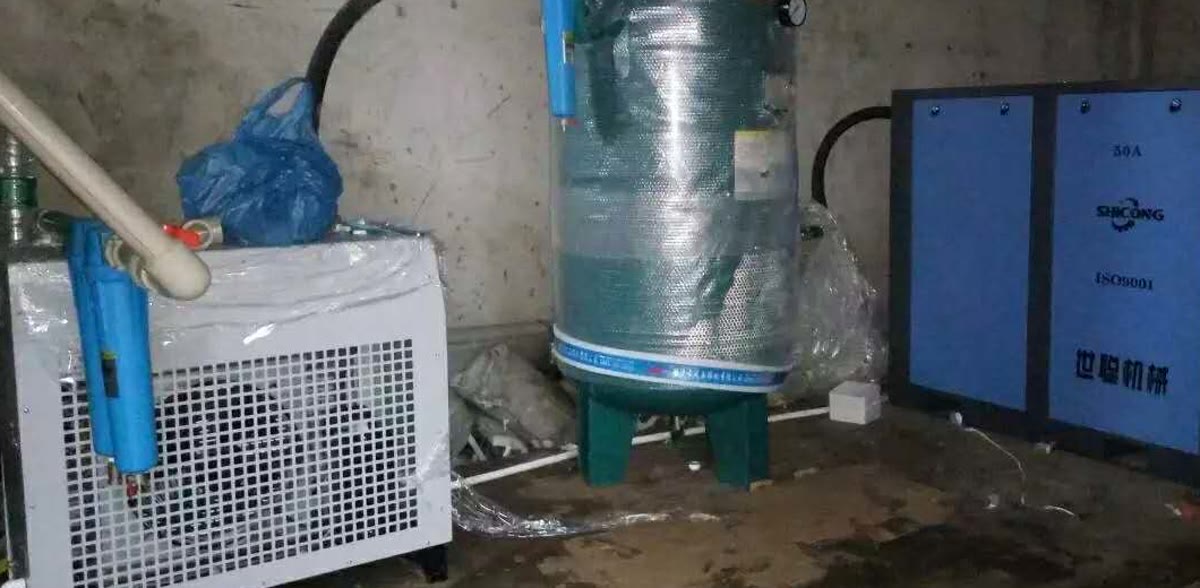
The largest part dimensions and mass, the substrate, the required surface standard (Sa class and roughness), the throughput in parts per shift, and the available air supply in m3/min at 0.6 MPa. The air supply is often the limiting factor: a cabinet that needs 1.5 m3/min will not run properly on a 0.8 m3/min compressor, and the symptom is a weak blast that looks like worn abrasive.
When a cabinet is not enough: open blasting
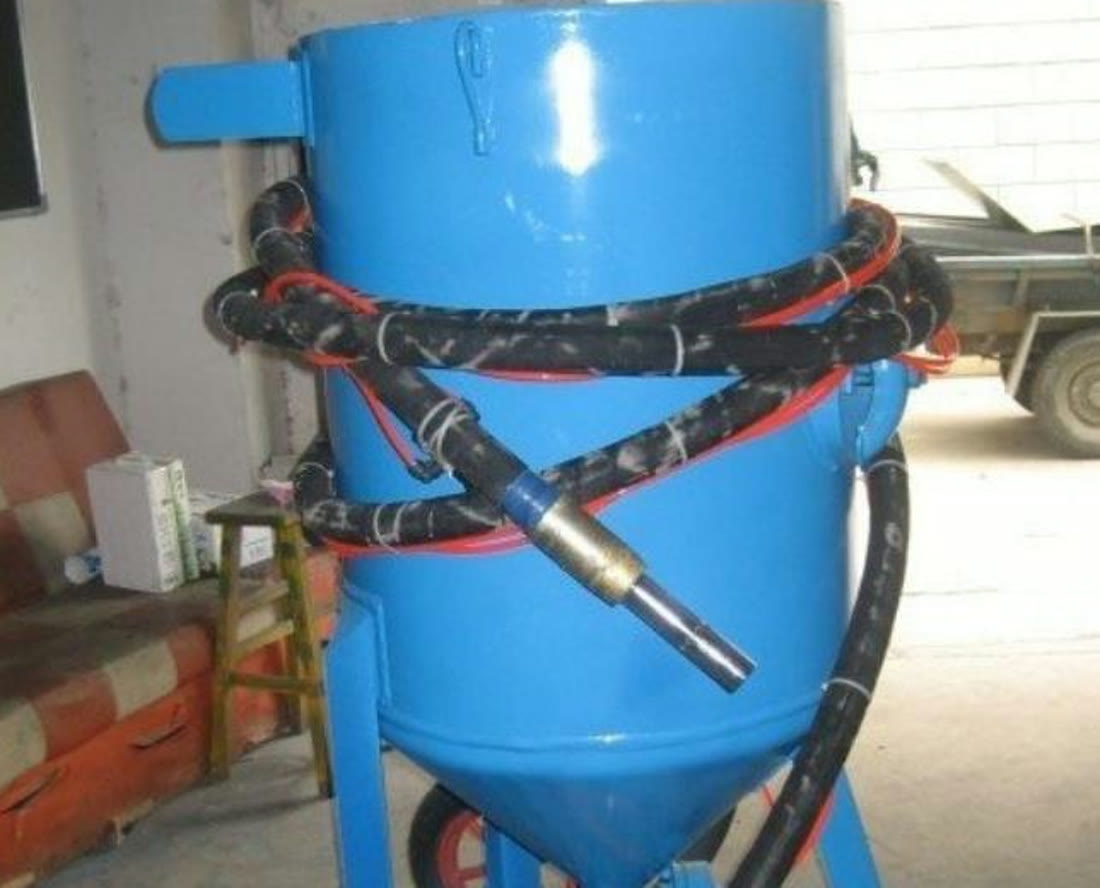
For parts that will not fit through a cabinet door we also supply pressure-pot open blasting equipment, where abrasive is pushed out of a pressurised vessel instead of being drawn in by venturi. It cuts faster and reaches further, and it can be taken to the part rather than the other way round, but it needs a supplied-air hood for the operator and a blast room or extraction tent around the work. A cabinet and a pressure pot answer different questions, and most workshops that do both kinds of work end up with one of each.
Frequently asked questions
Why is blasting necessary before spraying?
Because the coating bonds mechanically, not chemically. A grit-blasted surface at Sa 2.5 to 3 gives an angular profile of 40 to 100 micrometres depending on abrasive, and that profile is what the sprayed particles key into. Spraying onto a machined or oxidised surface gives a coating that looks fine and lifts at the first thermal or mechanical shock.
Can it blast a large shaft?
No. A cabinet machine is limited by the door opening and the internal volume, and it is intended for parts a person can handle through the gloves. Long shafts, frames and pressure vessels are blasted in a walk-in blast room or with an open nozzle under extraction, and we will say so rather than sell a cabinet that cannot do the job.
What abrasive should I use?
Brown fused alumina for a sharp, deep profile on steel; glass bead where a peened, low-roughness finish is wanted; steel grit where the abrasive is recycled many times and density matters. The choice sets the profile, and the profile sets the coating bond strength, so it belongs in the process specification rather than in the purchasing decision.