Where HVAF sits among the supersonic processes
HVOF and HVAF are often discussed as if one replaces the other. They are the same idea with a different oxidiser, and the difference in oxidiser drives everything else. HVOF burns fuel in pure oxygen: hot, fast, and expensive to run because oxygen is expensive. HVAF burns fuel in compressed air: cooler, faster still, and cheaper per hour because air is nearly free.
| Property | HVOF (oxygen) | HVAF (air) |
|---|---|---|
| Flame temperature | 2,700-3,000 C | 1,900-2,100 C |
| Particle velocity | 600-800 m/s | 800-1,000 m/s |
| Oxidiser | Pure oxygen | Compressed air |
| Running cost | Higher, oxygen dominated | Lower, electricity dominated |
| Carbide decarburisation risk | Higher | Lower |
| Ceramics | Limited | Not suitable |
The values above are typical of the two process families rather than a specification of any single gun. They explain the trend: HVAF trades peak temperature for velocity, and for carbide coatings that trade is usually a win.
Why the cooler flame matters for carbides
Tungsten carbide decomposes rather than melts. Above roughly 2,000 degrees C in an oxidising plume it loses carbon and forms W2C and metallic tungsten; the coating then reads hard on a hardness tester but behaves badly in service, because the brittle phases crack and the ductile cobalt matrix has been depleted. Keeping the particles below that threshold while still accelerating them hard enough to bond is the whole design problem of a carbide gun.
The gun family
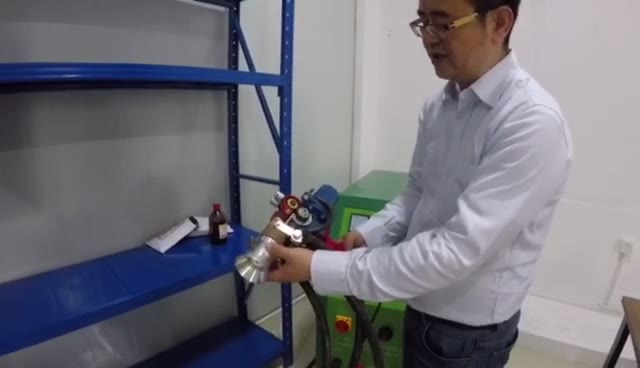
The SX-HVAF8000 is supplied with a high-power gun, a low-power gun and an internal-bore gun. That range is not a marketing list; it is what allows one system to cover small parts that would be overheated by a full-power pass, large areas where deposition rate matters, and bores that a straight gun cannot see into. The internal-bore gun is the one that makes cylinder liners and long sleeves practical.
Powder capability
The gun was designed around fine carbide powder, and the internal geometry was developed with fluid dynamics and finite element analysis rather than by scaling an existing nozzle. Fine powder is where the difficulty lies: it melts faster, decarburises faster, and is more easily blown off course by turbulence in the barrel. A gun that handles ultrafine WC consistently is a gun that can also handle the coarser grades without drama.
Control and gas safety
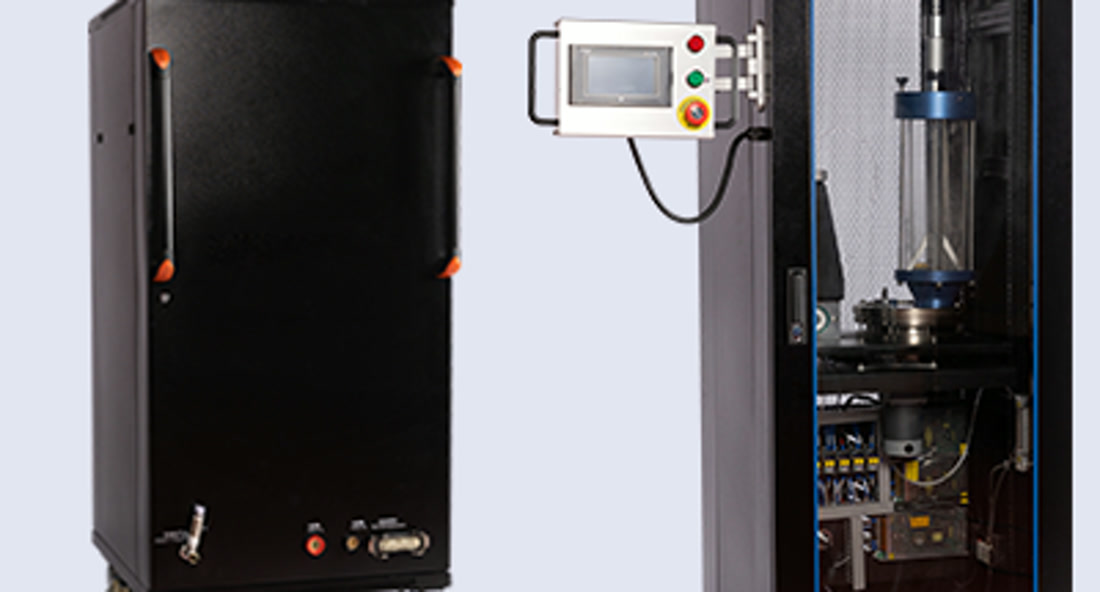
- Siemens human-machine interface with the recipe stored as a program, so a coating parameter set is a file rather than a note on the wall.
- Independent gas circuits, so fuel, air and carrier are regulated separately and a change in one does not drag the others.
- Built-in gas leakage sensor, because a fuel leak inside an enclosure is the failure mode that matters most.
- Gas dilution design that keeps the mixture outside the flammable range during start-up and shut-down, which is when most incidents happen.
Materials
More than a hundred sprayable materials are supported, covering wear resistance, corrosion resistance, dimensional restoration, electrical conductivity and thermal management. The useful way to think about it is not the count but the boundary: HVAF covers carbides, metals, alloys and cermets; it does not cover refractory ceramics, which belong to plasma.
Trial coupons and acceptance
A coating trial is run on coupons cut from the same material and heat treatment as the part, sprayed at three parameter sets, then sectioned and measured for thickness, porosity, microhardness and carbide retention. The parameter set that meets the specification becomes the program stored in the controller. When a customer later asks whether a coating complies, the answer is a section photograph and a measurement table from that trial, not a claim about the machine.
Before you order
Send the part drawing, the failure you are trying to solve, the substrate and its heat treatment, and the required coating thickness and finish. We will spray a trial coupon on your material before you commit to a machine - a coating trial costs a fraction of a system and settles questions that a datasheet cannot.
Frequently asked questions
What is the difference between HVAF and HVOF?
The oxidiser. HVOF burns fuel with pure oxygen, giving a flame around 2,700 to 3,000 degrees C. HVAF burns fuel with compressed air, so the flame is cooler, roughly 1,900 to 2,100 degrees C, but the gas volume is larger and the jet velocity is higher. The practical result is particles that arrive faster and cooler, which suits carbides.
Why does a cooler flame give a better carbide coating?
Because decarburisation is a temperature-driven reaction. Above roughly 2,000 degrees C, tungsten carbide in the plume reacts with oxygen and loses carbon, forming brittle W2C and free tungsten. A coating can then measure hard and still fail early in service. A cooler, faster jet keeps the carbide particles below that threshold while still depositing them with enough velocity to bond.
Can it spray ceramics?
Not the refractory ceramics that need to be fully molten. HVAF is a solid-state or semi-molten process; alumina and zirconia need a plasma plume at several thousand degrees. HVAF is the right tool for carbides, metals and some cermets, and saying so is more useful than claiming universal coverage.