Position in the range
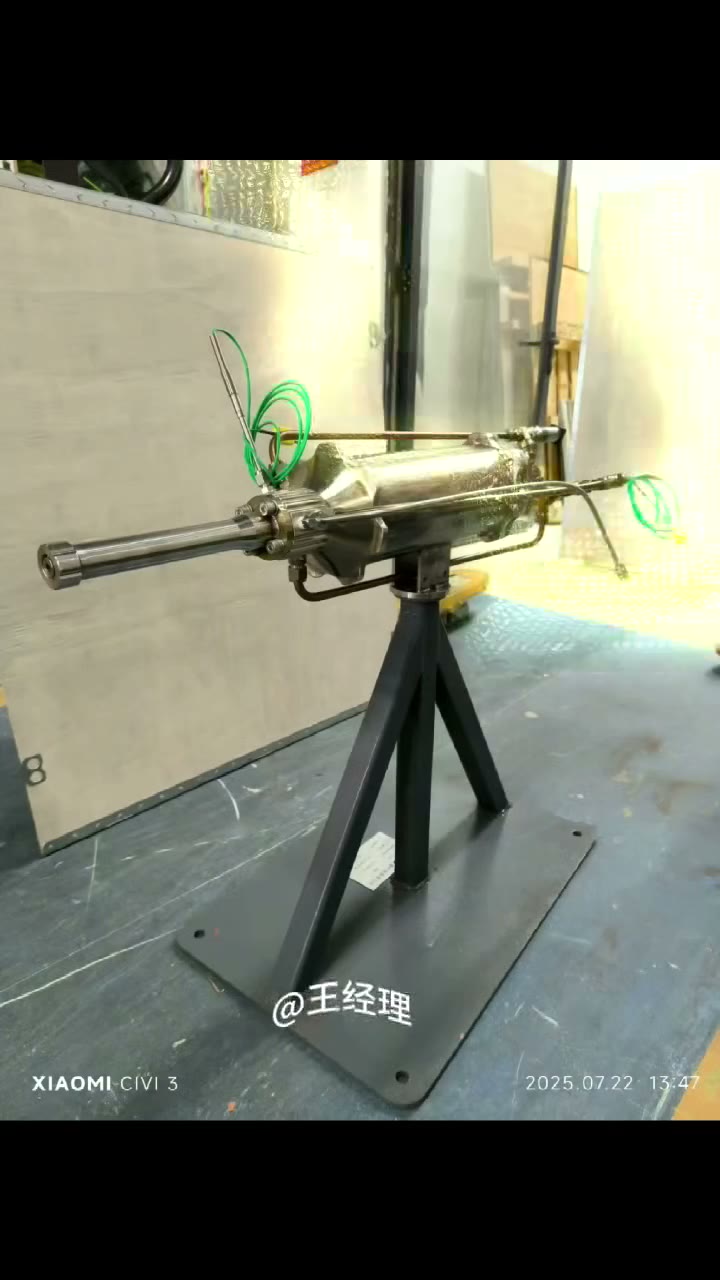
The SX-HVAF5000 is the high-power member of the air-fuel family. It carries a 200 kW torch together with an internal-bore gun, and it is aimed at two jobs: thick carbide coatings on large components, and coating the inside of bores where a straight gun cannot see the surface.
HVAF means the oxidiser is compressed air rather than pure oxygen. The flame is therefore about 1,000 degrees cooler than an oxygen-fuel flame, but the gas volume is larger and the jet velocity higher. For carbides that trade is almost always a win: the particle arrives fast without spending long enough at temperature to lose its carbon.
Why the chamber is long and the nozzle is wide
In an air-fuel gun the combustion temperature is comparatively low, so the particle has to be heated by residence time rather than by peak temperature. The chamber is deliberately long and the gas velocity inside it low, which gives the powder enough time in contact with hot gas to reach the right state.
Downstream, the nozzle bore is large relative to the powder stream. That matters because a narrow barrel lets the cold wall slow the particles travelling near it, and the coating then varies with radial position. With a wide bore the wall influence is negligible and the acceleration is uniform across the stream - which in practice is the difference between a coating that polishes evenly and one that shows rings.
How it compares
| Process | Flame temperature | Best for |
|---|---|---|
| HVAF, this system | Roughly 1,000 C below oxy-fuel | Thick carbide, low heat input, mud pumps, sleeves |
| HVOF, kerosene | Higher, oxygen-fired | Dense carbide where highest velocity matters |
| Plasma | Highest | Ceramics and refractory metals that must be molten |
Where it earns its place
Its relatively low heat input makes it the right choice where the substrate cannot take much heat: thin-wall castings, finished bores, and components that are already at their heat-treatment limit. In slurry service - mud pump sleeves, impellers, casings - a thick, well-bonded carbide layer applied without distorting the part is exactly the requirement, and that is the workload this system was specified around.
Operation and maintenance
The gun is water-cooled and the consumables are the nozzle, the chamber and the powder injector. All three wear gradually: the nozzle opens, the chamber erodes at the throat, and the injector widens the spray cone. Track coating porosity on a weekly coupon rather than waiting for a visible defect, because by the time the coating looks wrong the parts in between are already scrap.
Before you order
Part geometry including bore diameter and depth, coating material and thickness, substrate and its heat treatment, and the air supply available (HVAF is air-hungry - the compressor is often the limiting utility). Send a drawing and we will confirm whether the internal-bore gun reaches the surface you need to coat.
The utility people underestimate: air
HVAF uses compressed air as the oxidiser, so the compressor is part of the process, not a shop service. A system at this power level wants a supply in the region of 8 to 15 cubic metres per minute at 0.6 to 0.8 MPa, dry and oil-free, and it wants it held during a full pass rather than only at start-up. A ring main designed for hand tools will deliver the pressure at idle and lose it the moment the gun fires.
Two habits avoid most commissioning problems: take the supply from a dedicated receiver close to the cell, and measure flow at the gun with the trigger open. A drop of 0.05 MPa changes the plume enough to see in the coating.
Frequently asked questions
What does the 5000 give me over the 8000?
Power and dwell time. The 5000 uses a 200 kW torch with a longer combustion chamber and a larger nozzle bore, so more powder passes through at the same velocity and the particles are heated more evenly. That suits thick carbide layers on large parts; the 8000 is the more economical choice for thin coatings and small batches.
Why is a cooler flame better for carbide?
Because decarburisation is driven by temperature. The air-fuel flame runs roughly 1,000 degrees cooler than an oxygen-fuel flame, so the particle stays below the point where WC loses carbon, while the higher gas volume still accelerates it to a deposition velocity. The result is a coating that keeps its carbide instead of reading hard and wearing fast.
What is the large nozzle diameter for?
It removes the length limitation that narrow barrels impose: the powder stream is a fraction of the bore, so the wall has little influence on particle velocity and every particle is accelerated by the core flow. It also makes the gun less sensitive to slight misalignment of the injection port.