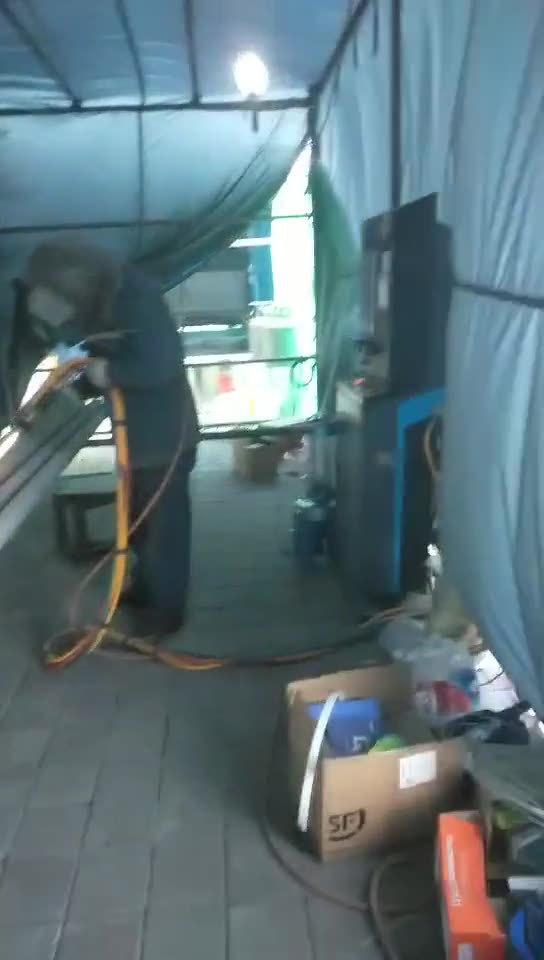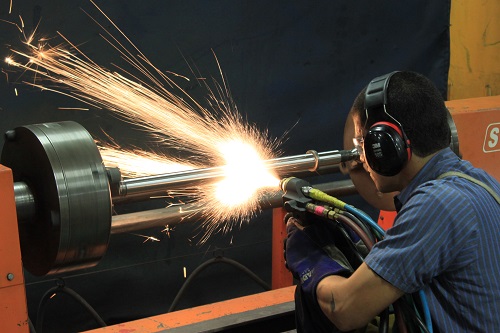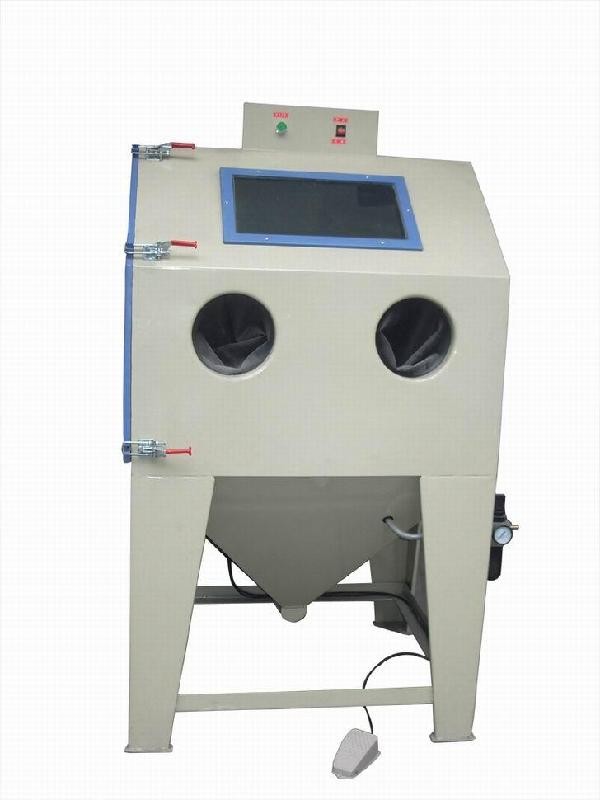
A sandblaster - more precisely an abrasive blasting machine - is equipment that throws a stream of abrasive particles at a surface at high speed to clean it, roughen it or change its surface condition. The abrasive is accelerated by compressed air (or by a centrifugal wheel in wheel-blast machines), and the impact does three things at once: it removes contamination, it cuts a profile into the substrate, and it leaves a compressive layer in the surface.
In a coating shop the machine is not there to make parts look clean. It is there to create the anchor pattern that a thermally sprayed coating needs in order to bond. A plasma or HVOF coating does not glue itself to smooth steel; it keys into a rough, oxide-free surface, and if the blast step is wrong the coating fails at the interface no matter how good the spray parameters are.
How the abrasive is propelled
There are two families of dry blasting machine, and the difference is where the energy enters the abrasive stream.
Suction (injector) blasting. Compressed air passes through a gun and creates a negative pressure at the abrasive inlet. Atmospheric pressure pushes abrasive up the feed hose into the gun, where the air stream accelerates it down the nozzle. The blast pressure available at the nozzle is limited by the venturi effect, so suction machines are gentler: lower abrasive velocity, less grain fracture, lower media consumption, and a light gun an operator can hold all day. Cabinet blasters are almost always suction type.
Pressure-fed blasting. Abrasive is held in a pressure vessel and pushed into the air stream under the full line pressure. Velocity at the nozzle is much higher, cleaning is faster on heavy scale and thick rust, and the machine is the standard choice for structural steel and shipyards. The cost is media consumption - grain breaks on impact and on the way through the metering valve - and a heavier, more expensive gun.
In both cases the physics is the same. The air velocity inside the hose has to stay above the settling velocity of the largest particle, and the pressure has to overcome friction along the hose. As a hose gets longer, the pressure falls and the flow slows; particles first travel in an uneven suspension, then in a pulsating flow, then they drop out of suspension and settle on the bottom of the hose until the line blocks. This is why a blaster that runs perfectly with a 5 m hose can stop dead when the same gun is moved 30 m away from the pot.
Dry, wet and specialised variants
Dry blasting is the default for coating preparation because a dry, profiled surface is what the spray process wants. Wet (slurry) blasting mixes abrasive with water and a pump delivers the slurry to the gun, with compressed air providing the acceleration. Dust is suppressed at the source, which matters for heritage work, for lead paint removal and for indoor sites, but the surface comes out wet and has to be dried before coating.
Beyond those two there are task-specific machines: automated cabinets with a reciprocating gun and a rotary table for production blasting, wheel-blast machines that throw steel shot with a centrifugal wheel instead of air, and cryogenic deflashing machines that freeze rubber burrs with liquid nitrogen and then blast them off with polymer media.
What blasting does to a surface
The visible result is cleanliness, normally specified by the Swedish Sa scale: Sa 1 (light blast), Sa 2 (thorough), Sa 2.5 (very thorough, the usual coating spec) and Sa 3 (white metal). The measurable result is roughness, expressed as Ra or Rz, and for thermal spray preparation the useful window is roughly 40-70 micron Rz.
The third result is invisible: peening. Each impact leaves a small plastic dent and a compressive stress field under it. That is why a blasted surface resists fatigue crack initiation better than a machined one, and why glass bead peening is used as a finishing operation rather than a cleaning one.
The air supply is part of the machine
A blast cabinet is only as good as the air fed to it. Moisture carries abrasive into the feed hose and turns it into a plug; oil contaminates the substrate and destroys adhesion; pressure drop at the gun quietly removes half the cleaning rate. A working installation therefore looks like this:
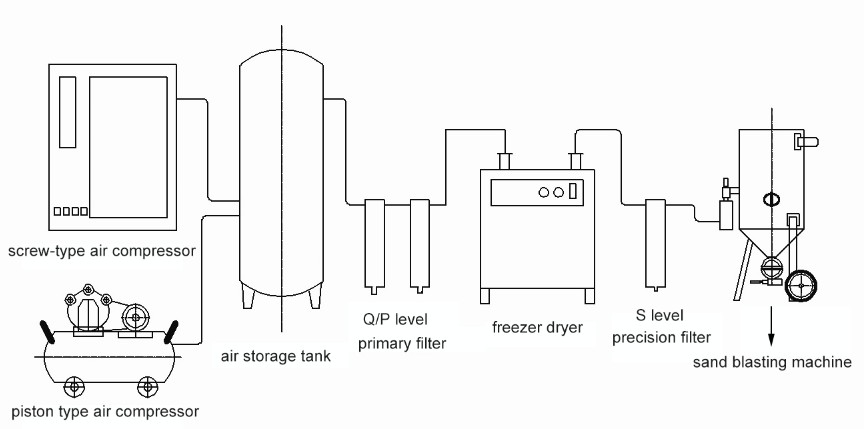
Compressor, air receiver to smooth the pulses, a coarse pre-filter, a refrigerated dryer, a precision filter, then the machine. Skipping the dryer is the most common false economy in a coating shop: the cabinet works, but the finish varies with the weather.
Cabinet, open-air or automated
Cabinet machines enclose the work and recover the abrasive. They suit parts that fit through the door - moulds, pump housings, shafts, small weldments - and they are the least dust-producing option. The SX-80F is an 800 x 600 mm cabinet for exactly this duty, and the SX-900F is the larger eco-friendly version for continuous production.
Open-air blasting is the only option for bridges, tanks and structural steel, and it needs the full PPE and containment regime - supplied-air helmet, blast suit, and a recovery system for the spent abrasive.
Automated blasting moves the gun over a fixture with a PLC: X-Y traverse, table rotation, gun angle, dwell time and blow-off sequence are parameters rather than operator skill. It is the only way to hold a repeatable profile across thousands of identical parts.
Choosing an abrasive
Angular media cut; round media peen. Alumina and steel grit cut fast and leave a sharp profile; glass bead and ceramic bead round the surface and raise compressive stress; corn cob and plastic media strip coatings without touching the substrate. The choice is set by the substrate and by what the next process needs: a 46-mesh brown alumina for a carbide spray on steel, a 120-mesh glass bead for a cosmetic finish on stainless, plastic media for stripping a titanium part without altering dimensions.
One rule matters more than the rest: never mix media. A cabinet that has run steel grit and is then filled with glass bead will produce a contaminated finish, and the coating will fail in patches that are impossible to explain.
Safety, briefly but not optionally
Respirable silica from sand-based abrasives is a documented health hazard - which is why silica sand is banned as a blasting medium in most industrial countries and why alumina, garnet, steel grit and glass bead exist. A cabinet must be under negative pressure with the dust collector running before the gloves go in, and open-air blasting requires a supplied-air respirator, not a dust mask. Static, noise and abrasive injection injuries are the other three risks worth a written procedure.
Frequently asked questions
What is the difference between a sandblaster and a shot blaster?
A sandblaster throws abrasive with compressed air; a shot blaster throws steel shot with a rotating centrifugal wheel. Air blasting reaches into corners and is easy to aim by hand; wheel blasting is far more efficient on flat plate and continuous production.
Is silica sand still allowed as a blasting abrasive?
In most industrial countries, no - respirable crystalline silica from sand blasting causes silicosis. Alumina, garnet, steel grit, glass bead and ceramic bead are the standard replacements, and they also give a more consistent profile.
What surface finish should I blast to before thermal spraying?
Normally Sa 2.5 to Sa 3 with 40-70 micron Rz. Too shallow and the coating has nothing to key into; too deep and the profile peaks stick out through a thin coating and wear first.
Can one cabinet blast and peen?
Yes, by changing media. Angular alumina or steel grit cuts a profile for coating; glass bead or ceramic bead peens and finishes. The cyclone separator has to be re-set for the new media, and the two media should never be mixed in the same hopper.