Application fields:
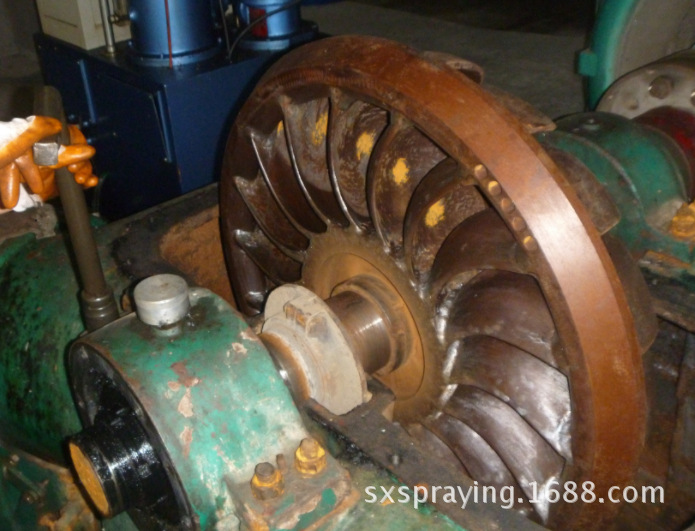
Crane and trolley wheels, sheave wheels and rope drums, large fan and pump discs, brake discs and drums, mill and kiln tyres, and other heavy rotating parts.
Technical principles and processes:
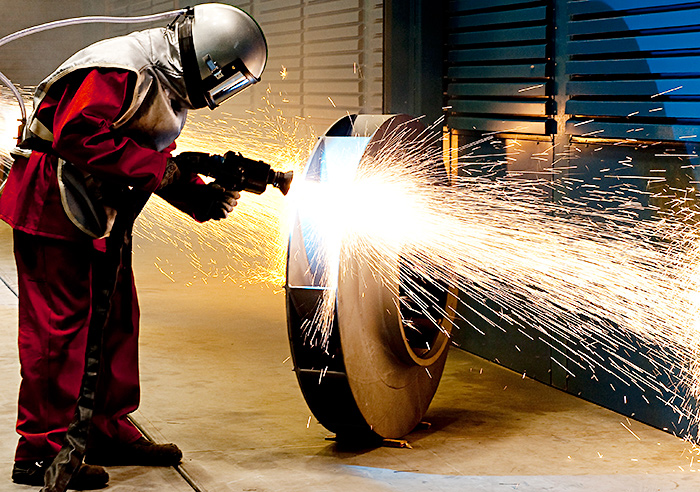
The part is cleaned, grit blasted and, where wear is significant, pre-machined to accept the coating. Metal wire is arc sprayed to build up the surface or to apply a protective layer, and the part is then machined or ground back to the required diameter and profile.
Coating performance:
- Deposit rates high enough for large components and deep build-up
- Rebuilds surfaces worn by several millimetres
- Wire options include carbon steel, stainless steel, bronze and zinc alloys
- Machined and ground to drawing diameter and profile
- Lower cost and shorter lead time than new part replacement
大型轮盘与回转件电弧喷涂:针对天车轮、绳轮、卷筒、风机盘等大型件,用电弧喷涂恢复尺寸并附加耐磨或防腐层,成本远低于换新。
Coating options
| Wire | Coating | Typical use |
|---|---|---|
| Carbon steel | Build-up and dimensional restoration, 0.5-3.0 mm | Crane wheels, sheaves, mill tyres |
| Bronze | Low friction, good bearing behaviour | Rope drums, sliding surfaces |
| Stainless (420 / 316) | Wear plus corrosion resistance | Wheels in wet or chemical environments |
| Zn-Al 85/15 | Sacrificial corrosion protection | Structural discs exposed outdoors |
Why arc spray suits large rotating parts
Arc spray has the highest deposition rate of any thermal spray process - 10-30 kg/h - and the equipment is portable. On a 1.5 m crane wheel with a worn flange, that means the part can be built back in hours rather than replaced, and often without dismantling the crane. Coating thickness up to 3 mm is practical, which is far beyond HVOF or plasma.
The trade-off is porosity, typically 3-8%, and lower bond strength than HVOF. For dimensional restoration that is acceptable - the coating is a build-up layer, not a wear surface, and it is usually machined back to the original profile.
Frequently asked questions
How thick can arc spray build up?
Up to 3 mm in a single setup for steel wire. Thicker builds are possible in layers, but residual stress rises and edge chipping becomes the limiting factor.
Can it be done on site without removing the wheel?
Often yes. Our portable arc spray units have been used on crane wheels, rails and sheaves in place, with local extraction and masking.
Does the repaired wheel need to be re-machined?
Yes for most running surfaces. The coating is sprayed oversize and turned or ground back to the original profile and hardness requirement.
Further reading: HVOF vs plasma spraying.