Application fields:
Centrifugal and screw pump shafts, hydraulic and pneumatic piston rods, plungers in reciprocating pumps and compressors, valve stems, and similar seal-carrying surfaces.
Technical principles and processes:
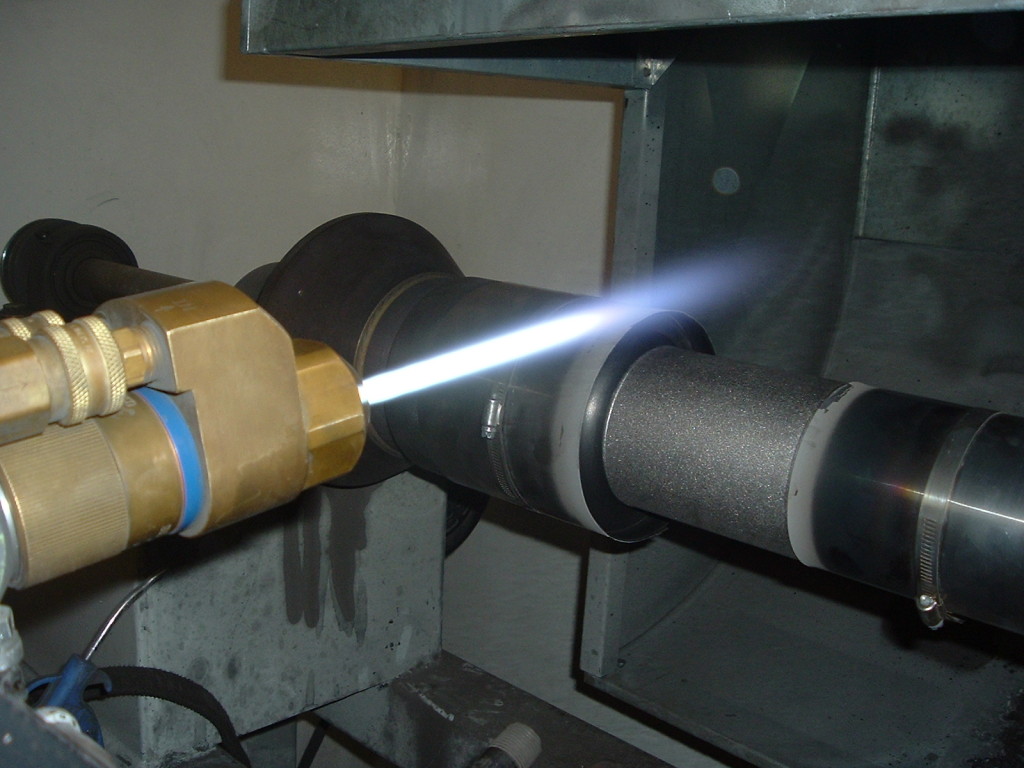
The shaft is degreased, masked at the seal and bearing seats, and grit blasted. A tungsten carbide-cobalt or carbide-nickel-chrome powder is sprayed by HVOF to form a dense coating, which is then finish ground and polished to the required diameter, roundness and Ra, so the seal runs on a smooth hard surface.
Coating performance:
- Micro-hardness 1100-1400 HV with very low porosity
- Coating thickness 0.10-0.30 mm, ground to final diameter
- Surface finish to Ra 0.2 for seal and packing contact
- Resistant to wear, fretting and many corrosive media
- Roundness and straightness verified after grinding
泵轴与活塞杆 HVOF 碳化钨涂层:针对密封配合面磨损导致泄漏的问题,用超音速火焰喷涂碳化钨并磨削抛光,获得致密、高硬、耐蚀的密封工作面。
Coating specification
| Parameter | Typical value |
|---|---|
| Coating | WC-10Co-4Cr (corrosion grade) or WC-12Co (impact grade) |
| Thickness | 0.10-0.30 mm, ground after spraying |
| Microhardness | 1,050-1,300 HV0.3 |
| Porosity | Below 1% |
| Bond strength | 70 MPa minimum (ASTM C633) |
| Surface finish | Ra 0.2-0.4 in the seal zone; Ra 0.1 available |
| Diameter tolerance | ±0.01 mm, cylindricity 0.005 mm |
| Maximum service temperature | 450 °C continuous |
Why HVOF and not hard chrome
Hard chrome plating is the traditional answer for pump shafts, and it works - until it doesn't. Chrome is brittle, it cracks in a network that reaches the substrate, and those cracks become corrosion paths in chloride service. HVOF tungsten carbide is applied at low substrate temperature, has less than 1% porosity, and the cobalt-chromium matrix tolerates chlorides far better. In seawater pumps it commonly outlasts chrome by three to five times.
What we need to quote a shaft
- Drawing with the finished diameter and the tolerance on the seal zone.
- Current condition: new part, worn, or previously chrome plated (chrome must be stripped first).
- Pump medium, temperature, and whether solids are present.
- Straightness limit - long shafts may need support during spraying and straightening afterwards.
Frequently asked questions
Can a worn shaft be built back to size?
Yes, up to about 0.5 mm of diametral build-up with carbide. Beyond that an arc sprayed build-up layer is applied first, then finished with HVOF carbide.
Does the coating need sealing?
Not for wear. For chloride or acid service a sealer is applied to close the residual porosity and extend corrosion life.
Will the shaft need rebalancing?
Normally not - the coating is symmetrical. High-speed shafts are checked for runout after grinding.
Further reading: WC-Co vs Cr3C2-NiCr.