
The high-temperature alternative to tungsten carbide
Tungsten carbide is the hardest practical coating material, and it is also the one that degrades fastest in hot oxidising service. Above roughly 500-540 C the cobalt binder oxidises, the carbide network is undermined, and a coating that performed well at ambient temperature starts failing in months.
Chromium carbide answers that problem. Cr3C2 has a melting point around 1810 C (it decomposes rather than melting cleanly), and the nickel-chromium binder resists oxidation to far higher temperatures than cobalt. A NiCr-Cr3C2 coating holds its wear resistance in the 800-900 C band, which is exactly where boiler tubes, superheater panels, high-temperature valve trim and turbine hardware operate.
Properties
| Property | Typical value | Notes |
|---|---|---|
| Microhardness | 700-900 HV0.3 | Lower than WC-Co, but retained at temperature |
| Binder | NiCr, typically 20-25 % | Oxidation resistance, and it wets the carbide well |
| Service temperature | Up to ~900 C | Above this the carbide starts to break down |
| Process | HVOF preferred; plasma possible | HVOF gives lower decarburisation and higher density |
| Typical thickness | 0.15-0.50 mm | Boiler and tube work often runs thicker |
| Porosity | Below 2 % with HVOF | Sealing not usually required for hot dry service |
Where it is specified
- Boiler and superheater tubes in coal and biomass plant, where erosion from fly ash combined with 500-600 C metal temperature destroys plain carbon steel.
- High-temperature valve trim - seats, discs and stems in steam and process service.
- Turbine and expander components that see particle erosion at temperature.
- Furnace rolls and skid rails in steel reheating, where oxidation and abrasion act together.
- Thermocouple protection tubes and probes needing erosion resistance without contaminating the process.
Why not just use tungsten carbide
Because it will not last. In dry abrasive service below 500 C, WC-Co is harder and better. Above that, the cobalt oxidises and the coating fails from the binder outward - the carbide particles are still hard, but nothing is holding them. Cr3C2 with a NiCr binder trades roughly 300 HV of room-temperature hardness for several hundred degrees of usable service temperature. That trade is the right one on a boiler wall and the wrong one on a pump sleeve.
Process notes
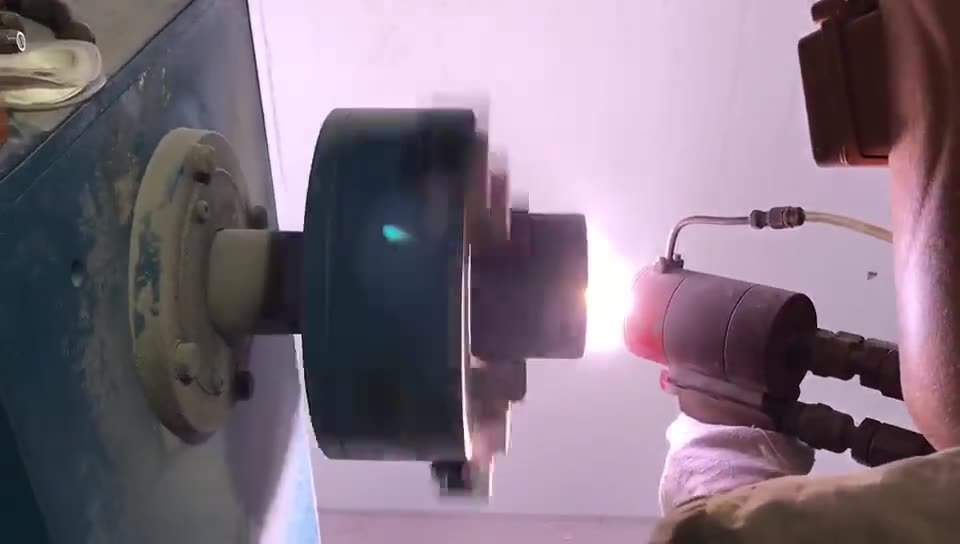
HVOF is the preferred process; it keeps particle temperature low enough to limit decarburisation while still producing a dense layer. Plasma works but tends to lose more carbon and produce a more porous deposit. Powder cuts are typically -45/+15 um for HVOF, and the NiCr-to-carbide ratio is normally 20-25 percent binder, though it can be adjusted for specific erosion conditions.
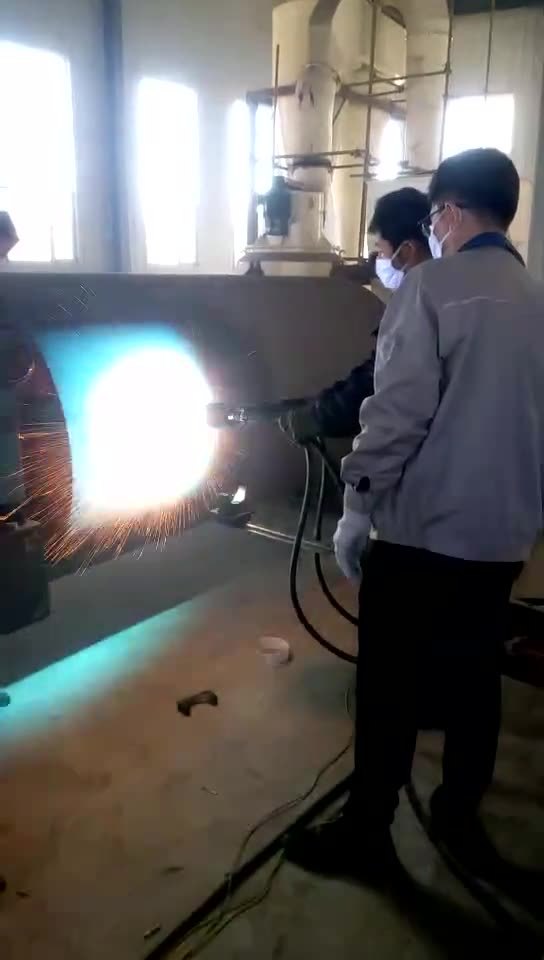
For boiler tube work the coating is often applied in situ on site, with portable HVOF or arc equipment, and the surface preparation - grit blasting to Sa 3 with an angular profile - is what decides whether the coating stays attached through thermal cycling.
What we need to quote
Service temperature and atmosphere, erosion mechanism (fly ash, catalyst fines, steam), substrate and its operating temperature, whether work is in a workshop or on site, and the acceptance standard. Boiler work usually specifies thickness and porosity limits that we quote against directly.
How it compares with the other high-temperature options
Three coatings compete in the 600-900 C erosion band, and the choice between them is not obvious.
| Coating | Strength | Limitation |
|---|---|---|
| NiCr-Cr3C2 (HVOF) | Best all-round erosion resistance at temperature, good oxidation resistance | Needs HVOF for best results; site work is slower than arc spray |
| NiCr-Cr3C2 (arc spray, cored wire) | Fast, portable, cheap per square metre | Higher porosity and oxide content, lower bond strength |
| NiCr alloy (without carbide) | Excellent oxidation and hot corrosion resistance | Much softer - no real erosion resistance |
| Ceramic (Al2O3, Cr2O3) | Higher hardness | Brittle under impact; spalls on tubes that flex |
On a boiler wall the practical decision is usually between HVOF-applied NiCr-Cr3C2 for the highest-wear zones and arc-sprayed cored wire for the bulk of the area, because the budget rarely covers HVOF everywhere. We quote both and let the customer decide where the money goes.
Frequently asked questions
At what temperature does tungsten carbide stop working?
Roughly 500-540 C in oxidising service. Above that the cobalt binder oxidises and the coating fails from the matrix outward, even though the carbide particles remain hard. NiCr-Cr3C2 is the standard substitute in the 800-900 C range.
Is NiCr-Cr3C2 as hard as WC-Co?
No - typically 700-900 HV against 1000-1250 HV for WC-Co. The trade is deliberate: you give up room-temperature hardness to keep the wear resistance at temperature. Below 500 C tungsten carbide is the better coating.
Can it be applied on site to boiler tubes?
Yes, with portable HVOF equipment. Surface preparation is the limiting factor rather than the spraying - Sa 3 blast with an angular profile, done in a controlled area, is what makes the coating survive thermal cycling in service.