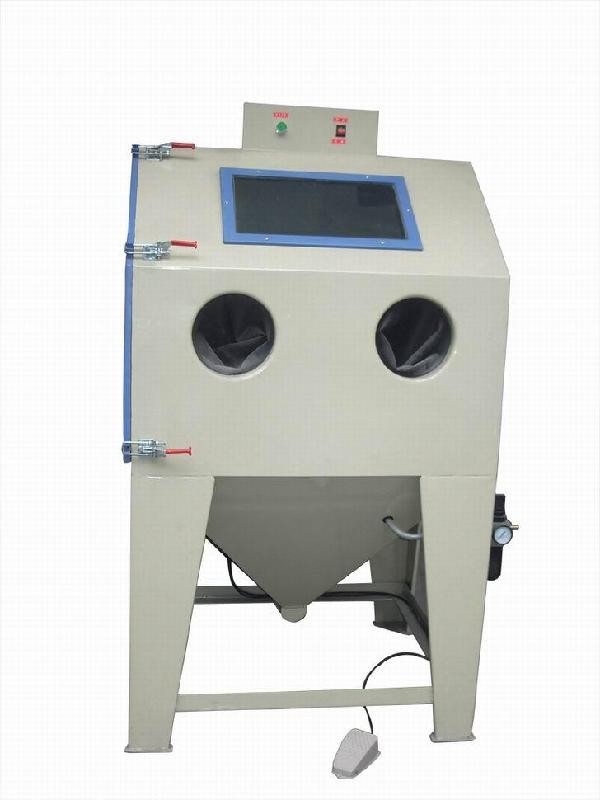
What the SX-80F is
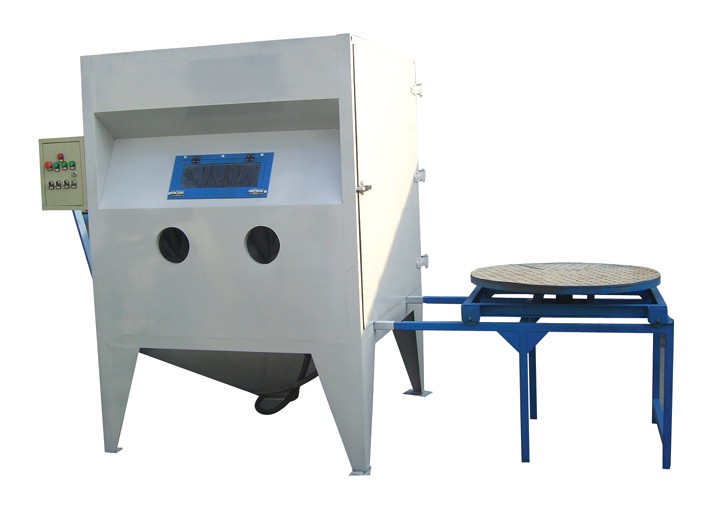
The SX-80F is a suction-blast cabinet with an 800 x 600 x 480 mm work chamber inside a 900 x 800 x 1300 mm body. It is the compact end of our blasting range: one operator, one pair of gloves, and enough room for pump housings, moulds, small weldments and batches of machined parts that need a Sa 2.5-3 profile before spraying.
The machine is delivered with a turntable and a movable trolley. The turntable lets the operator rotate a part under the nozzle instead of walking around it, and the trolley brings heavy parts in and out without lifting them over the door sill.
How the suction circuit works
Compressed air is fed to the blast gun, where the high-velocity jet creates a negative pressure at the abrasive inlet. That vacuum draws abrasive out of the cyclone hopper, up through the feed hose and into the gun, where it is accelerated down the nozzle and thrown at the workpiece. The same air does two jobs: it conveys the abrasive and it accelerates it.
The injector principle is also the reason this cabinet is cheap to run. Abrasive is accelerated only once, at the nozzle, so grain fracture is lower than in a pressure pot and consumption per square metre stays down. The trade-off is intensity: a pressure-fed machine hits harder and strips heavy scale faster, while a suction cabinet wins on finer work, low media consumption and a gun an operator can hold for a full shift.
Why the separator matters more than the nozzle
Every blast cabinet produces two streams - reusable abrasive and dust - and the separation between them decides what the machine actually costs to operate. If dust circulates back into the blast stream, the dust cloud inside the cabinet grows, visibility drops and the nozzle wears on powder instead of grain.
The SX-80F uses an adjustable cyclone separator. Reusable grain falls out of the air stream and returns to the hopper; fine dust and broken grit pass on to the baghouse, which is cleaned by a push-pull vibration valve. That adjustment is what lets one cabinet run 46-mesh alumina, 80-mesh glass bead or steel grit without sending good abrasive to the dust bin. In practice the operator sets the separator once per media change and then only tops up the hopper.
What it cleans, and to what standard
The cabinet removes mill scale, heat-treatment oxide, sand inclusions, residual salts, old paint and burrs from forgings, castings, weldments, stamped and machined parts, and moulds. On a coating line the target is normally Sa 2.5 to Sa 3 with a 40-70 micron profile: enough anchor pattern for a plasma or HVOF coating to key into, without cutting so deep that the profile peaks stand above the coating after finishing.
With glass bead instead of angular grit the same cabinet becomes a peening and cosmetic finishing machine - satin surfaces, closed porosity on castings, and a compressive surface layer instead of a cutting one.
Technical parameters
| Item | Value |
|---|---|
| Cabinet dimensions (L x W x H) | 900 x 800 x 1300 mm |
| Work chamber (L x W x H) | 800 x 600 x 480 mm |
| Power supply | 220 V, 50 Hz single phase |
| Lighting | 220 V, 25 W |
| Compressed air pressure | 0.15 - 0.7 MPa |
| Compressed air consumption | 0.5 - 1.2 m3/min, dry and oil-free |
| Separator air volume | 8.5 m3/min |
| Separator motor | 220 V, 50 Hz, 250 W |
| Dust removal | Baghouse with push-pull vibration cleaning |
Running it day to day
Two things make the difference between a cabinet that holds its finish and one that drifts. The first is air quality: the 0.5-1.2 m3/min has to be dry, because moisture carries abrasive into the feed hose and turns it into a plug. A refrigerated dryer and a coalescing filter ahead of the cabinet are not optional in a humid plant.
The second is the baghouse. With the vibration cleaning cycle running as designed, the collector removes primary and secondary dust across an eight-hour shift without manual intervention; operators only empty the drawer and check the bags at the start of each shift. A cabinet that starts fogging up mid-shift is telling you the cleaning cycle has stopped, not that the media is wrong.
SX-80F or SX-900F
Both machines use the same suction principle and the same separator logic. The SX-80F is the smaller, lower-cost cabinet for single parts and mixed batches. The SX-900F is the larger eco-friendly model, built for plants that blast continuously and need lower dust emission at the fence line. If you are sizing for a new spray cell, send us the largest part and the daily throughput and we will tell you which chamber fits.
Frequently asked questions
What air supply does the SX-80F need?
0.5 to 1.2 m3/min at 0.15 to 0.7 MPa, dry and oil-free. In a humid plant add a refrigerated dryer and a coalescing filter ahead of the cabinet, otherwise moist abrasive plugs the feed hose.
What is the largest part that fits in the cabinet?
The work chamber is 800 x 600 x 480 mm, so a part up to roughly 700 x 500 x 350 mm can be turned on the turntable. Larger or heavier parts are handled through the side door on the trolley, or on the larger SX-900F.
Can the SX-80F be used for glass bead peening?
Yes. Change the media and re-set the cyclone separator, and the cabinet becomes a peening and cosmetic finishing machine - satin surfaces, closed casting porosity and a compressive surface layer.