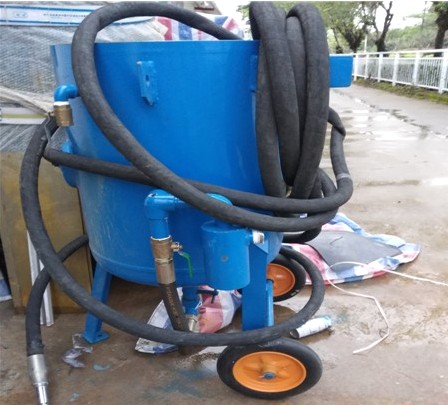
Pressure-fed, not suction
In a suction cabinet the air pulls abrasive into the gun and the nozzle only ever sees atmospheric pressure plus the venturi effect. In a pressure-fed machine the abrasive sits inside a pressure vessel and is pushed into the air stream, so the full line pressure of 0.5-0.7 MPa arrives at the nozzle. For the same compressor the impact energy roughly doubles: mill scale, thick rust, old paint and concrete laitance come off in one pass instead of three, and the profile is cut deeper in the same dwell time.
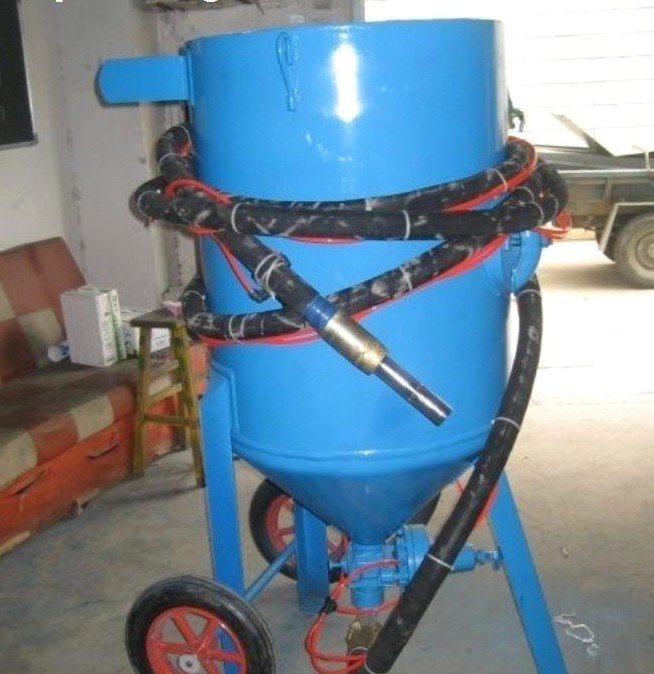
That is why pressure-fed units dominate shipyards, bridge work and tank farms, and why the SX-P300 is built as a mobile vessel on wheels rather than as a cabinet. The machine goes to the work - a hull, a girder, a tank shell, a rail wagon - instead of the work coming to the machine.
What decides whether it performs
Three things separate a pressure blaster that runs all day from one that fights its operator: the abrasive valve, the moisture trap, and how the blast is controlled.
The abrasive valve. It has to meter a stable air-abrasive mixture at the bottom of the vessel. If it surges, the hose loads up and the nozzle blocks; if it starves, compressed air is spent accelerating nothing. The valve on this unit is adjustable, so the air-to-abrasive ratio can be trimmed for the media in use - a coarse copper slag needs a wider opening than a fine garnet.
Moisture. Compressed air at 0.7 MPa carries water, and wet abrasive bridges in the vessel and stops the machine dead. A water separator sits at the air inlet ahead of the vessel, and the drain is opened at the start of each shift. In a humid climate this single habit prevents most of the "my blaster keeps blocking" calls.
Control at the nozzle. Blasting a tank interior or a bridge underside puts the operator far from the pot. The unit is run with a remote deadman control so the blast stops the moment the trigger is released. That is a safety requirement, not a convenience: a pressurised hose that keeps firing when it is dropped is how people get hurt.
Применение
- Shipbuilding and ship repair - hulls, decks, ballast and cargo tanks
- Bridge and structural steel - girders, bearings and welded joints before coating
- Storage tanks, pressure vessels and pipelines - internal and external surfaces
- Rail, port and hydraulic structures; mining and metallurgical plant
- Machine tool bodies, heavy castings and general preparation before painting or thermal spray
Technical parameters
| Item | Value |
|---|---|
| Working pressure | 0.5 - 0.7 MPa |
| Air consumption | 3 - 7 m3/min (depends on nozzle bore) |
| Abrasive size | 0.1 - 3.0 mm |
| Surface cleanliness | Sa 2.5 - Sa 3 |
| Blast principle | Pressure-fed, air-abrasive mixing inside the vessel |
| Mobility | Wheeled frame, blast hose and nozzle supplied with the set |
| Media | Copper slag, garnet, steel grit or shot, alumina; 0.1-3 mm |
Choosing between pressure and suction
The trade-off is simple. A pressure blaster cleans faster per square metre and reaches a deeper profile; a suction cabinet uses less media, is gentler on grain and finishes finer work better. Most coating shops end up with both - a cabinet for parts that fit through a door, and a pressure pot for structures that do not.
Our SX-80F and SX-900F cover the cabinet side; the SX-P300 covers the field side. If you want the physics behind the difference before choosing, the guide What is a sandblaster walks through it.
Running cost
Two consumables dominate: the nozzle and the abrasive. Nozzle bore sets the air demand - a wider bore blasts faster but needs a bigger compressor, and once the bore has worn 20% the pressure at the work drops noticeably even though the gauge has not moved. Checking the nozzle against a new one, and replacing it before it is oval, is the cheapest efficiency gain in any blasting operation. Abrasive is the second cost: copper slag is cheap and single-use, garnet and steel grit are more expensive but can be recovered - which is where a recirculating system earns its keep.
Frequently asked questions
What compressor does the SX-P300 need?
Between 3 and 7 m3/min at 0.5-0.7 MPa, depending on nozzle bore. For site work a 7 m3/min towable diesel compressor is the usual match; a smaller 3-4 m3/min unit runs a narrow nozzle but not a wide one.
Can the SX-P300 be used indoors?
Only with extraction. It is an open blasting unit, so the dust it makes has to be captured by a separate dust collector or blast room; the cabinet machines (SX-80F, SX-900F) are the indoor option for parts that fit inside them.
Which abrasive can it run?
Any dry abrasive from 0.1 to 3.0 mm - copper slag, garnet, steel grit or shot, alumina. Silica sand is not recommended for health reasons; the respirable dust it produces causes silicosis.