Two different jobs on the same pan
Cookware coating enquiries usually mix up two separate layers. The inside of a wok or frying pan needs a food-contact ceramic non-stick finish that releases egg and rice, survives a metal spatula and tolerates repeated heating cycles. The outside base may need a sprayed metallic layer for induction compatibility, magnetic/thermal conductivity, or wear and corrosion resistance. They are applied by different processes and specified separately. We supply the coating service for both, and we also build the spraying line if you want to run it in your own factory.
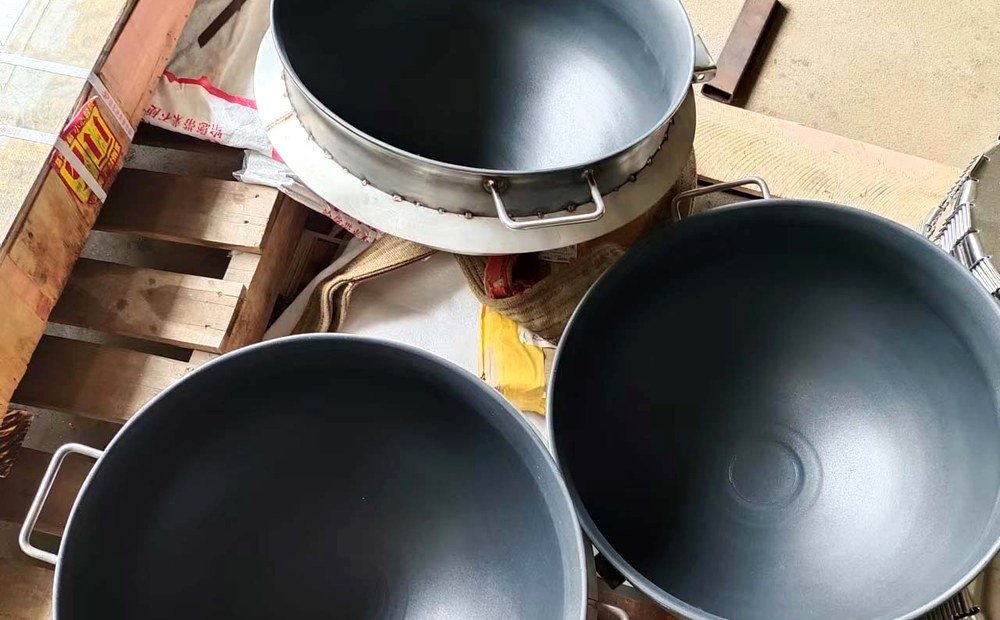
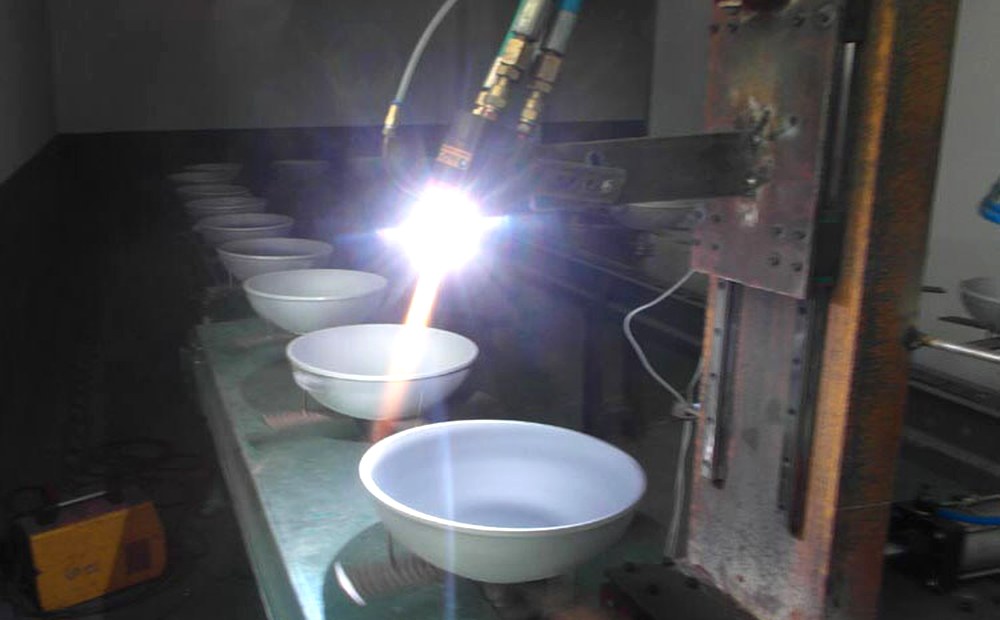
The photograph shows finished black ceramic-coated woks before packing. Our process route is a duplex system: a prepared, grit-blasted substrate with a thermally sprayed metallic or ceramic underlayer, followed by an automatically sprayed and cured ceramic non-stick topcoat. Where the customer only wants the wear layer, we stop after the spray step.
The coating stack, step by step
| Step | What we do | What to control |
|---|---|---|
| 1. Degrease and blast | Alkaline clean, rinse, grit blast the interior with a fine abrasive to a uniform anchor profile | No silicone or release-agent residue; spray within the re-oxidation window |
| 2. Underlayer | Arc or plasma spray Al, Fe, Ni-Al or a ceramic bond layer; on induction bases this is the magnetic/conductive layer | Adhesion, thickness uniformity, no burn-through on thin aluminium |
| 3. Topcoat | Automatic rotary spray of a ceramic-filled non-stick system, then a controlled thermal cure | Wet film thickness, cure temperature and dwell, rim masking |
| 4. Inspect and pack | Visual check, adhesion/cross-cut, release test, thickness sample, acid and boiling-water checks | Batch traceability and food-contact documents |
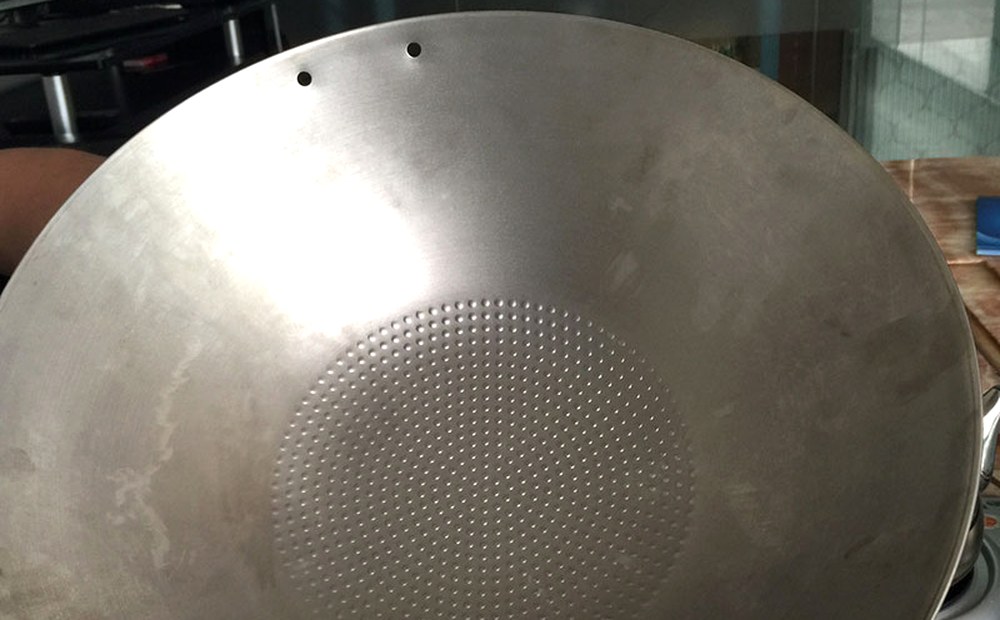
The textured metal surface in the detail photograph is a sprayed underlayer; the smooth black finish in the cover photograph is the cured ceramic topcoat. Do not specify them as a single "coating thickness" - a drawing that calls out only 40 µm of ceramic will not tell the spray shop what build-up the base needs.
Food-contact claims: what to ask for
Old marketing copy for ceramic cookware often quotes a leaching test on six elements - arsenic (As), cadmium (Cd), hexavalent chromium (Cr6+), lead (Pb), copper (Cu) and mercury (Hg) - and an FDA review of constituent substances. Those are the right questions, but a certificate from a coating supplier ten years ago is not a compliance document for your current production batch. Ask for a current migration/leaching report tied to the exact coating lot, plus the declaration relevant to your market (FDA food-contact, EU 1935/2004, LFGB or the local equivalent), and confirm the formulation is PTFE- and PFOA-free if that is your selling point.
Three bench checks are worth running before a production release: 24 hours in boiling acetic acid, 72 hours in boiling water, and 24 hours in 10% salt water, followed by release and adhesion retesting. Antibacterial claims require their own test report - do not repeat a percentage copied from a brochure. We supply coupons and the test protocol with trial batches.
Where cookware coatings actually fail
Rim and edge chipping. The coating is thinnest at the rim and takes the most mechanical abuse. Mask the rim correctly and specify a small extra build at the transition.
Thermal cycling delamination. Aluminium and a ceramic topcoat expand at different rates. The underlayer exists to bridge that mismatch; a cure schedule that is too hot or too short shows up as blistering after a few dozen cycles.
Alkaline detergent attack. Dishwasher detergents and prolonged soaking are harder on a ceramic non-stick finish than cooking is.
Induction base debonding. A sprayed magnetic base on a thin pan sees rapid thermal cycling. Bond strength and base flatness matter more than layer thickness.
Hot spots on thin woks. Uneven wall thickness produces local overheating; fix the pressing before blaming the coating.
For a comparison with the same duplex idea in industrial equipment, see our wear-resistant plus non-stick coating for lithium battery equipment. The thermal spray material selection guide explains why a hard wear layer and a release layer are rarely the same material.
The spraying line
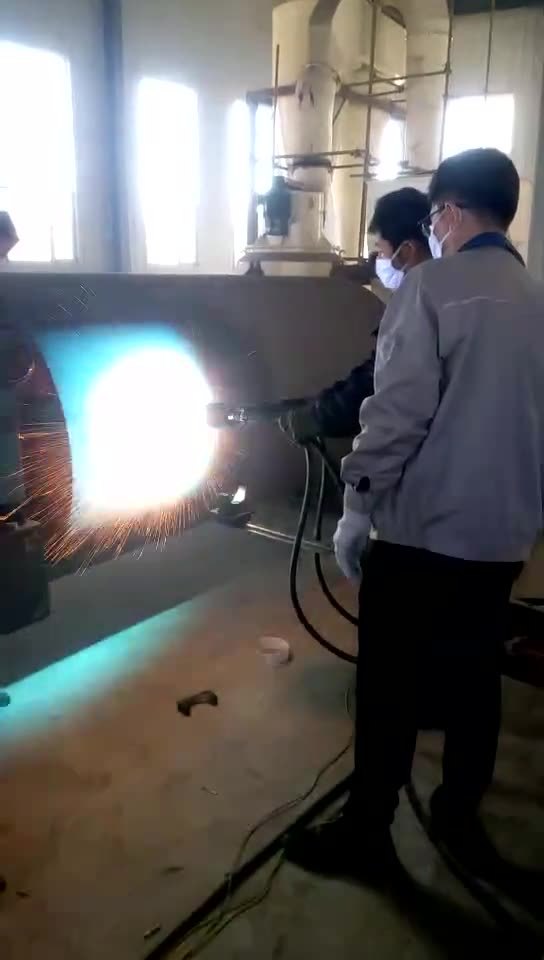
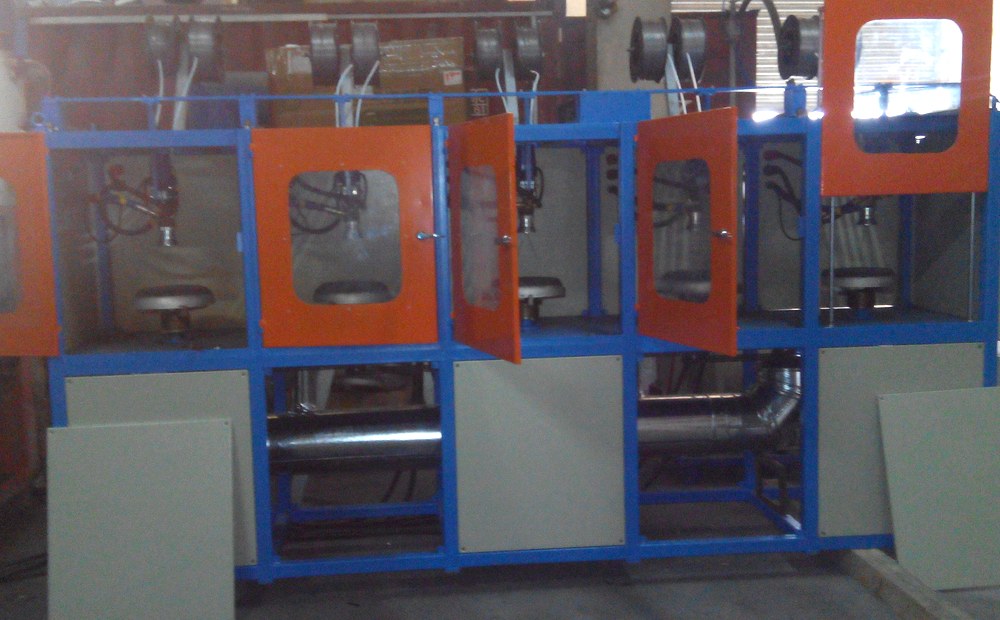
The photograph shows a multi-station cookware coating line: pans index on rotating fixtures through preheat, underlayer spray, topcoat spray, curing and cooling, with extraction at each spray station. A line is quoted against your pan geometry and takt time, not as a fixed catalogue model. Utilities to plan for are clean dry compressed air, gas or electric curing heat, exhaust and filtration for overspray, and a temperature-controlled coating supply. We commission the line, set the gun paths and cure profile for your part, and train your operators on the checks that actually catch drift: wet film thickness, cure temperature trace and release testing.
If you need the thermal spray side in-house, the underlayer can be run on our SX-80 plasma system or an electric arc wire spray system, depending on whether the base layer is a ceramic or a metal.
Typical specification
| Item | Typical range | Verified by |
|---|---|---|
| Substrate | Die-cast or spun aluminium, 3003/1050, stainless steel, multilayer base | Mill certificate and part drawing |
| Sprayed underlayer | 50-150 µm metallic or ceramic bond layer | Thickness gauge, cross-cut adhesion |
| Ceramic non-stick topcoat | 20-60 µm cured dry film, per supplier system | Thickness sampling, cure record |
| Continuous service | Up to roughly 260-300 °C for cooking; no empty-pan overheating | Thermal cycling test |
| Release | Egg/rice release after cycling, no oil | Agreed in-house release protocol |
What we need to quote
Pan alloy and wall thickness, diameter and depth, whether the base must work on induction, interior colour and finish, the food-contact declaration your market requires, target annual volume and takt time, the failure you are trying to eliminate, and whether you need coated parts, trial coupons, or a complete spraying line. We will recommend the underlayer and topcoat separately and will not quote a single "ceramic coating" thickness.
Frequently asked questions
Is the ceramic non-stick coating PTFE and PFOA free?
Yes, the ceramic systems we supply are PTFE-free and PFOA-free. Ask for the current formulation declaration and a lot-specific migration report rather than relying on an old brochure certificate.
Can you coat pans that will be used on induction hobs?
Yes. The induction function comes from a sprayed metallic magnetic/conductive base layer on the outside, which is a separate step and specification from the interior non-stick topcoat. Base flatness and bond strength are the critical controls.
Do you supply food-contact certificates?
We provide the coating supplier's current declaration and leaching/migration test reports with trial and production batches, and we run acid, boiling-water and salt-water checks on request. Final market compliance remains the brand owner's responsibility.
Can we buy only the spraying line and run it ourselves?
Yes. We build multi-station cookware coating lines, set the gun paths and cure profile for your pan geometry, and train your operators. We can also supply the thermal spray equipment for the underlayer separately.
What is the minimum trial quantity?
We normally start with 20-50 pans or a set of flat coupons for adhesion, release and thermal-cycling tests before fixing the production parameters. Send the pan drawing and target volume first so the trial fixtures match production.