What "recirculating" actually means
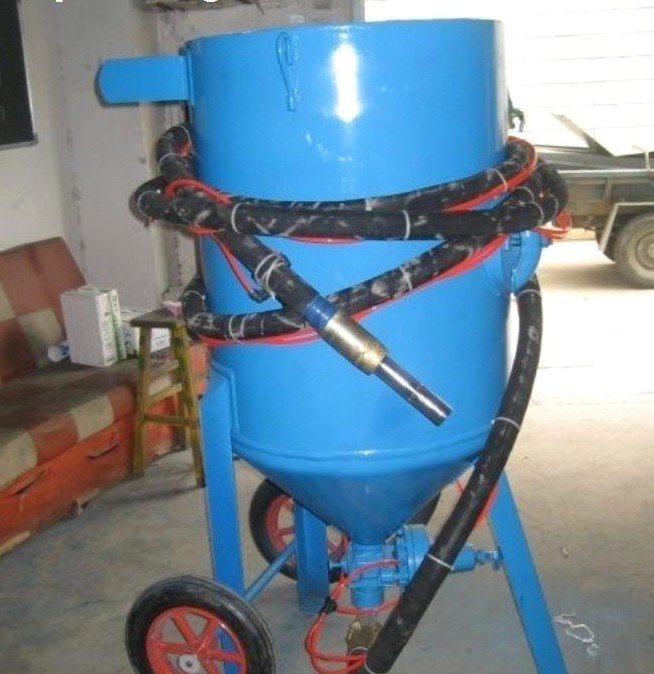
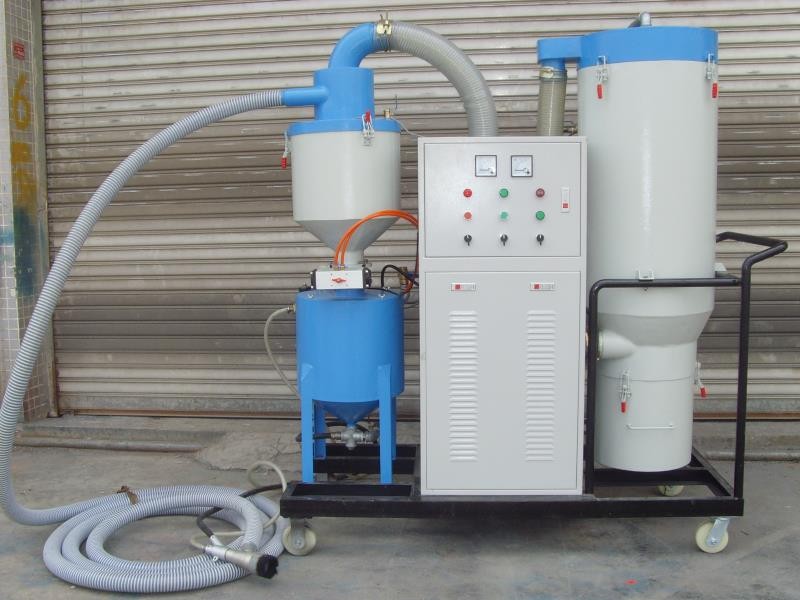
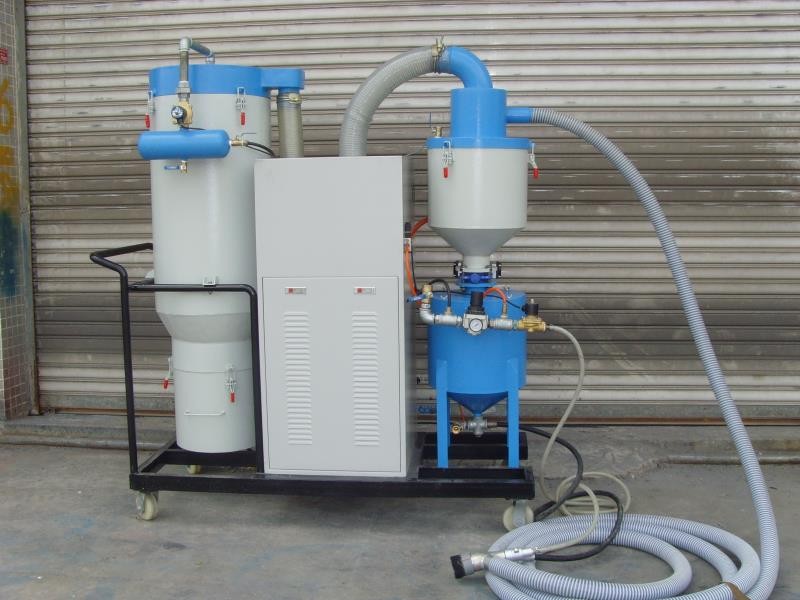
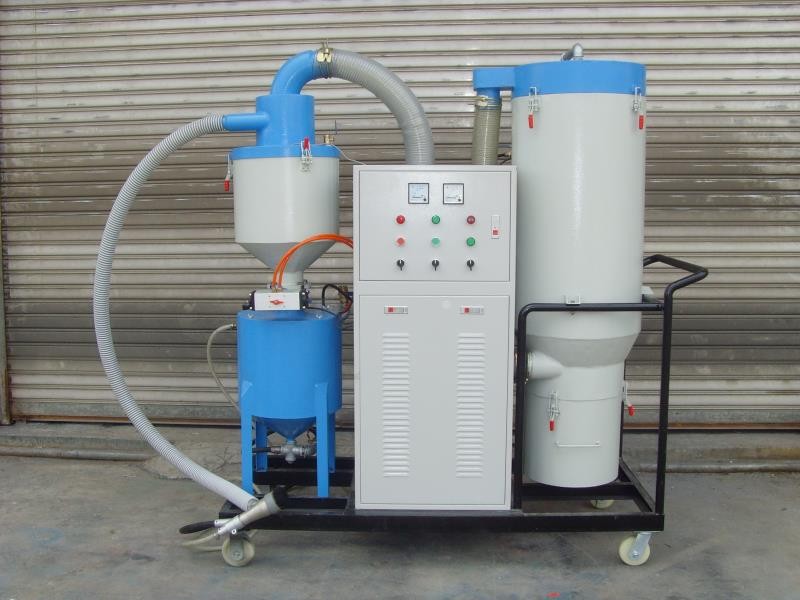
Open blasting is a one-way process: abrasive goes out of the nozzle, hits the workpiece and is swept into the dust bin with the rust it removed. A recirculating system closes that loop. A vacuum source draws the spent abrasive and dust back through a recovery hose into a separator, the separator returns intact grain to the pressure vessel and sends the dust and rust to the filter, and the next blast pass uses the same media again.
On this series the measured recovery rate is approximately 99%. For a shop running garnet or ceramic bead - media that costs real money per tonne - that number is the whole business case. For an indoor cell it is also the difference between a workable dust load and a room nobody can stay in.
Three functions, one switch
The unit is built to do open blasting, industrial blasting and enclosed eco-blasting with the same console: blasting, abrasive recovery and separation run under a single control sequence. The operator sets the working pressure, and the machine handles the rest - which is why it is used where the same part family is blasted day after day rather than for one-off repair work.
Working pressure is adjustable across 0.2-0.8 MPa. That range matters more than it sounds: a thin sheet or a machined surface wants 0.3 MPa and a fine media, while a heavy casting with mill scale wants the top of the range. A single fixed-pressure machine forces the operator to choose one and compromise on the other.
The control valve is the heart of it
The combined air-and-abrasive valve is the component that decides whether a pressure blaster runs reliably. This design follows the Schmidt principle: air supply and exhaust switch instantly, the pressure vessel is pressurised and vented by the same valve, and - critically - abrasive and dust are kept out of the control internals. Valves that let grit into the seals start sticking within weeks, and a sticking valve on a pressurised vessel is both a production problem and a safety one.
Air preparation and filter cleaning
Compressed air is treated twice before it reaches the vessel: a built-in water separator removes bulk condensate, and a secondary oil-water stage protects the media from oil carry-over. The filter cartridge is cleaned by an automatic back-blow device, so the operator does not have to stop production to shake bags; a back-blow button on the panel allows a manual cycle when the differential pressure tells you it is needed.
Technical parameters
| Item | Value |
|---|---|
| Working pressure | 0.2 - 0.8 MPa, adjustable |
| Abrasive recovery rate | Approximately 99% |
| Surface cleanliness | Sa 2.5 - Sa 3 |
| Vacuum source | Electric winch-driven or fully pneumatic (two versions) |
| Filter cleaning | Automatic back-blow, manual override on panel |
| Air treatment | Built-in water separator plus secondary oil-water separation |
| Modes | Open blasting / industrial blasting / enclosed eco-blasting |
| Mobility | Trolley frame with recovery hose and blast hose |
Where it pays for itself
Three situations justify the extra cost over a plain pressure pot. The first is expensive media: garnet, ceramic bead and steel grit are recovered at roughly 99%, so the media bill falls by an order of magnitude on repetitive work. The second is indoor blasting, where the recovery hose is also the dust control - there is no cloud of spent abrasive to extract. The third is containment: on site, spent abrasive that cannot be left behind has to be collected anyway, and a machine that collects it while it works is cheaper than a separate clean-up crew.
Maintenance is deliberately simple: empty the dust bin, check the separator screen for tramp material, confirm the back-blow cycle is firing, and inspect the recovery hose for wear at the bends. A unit that suddenly recovers less than it used to is almost always telling you the filter is blinded or the hose has a leak, not that the vacuum has failed.
Frequently asked questions
How much abrasive does the system actually recover?
About 99% in normal operation. Intact grain returns to the pressure vessel; broken grain, rust and dust go to the collection bin. Recovery falls when the filter is blinded or the recovery hose leaks, so both are part of routine checks.
What is the difference between the electric and pneumatic versions?
Only the vacuum source. The electric version uses a winch-driven unit; the fully pneumatic version uses a vacuum generator driven by compressed air. The pneumatic version has no electrical components at the blast point, which suits sites where power is not available or where water is present.
Can it run as a normal pressure blaster without recovery?
Yes. Open blasting, industrial blasting and enclosed eco-blasting are three modes on the same console; the recovery circuit can be left off when you are working on a large structure and recovering is not practical.
What working pressure range does it cover?
0.2 to 0.8 MPa, adjustable at the panel. Thin or machined parts run at the low end with fine media; heavy castings with mill scale run at the top of the range.