Hard chrome plating has been the default wear surface for a century: cheap, thin, hard and well understood. What is changing is not its performance but its chemistry. The plating bath is built on hexavalent chromium, and that is the part the regulators have decided the industry can no longer use at scale.
Why shops are moving away from chrome
Hexavalent chromium is a confirmed carcinogen, and the pressure comes from three directions at once:
- Worker exposure rules. Occupational limits for Cr(VI) have tightened repeatedly, which raises the cost of running and monitoring a plating line.
- Authorisation regimes. Under REACH, chromium trioxide used in plating requires an authorisation in the EU, granted case by case and time limited. Similar restrictions are spreading in other markets.
- Waste treatment. Rinse water and spent bath carry Cr(VI), which must be reduced and disposed of as hazardous waste. That cost keeps rising and is now a real fraction of the plating price.
The practical consequence for a buyer of coated parts is simple: fewer plating shops, longer lead times, rising prices, and the risk that a supply chain qualified around chrome has to be re-qualified at short notice anyway.
The realistic alternatives
Several processes can replace hard chrome, and they are not interchangeable. The choice follows the wear mechanism, the part geometry and the temperature.
| Process | Typical thickness | Hardness | Best for |
|---|---|---|---|
| HVOF tungsten carbide (WC-Co, WC-CoCr) | 0.05-0.50 mm | 1,000-1,400 HV | Abrasion, erosion, impact, hydraulic rods, rolls |
| HVOF chromium carbide (Cr3C2-NiCr) | 0.10-0.40 mm | 800-1,000 HV | Hot wear, oxidising atmospheres to about 800 C |
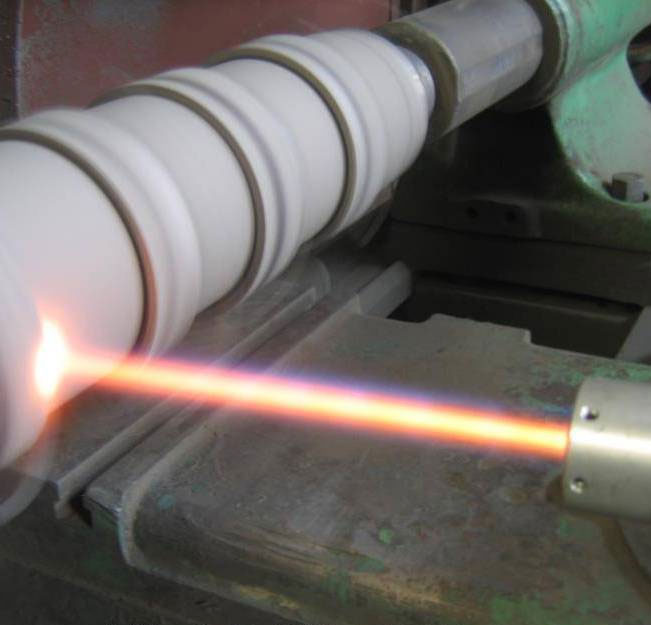
| Plasma ceramic (Cr2O3, Al2O3) | 0.10-0.50 mm | 900-1,400 HV | Corrosion plus wear, insulation, release surfaces |
| PTA / laser cladding | 0.5-3.0 mm | HRC 55-65 with carbide | Heavy wear, rebuildable parts, metallurgical bond |
| Cold spray | 0.2-2.0 mm | Depends on metal | Dimensional restoration, conductive layers, no heat |
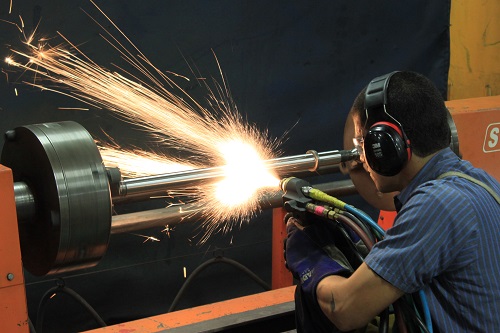
For most wear-critical parts the answer is HVOF tungsten carbide, because it delivers the closest match to chrome's combination of thinness, hardness and finish while improving abrasion resistance.
Where HVOF carbide genuinely beats chrome
- Abrasion and erosion. A dense WC-Co or WC-CoCr layer typically outlasts hard chrome several times over in abrasive slurry, dust-laden air and particle erosion. This is the single biggest reason for conversion.
- No hydrogen embrittlement. Chrome plating generates hydrogen that diffuses into high-strength steel and requires a baking step afterwards. Thermal spraying is a dry deposition process - there is no hydrogen to bake out, which matters on high-strength fasteners, springs and landing gear steels.
- Local build-up without extra masking. Thicker local layers are practical, so a worn area can be rebuilt rather than scrapped.
- Repairability. A worn coating can be stripped and re-sprayed, often on the same part, several times.
Where chrome still wins - be honest about this
Chrome is not beaten everywhere, and pretending otherwise damages credibility with engineers:
- Very thin, very uniform layers on complex geometry. Plating throws into recesses and internal features that a spray plume cannot reach at a workable angle. Small bores, blind pockets and intricate profiles remain difficult for spraying.
- Low-cost simple parts. For a small, low-value part with mild wear, chrome can still be cheaper per unit - though the compliance cost is eroding that advantage.
- Decorative and optical surfaces. Cosmetic chrome is a different requirement from wear chrome, and spray coatings are opaque and slightly rougher.
- Very high tolerance at very low thickness. Where the specification calls for 10-20 um with a mirror finish, plating remains easier to control.
The fatigue question, which decides many conversions
Hard chrome reduces the fatigue strength of high-strength steel, and designers have historically compensated for that debit. HVOF carbide coatings generally show a smaller fatigue debit, but the number is application-specific: it depends on substrate, coating thickness, residual stress, surface preparation and the stress spectrum. In aerospace and other safety-critical work the conversion is therefore qualified by test - fatigue coupons and full-scale part testing - not by datasheet comparison. Any supplier who promises a fatigue number without testing the actual part is guessing.
Practical conversion checklist
- Substrate and heat treatment. Confirm the steel grade and tempering temperature; the spray process must not exceed it. HVOF keeps part temperature low, but pre-heat and cooling still need planning.
- Pre-machining allowance. A sprayed layer needs a blast profile and usually a bond coat, so the pre-coat diameter is not simply "chrome thickness minus". Typical finishing allowance is 0.05-0.15 mm per side.
- Masking. Define coated and uncoated zones on the drawing - threads, keyways, seal grooves, locating faces.
- Bond coat. On steel, a thin Ni-based bond layer improves adhesion and adds corrosion protection at the interface; on some parts it can be omitted.
- Sealing. HVOF carbide has porosity below 1% but not zero. In corrosive or immersed service a sealer is applied.
- Finishing. Grinding and, where needed, polishing to the seal or bearing roughness - the coating is applied oversize and machined back.
- Inspection. Thickness, hardness, bond strength (coupon), finish, roundness, and where relevant a fatigue or bend test.
What it costs
Per square metre, HVOF carbide is more expensive than chrome plating at the point of coating. Per year of service it is frequently cheaper, because the coating lasts several times longer and the part can be recoated instead of replaced. The comparison only makes sense over a maintenance interval, not per invoice - and it should include the downtime avoided, which usually dominates both numbers.
Bottom line
For abrasive and erosive wear on steel parts, HVOF tungsten carbide is a mature replacement for hard chrome and in most cases a better one. For very thin layers on complex internal geometry, chrome still has an engineering advantage, and the honest answer is to keep it or to redesign the part. We coat both ways of working - spray for wear parts, and where the geometry rules out spraying we will say so rather than sell a coating that cannot reach the surface.
Frequently asked questions
Is HVOF tungsten carbide a direct drop-in replacement for hard chrome?
Not drop-in - the coating is applied thicker (typically 0.1-0.3 mm), needs a blast profile and finishing allowance, and the fatigue behaviour must be validated for the part. For most wear applications it performs better than chrome, but the drawing and process need to be re-qualified.
Can thermal spray coat internal bores that chrome used to cover?
Large bores can be sprayed with an internal gun, typically from about 60 mm diameter upward depending on depth. Small bores and blind pockets remain difficult, and there chrome plating or a different design is still the practical answer.
Does HVOF carbide avoid hydrogen embrittlement?
Yes. Thermal spraying deposits molten or softened particles; no hydrogen is generated at the substrate, so the baking step required after chrome plating is not needed. That is one reason conversions are common on high-strength steels.
Which is cheaper, chrome or HVOF carbide?
Chrome is cheaper per part at the point of coating. HVOF carbide usually wins over a maintenance interval because it lasts several times longer and the part can be recoated instead of replaced - and it avoids the rising compliance and waste costs of hexavalent chromium.