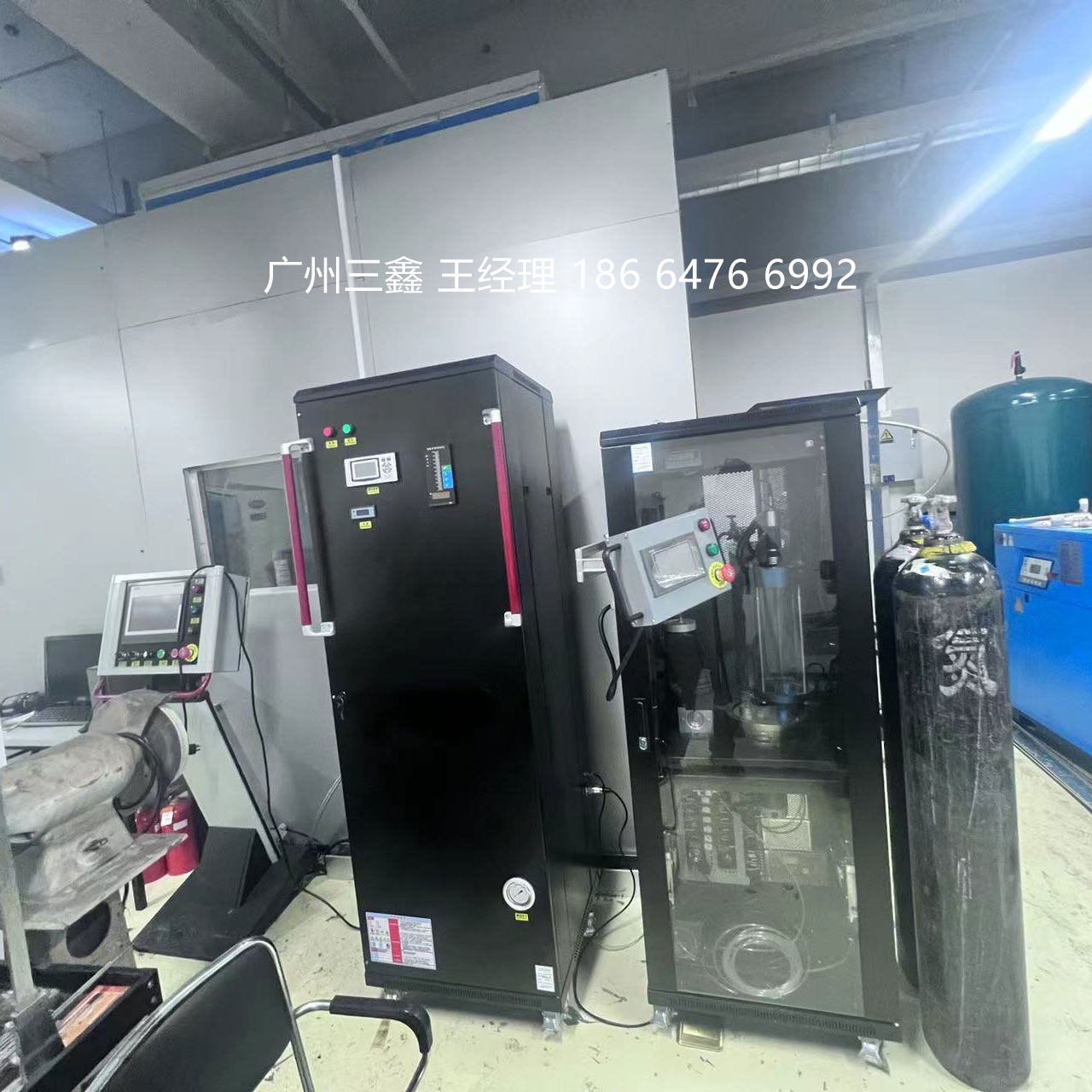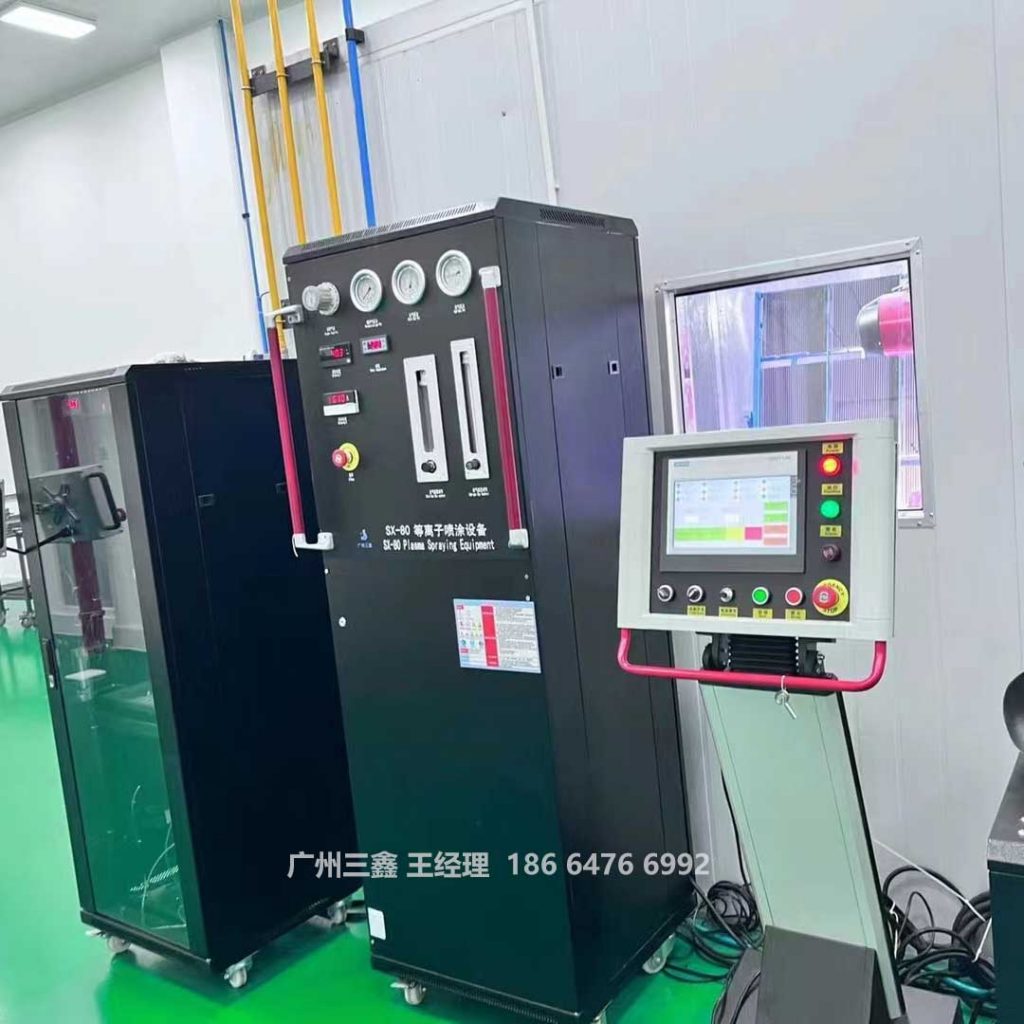
Graphite boats carry wafers and ceramic green bodies through sintering and crystal-growth furnaces. Bare graphite reacts with the charge and oxidises away, so the working surfaces are protected with an yttria (Y₂O₃) or zirconia (ZrO₂) coating applied by flame spraying. This production line automates that step for semiconductor and high-temperature ceramics plants.
Line Configuration
| Module | Function |
|---|---|
| Flame spray guns + powder feeder | Propane/acetylene flame melts Y₂O₃ or ZrO₂ powder onto rotating boats |
| Rotary fixtures | Constant part rotation for uniform thickness |
| Dust extraction | Captures overspray for a clean shop environment |
| Process control | Gas flows, gun travel and cooling monitored per recipe |
Coating Properties
- Service temperature up to 2000 °C – Y₂O₃ is phase-stable and does not react with most charge materials.
- Thickness 0.3–1.0 mm – enough to outlast multiple boat campaigns; edges are built up where wear concentrates.
- Chemical purity – high-purity powders keep metallic contamination out of the sintering environment.
- Longer boat life – replacement frequency drops sharply and per-part cost falls accordingly.
We also provide the same protection as a graphite boat coating service, and plasma versions of this line are described in our SX-80 plasma system page.
Frequently Asked Questions
Why flame spray rather than plasma for graphite boats?
Flame spraying is gentler on the graphite substrate and gives a slightly rougher, more open coating that bonds well and costs less per boat. For boats requiring a very smooth surface we switch to plasma spraying with fine YSZ powder.
What surface roughness can be achieved?
As-sprayed Ra is around 6-12 um. With sealing and polishing we reach Ra below 1.6 um, which prevents sintered products from sticking to the boat surface.