What thermal spraying actually puts into the air
Every thermal spray process produces two airborne fractions that behave very differently. The first is fume: metal or oxide vapour that condenses into particles mostly below one micrometre. The second is overspray: powder or atomised wire droplets that missed the part, typically 10 to 100 micrometres across. Blasting in front of the spray adds a third stream of broken abrasive and removed scale.
A collector sized only against the visible dust will pass the fume, and the fume is the fraction that reaches the operator's breathing zone and settles on every surface in the building. This is why spray shops that look clean still fail air-quality inspections, and why the extraction system has to be sized from the process rather than from the floor area.
Two stages, two different jobs
Our systems place a cyclone in front of a cartridge filter, and the split of work between them is deliberate. The cyclone uses the centrifugal force of a rotating gas stream to throw coarse particles against the wall, where they fall into a hopper. It has no consumables, needs no compressed air, and removes the part of the load that would otherwise blind the cartridges within a shift.
| Stage | Fraction removed | Typical efficiency | Notes |
|---|---|---|---|
| Cyclone | Above roughly 10 um | 80-95% of the coarse load | No consumables, no compressed air, protects the filter stage |
| Cartridge | 0.5 um and above | Up to 99.99% | Pleated polyester with a submicron surface layer |
Fan, air volume and static pressure
The fan has to overcome the duct, the cyclone, the filter and the stack, and still hold enough vacuum at the hood face. A variable-frequency drive is standard on our larger cabinets because the pressure drop of a clean filter and a loaded filter differ by a factor of two, and a fixed-speed fan either wastes power when clean or loses capture when loaded.
| Model | Motor (explosion-proof) | Air volume | Static pressure | Speed | Note |
|---|---|---|---|---|---|
| SX12C-37Kw-4P | 37 kW | Above 32,000 m3/h | 2,480-1,720 Pa | 1,450 rpm | Variable-frequency fan |
Three cabinet sizes are built on this platform, designated 04/24, 04/32 and 04/48, and the number of filter cartridges scales with the cabinet. The fan above belongs to the largest of the three; smaller cells use a proportionally smaller motor and duct.
Inside the filter cartridge
- Imported polyester fibre media with an ultra-thin submicron layer bonded to a conventional core. The fibres in that surface layer are packed tightly enough that the pores are smaller than the particles being captured, so the dust collects on the surface instead of embedding in the depth of the media.
- Pleated construction increases filtration area inside the same cabinet footprint, which lowers the air-to-cloth ratio and therefore the pressure drop.
- Short cartridge height keeps installation and replacement work low - a cartridge can be changed from the access door without dismantling the duct.
- Lower filtration velocity than a baghouse of the same volume, which matters for sticky oxide fume.
Pulse-jet cleaning
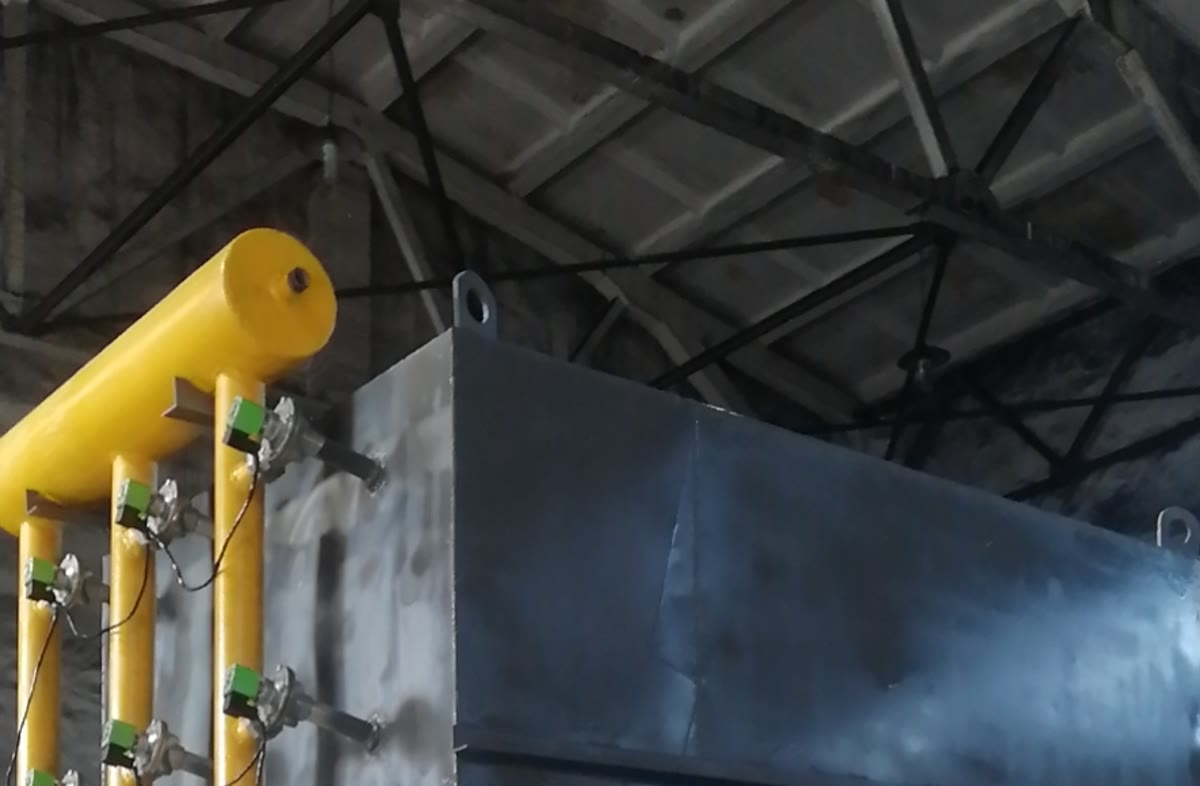
Cleaning is on-line: a controller fires a solenoid valve, the pulse valve releases compressed air from the receiver into a venturi at the top of the cartridge, and the resulting pressure wave flexes the pleats and drops the dust cake into the hopper. Because the pulse runs while the fan is running, the cell does not have to stop for cleaning. Timing can be set on differential pressure or on a fixed interval; differential pressure is the better signal because it follows the actual dust load rather than the calendar.
Sizing the system in three numbers
1. Capture velocity at the hood
For an open spray booth the air has to be moving at roughly 0.3 to 0.5 m/s across the face of the opening, otherwise the plume from a plasma gun escapes upward past the hood. Multiply that velocity by the open area, and add the cross-draft from the make-up air, which on a large booth is often the dominant term.
2. Transport velocity in the duct
Metal and oxide particles settle in horizontal runs. Ducts carrying spray dust are normally sized for 18 to 22 m/s so that nothing drops out, and every horizontal leg needs a clean-out. Undersized ducts are the single most common cause of a system that works when new and plugs within a year.
3. Air-to-cloth ratio
Cartridge collectors for thermal spray are usually selected between 0.8 and 1.2 m/min. Above that the cleaning pulses cannot keep up with the loading rate, the pressure drop climbs, and capture velocity at the hood falls away exactly when the cell is busiest.
When a cartridge collector is the wrong choice
- Oily or condensable fume. Oil mist from oil-fuel HVOF, or condensate from a cold stack, blinds pleated media permanently. A scrubber or a pre-coalescer is the correct answer.
- Combustible metal dust. Aluminium, magnesium and titanium powders are explosible. Those cells need explosion venting, grounding and bonded duct, and often a wet collector instead of dry media.
- Chromium-bearing powders. Thermal spray of chromium carbide or chromium oxide can generate hexavalent chromium in the plume. That changes the filter class, the PPE regime and the waste classification of the used cartridges; it is not a detail to settle after commissioning.
What we need to size a system
Process and number of guns, booth opening dimensions, powder or wire chemistry, whether blasting shares the collector, stack height available, and the local emission standard the installation has to meet. Send those and we return a fan selection, a duct layout and a filter area calculation rather than a catalogue page.
Frequently asked questions
Why do I need two stages instead of one filter?
A cartridge alone blinds quickly. Overspray from plasma or HVOF is largely 10 to 100 micron powder, and a pleated cartridge will hold that on its outer surface until the pressure drop forces constant cleaning. A cyclone takes the coarse fraction out first at almost no running cost, so the cartridges only see the fume. In practice the cyclone roughly halves cartridge consumption on a production cell.
Can the same collector handle blasting dust as well?
Only if the blasting is inside a cabinet with its own extraction, and even then it is better to keep the two streams apart. Blasting abrasive is dense and abrasive; it erodes fan wheels and pulse valves. If a single collector must serve both, put the blast cabinet on a pre-separator and expect the fan to need hard-facing or a wear liner.
What do I need to tell you to get a quotation?
The process (plasma, arc, HVOF or HVAF), the number of guns running at once, the size of the booth opening, the powder or wire chemistry, and whether the building has an existing stack or we need to supply one. From those four items we can size the fan, the duct and the filter area and give you a layout drawing.