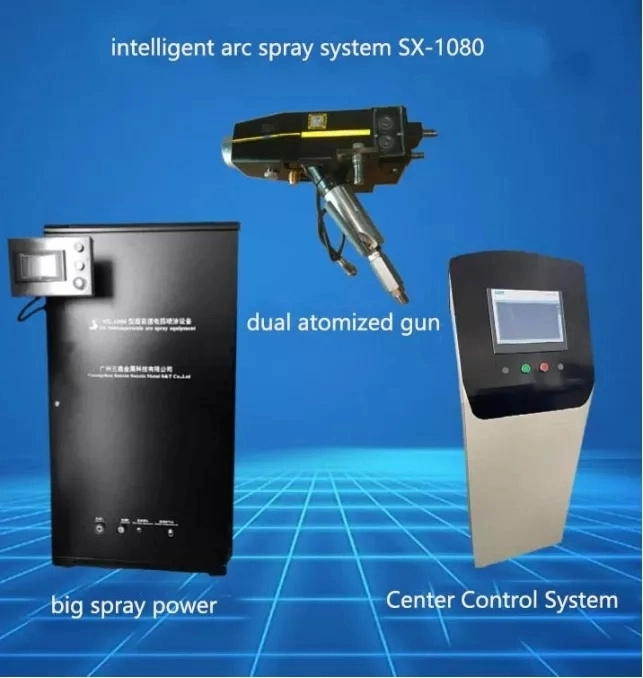
The SX-1080 is an economical yet intelligent wire arc spray system. A central Siemens PLC and touch screen control voltage, current, air pressure and wire feed in closed loop, storing recipes and logging operating parameters. The dual-atomizing arc gun supports different nozzle and air-cap combinations for a wide range of spray patterns and coating finishes.
Key Specifications
- Power: 16 kW (35 kW / 1000 A high-power option available)
- Wire diameter: 1.6 – 3.0 mm (up to 3.2 mm with high-power supply)
- Typical spray rate: 8 – 30 kg/h depending on wire material
- Spray gun weight: 2.65 kg
- Control: Siemens touch screen + PLC, automatic ignition/shutdown, fault alarm
- Wire feed: synchronized drive, single sealed motor, feed distance up to 20 m
Applications
- Bridge and steel-structure zinc/aluminum anti-corrosion
- Wind-power flange and tower coating
- Water gates, ships, tanks and pipeline exteriors
- Copper, zinc and aluminum coatings for general industry
What "intelligent" means in practice
A conventional arc set has three knobs: voltage, wire feed and air. The operator adjusts until the arc sounds right, and the setting drifts as the nozzle wears and the ambient temperature changes. The SX-1080 closes the loop on those variables through a Siemens PLC and touch screen, so a recipe that produced an acceptable coating on Monday produces the same coating on Friday, and the parameters are logged rather than remembered.
That matters most when more than one operator runs the cell, or when a customer audits the process. A printed parameter record per batch is often the difference between passing and failing a supplier audit.
Dual atomising gun
The gun atomises the arc with two air streams and accepts different nozzle and air-cap combinations. A tight cap gives a narrow, fast spray pattern for small parts and edges; a wide cap covers area faster at lower velocity. Being able to change caps without changing the power supply is what lets one machine cover both repair work and production coating.
Choosing the power option
| Option | Suits | Note |
|---|---|---|
| 16 kW standard | Zinc and aluminium, up to 3.0 mm wire | Most common choice for structural work |
| 35 kW / 1000 A | Copper, carbon steel and hard-alloy wire up to 3.2 mm | Higher deposition rate; needs 4.6 m3/min air |
Before you order
Wire materials and the mix of them, required deposition rate in kg/h, largest and smallest parts, air supply, and whether the machine will later be mounted on a robot or positioner. If automation is planned, say so at the quotation stage - the interface and the gun mounting are cheaper to specify now than to retrofit.
Where it sits in the range
| Model | Power | Best for |
|---|---|---|
| SX-400 | 15 kW | Portable repair, zinc and aluminium, small areas |
| SX-600 | 21.6 kW | Hard-alloy wire, dense coatings, boiler work |
| SX-1080 | 16 kW (35 kW option) | PLC-controlled production, mixed wires, audit trails |
| SX-1000 | 36 kW / 1000 A | High deposition rate, copper and steel wire, automation |
The choice is rarely about power alone. If two operators run the same job on different shifts, the closed-loop control of the SX-1080 is worth more than the extra kilowatts of a larger machine, because consistency between operators is what the customer inspects.
What the controller actually records
Voltage, current, air pressure, wire feed rate and the running hour meter are logged against the recipe, and the touch screen exports the data for filing. For a supplier audit that is usually enough: it demonstrates that a batch was sprayed inside a defined parameter window, and it shows when a parameter drifted outside it. What it does not do is measure the coating - thickness and adhesion still need a physical check, and claiming otherwise would be false comfort.
Frequently asked questions
What does the PLC control on the SX-1080?
Voltage, current, air pressure and wire feed in closed loop, with recipes stored for each wire and part and operating parameters logged for traceability.
What wire sizes and power options are available?
1.6-3.0 mm wire on the standard 16 kW supply, up to 3.2 mm with the 35 kW / 1,000 A high-power option.
What is the dual-atomising gun for?
Different nozzle and air-cap combinations give different spray patterns and coating finishes, so one gun covers everything from broad anti-corrosion coverage to more focused repair work.