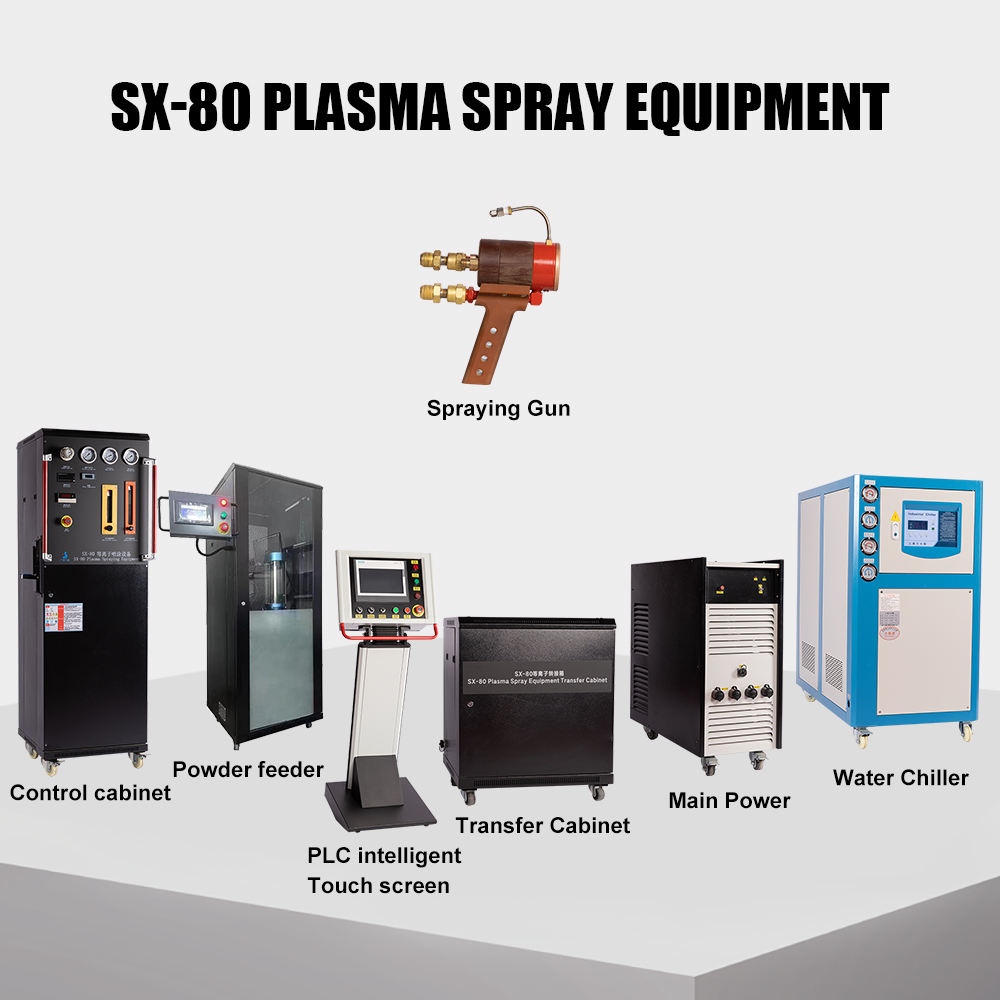
What the SX-90 is for
The SX-90 is an 80 kW plasma system built around ceramic and refractory work: alumina, chromia, zirconia, titania and thermal barrier systems. At this power level the plume is stable enough to melt zirconia consistently, which is where a 40 kW machine starts to struggle - the particles either do not melt through or they overheat while the feed rate is reduced to compensate.
It is also the platform used inside our turnkey cells, because the control package is designed to be operated by a production team rather than by a process engineer. Recipes are stored, recalled with one touch, and the parameters print as a batch record.
The control package
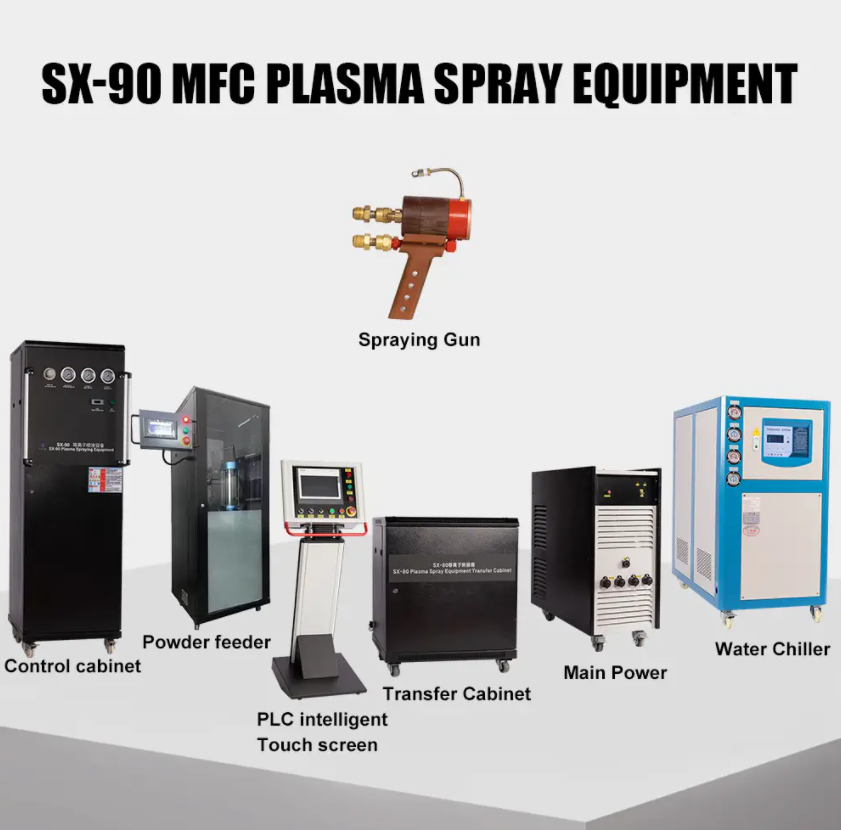
The cabinet has moved from a button panel to a touch terminal with a PLC. That change is not cosmetic: a recipe is now a stored file rather than a laminated card, so shift-to-shift variation drops away and a new operator can run an approved program on the first day.
The gas train uses Alicat mass flow controllers. Their value is response speed - around 5 milliseconds - and direct mass measurement, which means the flow does not drift as the supply pressure falls through a long shift. Unstable gas flow shows up as a pulsing plume and a wandering arc voltage, and the coating symptom is a banded, uneven deposit that no amount of gun-speed tuning fixes.
Cabinet set
| Element | Specification |
|---|---|
| Main power supply | 3-phase 380 V, 50/60 Hz, 80 kW, continuous duty |
| Control cabinet | Touch screen + PLC, 220 V control circuit, 760 x 600 x 1800 mm |
| Gas safety centre | 220 V, two gas inlets, 760 x 600 x 1800 mm |
| Water-electricity transfer box | Links supply, cabinet, heat exchanger and torch; 650 x 600 x 1800 mm |
| Powder feeder | Scraper type, 25-120 g/min, 460 x 615 x 1650 mm |
| Chiller and torch | Industrial chiller sized for continuous duty; SG-100 multi-mode torch |
Why the feeder is listed as a specification
On a ceramic coating the feeder is often the limiting component, not the power supply. A scraper feeder holds a flat delivery curve down to low rates, which is what a 20 to 40 micron ceramic layer needs; a disc feeder at the bottom of its range becomes pulsed, and a pulsed feed shows as a mottled surface that polishing will not remove. The 25-120 g/min band on this unit covers thin TBC layers and thicker wear coatings without changing hardware.
Installation and running cost
The system draws the full 80 kW only at maximum current; typical ceramic work runs at 30 to 60 kW. Cooling water quality matters more than most sites expect - untreated mains water scales the heat exchanger within a season and the torch then runs hot even though the chiller is working. Plan for treated water and a filter, and check return-water temperature as a weekly habit.
Before you order
Coating material and thickness, part envelope and weight, parts per shift, available power and water, and whether the cell will later be automated. If you already run an imported 80 kW system, send the model - the SX-90 was developed against units of that class and the consumables and torch interface can often be matched.
What 80 kW changes on the shop floor
The practical difference is not a bigger number on a plate, it is that zirconia and chromia can be sprayed at a feed rate that makes the job economic. On a 40 kW supply the same coating is applied at half the rate and with a narrower process window, so the operator spends the shift chasing the plume. At 80 kW the plume stays stable across the feed range, which is what turns a development process into a production one.
The second change is duty: an 80 kW supply at 90% load rate will run continuously, so a cell can be scheduled like any other machine rather than in bursts with cooling gaps.
Frequently asked questions
Why does the gas control matter more than the power rating?
Because the plume enthalpy is set by gas flow as much as by current. A 1% drift in argon flow changes the arc voltage and the particle dwell time; on a ceramic that shows up as porosity variation across the part. The SX-90 uses Alicat mass flow controllers with a response time around 5 ms, so the flow is held at the setpoint instead of following the regulator's pressure droop.
Can the same system spray carbide?
No. Tungsten carbide belongs to HVOF or HVAF, where the particle stays below the decarburisation threshold. A plasma plume is hot enough to strip carbon from WC and the resulting coating measures hard but wears badly. The SX-90 covers ceramics, refractory metals and cermets; carbide work needs a different machine.
What does a complete SX-90 installation include?
Main power supply, control cabinet with touch screen and PLC, gas safety centre, water-electricity transfer box, industrial chiller, powder feeder and the SG-100 torch. Site side needs 3-phase 380 V capable of 80 kW, cooling water, argon or nitrogen supply, and a spray cell with extraction.