Corrosion protection for marine and coastal service
Naval and coastal defense equipment fails from corrosion before it fails from anything else. Salt spray, cyclic wetting and galvanic contact between dissimilar metals attack welds, fastener rows and the inside of hollow sections where paint cannot be maintained.
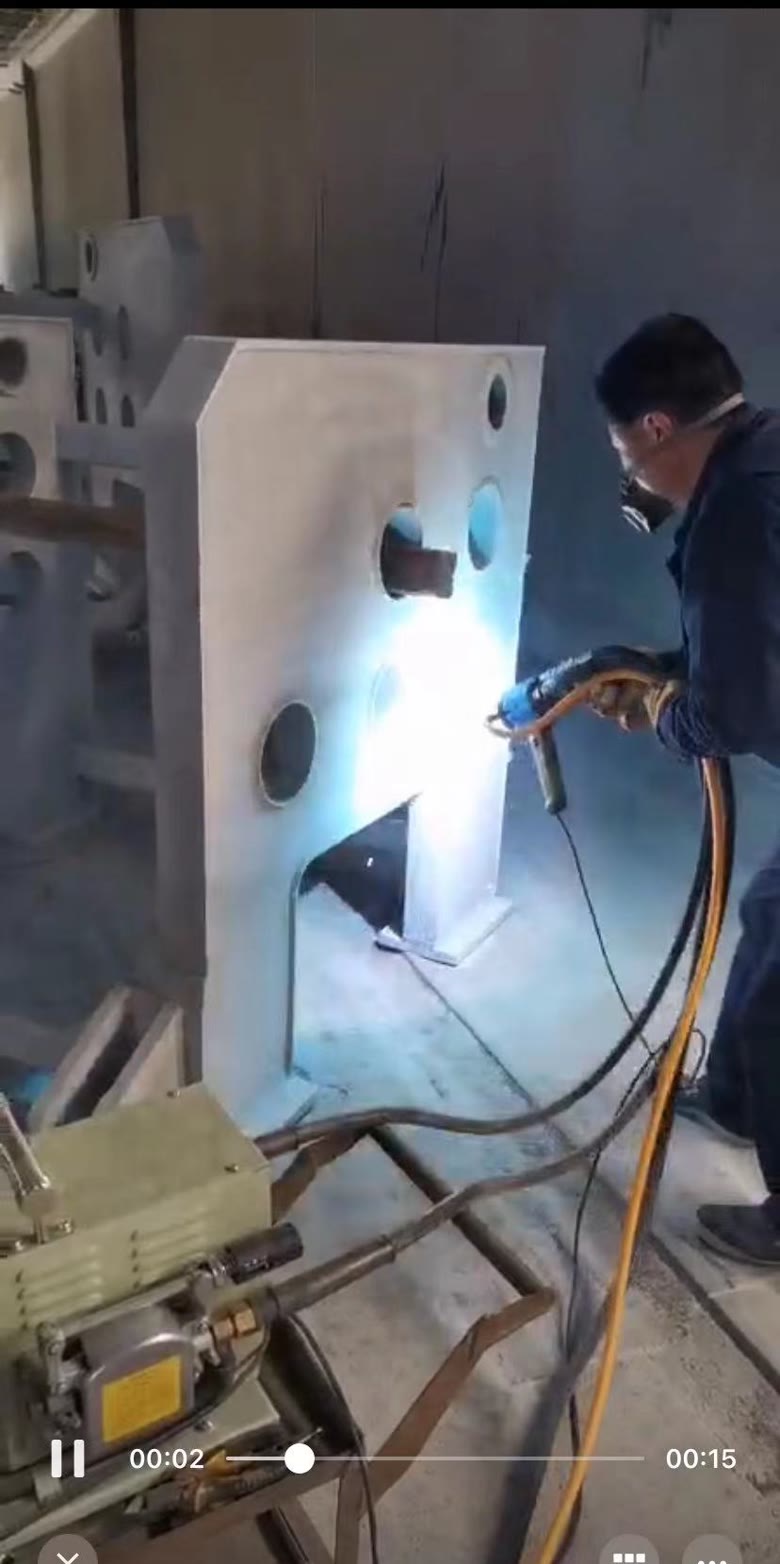
Thermally sprayed aluminium is the established answer. An arc-sprayed aluminium layer of 0.15-0.30 mm provides sacrificial protection - it corrodes preferentially and protects the steel even where the coating is damaged and exposed metal shows through. That is fundamentally different from a paint barrier, which fails as soon as it is breached. Zinc-aluminium 85/15 is used where a longer service life is needed in seawater immersion, and pure zinc where the environment is atmospheric rather than immersed.
The layer is not decorative, so surface preparation decides the outcome. Sa 2.5 to Sa 3 blast with an angular profile of 60-100 um, sprayed within the coating window before the profile oxidises, then sealed with a low-viscosity sealer to close the porosity. Sealed aluminium arc spray on properly prepared steel is specified for 20 years and longer in marine environments.
Large fabrications that cannot be moved
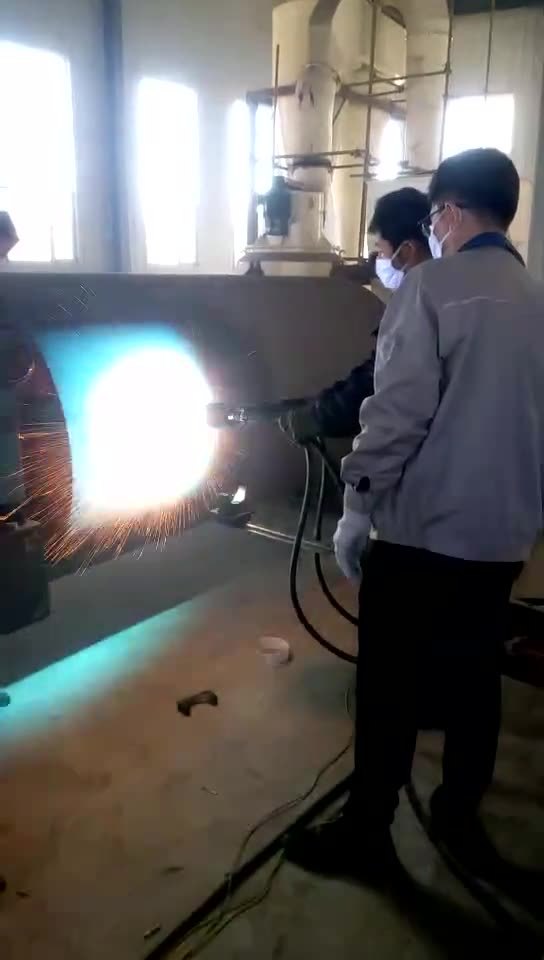
Hulls, turret structures, launch frames, radar masts and shelter frames are too large to send to a coating shop. Our approach is to bring a containerised spray cell to the site: arc spray equipment with 100 m hose runs, local extraction, and operators working to the same parameters as in our workshop. This is the same capability we deploy for on-site pipeline and tank work, adapted for defense fabrication yards.
For facilities that want the capability in-house rather than contracted, we supply the complete cell - spray system, soundproof booth, dust collector, turntable and ducting - and commission it on site. That is what the acoustic and extraction installations in our reference photos are: a full spray facility built inside an existing factory bay, including the smoke test before handover.
Turbine blade and component restoration
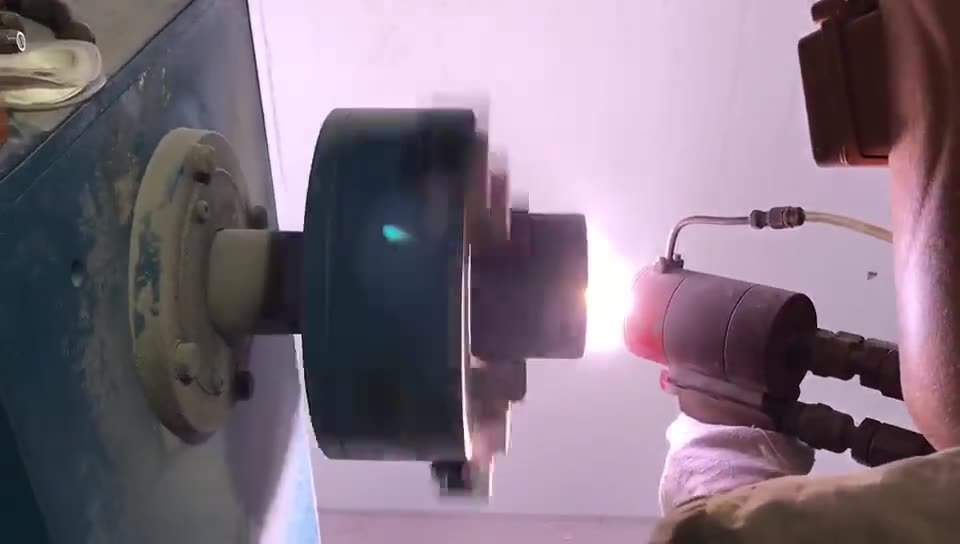
Gas turbine and steam turbine blades in defense industrial facilities wear at the tip, at the knife-edge seals and along the leading edge. HVOF tungsten carbide or a wear-resistant alloy sprayed on the worn area and ground back to drawing restores running clearance at a fraction of the cost of a new blade set. We have done this work at Harbin turbine works on military project blades, spraying with kerosene-fuelled supersonic equipment on site.
Process capability
| Requirement | Capability |
|---|---|
| Corrosion coating | Arc spray Al, Zn, Zn-Al 85/15, 0.15-0.50 mm |
| Surface preparation | Sa 2.5-3, angular profile 60-100 um, on-site blasting |
| Sealing | Low-viscosity sealer, penetrating type, applied within window |
| Salt spray performance | 1000 h and beyond for sealed Al on prepared steel |
| Wear coating | HVOF WC-Co / WC-CoCr, 0.05-0.50 mm |
| On-site mobilisation | Containerised cell, 100 m hose runs, local extraction |
| Workshop cell delivery | Spray system, booth, dust collector, turntable, commissioning |
On qualification and confidentiality
Defense procurement brings requirements that a commercial coating shop does not face: supplier qualification, material traceability, and in many cases confidentiality about what the part actually is. We work within that. We do not need to know the platform or the system - we need the substrate, the required coating, the acceptance standard and the drawing tolerance.
What we do not claim: we are a coating equipment manufacturer and contract coating supplier, not a qualified defense supplier in our own right. Where a project requires specific supplier qualification or security clearance, that qualification belongs to the prime contractor or the facility, and we work as their coating subcontractor under their quality system.
What we need to quote
Substrate material and section thickness, the area and geometry to be coated, the corrosion or wear requirement and acceptance standard, whether work is in our workshop or on your site, and the schedule. For on-site work we also need to know the available power, compressed air capacity and whether blasting can be done in the same area.
Frequently asked questions
Why use thermal spray instead of paint for marine corrosion?
Because sprayed aluminium protects galvanically, not just as a barrier. If the coating is scratched or a fastener is replaced, the aluminium around the damage continues to protect the steel. Paint fails at the first breach and corrosion then spreads under the film, which is why painted structures need constant touch-up and sprayed aluminium does not.
Can you coat a structure that cannot be moved to a workshop?
Yes. We mobilise a containerised spray cell with up to 100 m of hose, local extraction and on-site blasting. The constraint is usually the blast containment and the power and air supply at the site, not the spraying itself.
Do you have defense supplier qualification?
No, and we do not claim one. We are a coating equipment manufacturer and contract coater. Where a project requires qualified supplier status or security clearance, that sits with the prime contractor or the facility, and we work under their quality system as a coating subcontractor.
What surface preparation is required for arc-sprayed aluminium?
Sa 2.5 to Sa 3 blast with an angular profile of 60-100 um, and spraying inside the coating window before the fresh profile oxidises - typically within four hours in humid conditions. Preparation is the single factor that decides whether the coating reaches its 20-year design life.