Corona Roller Ceramic Insulating Coating
In corona treatment of polymer films such as BOPP, PET, PE and PP, the film passes over a corona roller that works against a high-voltage electrode of several thousand to tens of thousands of volts. The roller surface must therefore offer excellent electrical insulation and, because corona discharge produces ozone, strong chemical stability as well.
Ceramic Coating Instead of Rubber Lining
Corona rollers were traditionally lined with silicone rubber, synthetic rubber or epoxy resin to obtain the required insulation. Under continuous corona discharge these linings age quickly and fail, shortening service life. A plasma sprayed ceramic coating on the metal roller body is a proven alternative, widely adopted in the United States, Japan and other industrial countries.
Technical Solution
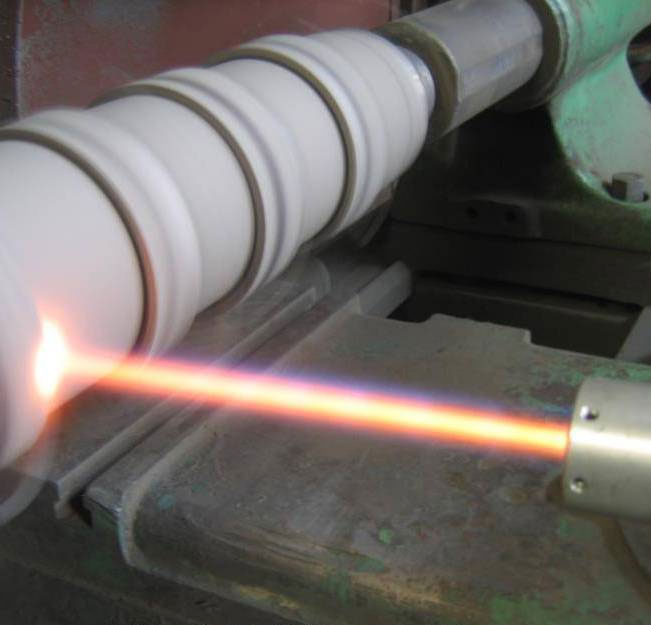
- High-energy plasma spraying of a ceramic layer onto the metal roller body.
- Composite gradient coating design that prevents cracking of the Al2O3 layer and increases insulation resistance.
- Special sealing treatment that closes residual porosity and prevents electrical breakdown through pores.
Process Flow
Base roller (new or used, supplied by customer) → dimensional inspection → rough cylindrical grinding → dynamic balancing → surface cleaning and activation → ceramic spraying → precision grinding and polishing → sealing and post-treatment → insulation performance inspection.
Coating Performance
- Bond strength: above 65 MPa.
- Microhardness: approximately HV0.3 780.
- Coating thickness: 0.5-1.8 mm as standard, 2.0 mm available.
- Surface roughness: Ra 0.20 as standard.
- Insulation: no breakdown under 10-20 kV alternating voltage at 10-30 kHz; withstand voltage above 20,000 V.
- Wear and corrosion resistant with high-temperature oxidation resistance; service life many times longer than silicone rubber lining.
Specification summary
| Parameter | Standard | Option |
|---|---|---|
| Coating material | Al2O3 99% | Al2O3-TiO2 for higher toughness |
| Bond coat | NiAl 0.08-0.10 mm | Graded NiAl/Al2O3 transition for thick builds |
| Coating thickness | 0.5-1.8 mm | Up to 2.0 mm |
| Bond strength | Above 65 MPa | - |
| Microhardness | HV0.3 780 typical | - |
| Surface roughness | Ra 0.20 | Ra 0.10 for critical web contact |
| Dielectric strength | No breakdown at 20 kV | Tested at customer-specified voltage |
| Runout | Under 0.02 mm | Balanced to ISO 1940 G2.5 on request |
Why ceramic replaces rubber lining
Silicone and synthetic rubber linings insulate well when new, but corona discharge, ozone and heat age them continuously. Breakdown usually appears as a pinhole that grows into a burned track, and the roller has to come off the line. A plasma sprayed alumina layer is inorganic: it does not age in ozone, does not soften at operating temperature, and its dielectric strength does not drift with time. Users in film and foil converting typically see several times the service life of a rubber lining.
The three controls that decide whether it works
- Gradient build. A single thick alumina layer cracks from thermal mismatch. We build a graded metal-ceramic transition so stress is distributed instead of concentrated at the interface.
- Sealing. Porosity is the path to breakdown. A vacuum or warm-dip sealer closes the through-thickness channels; without it, thickness alone will not hold voltage.
- End coverage. The highest field is at the roller ends, where spray angle thins the layer. Gun over-travel and thickness mapping at both ends prevent edge flashover.
Frequently asked questions
What is the difference between your coating and a ceramic sleeve?
A sleeve is a separate ceramic tube bonded or shrunk onto the roller, with an adhesive layer that can fail thermally. A sprayed coating is bonded directly to the steel body with no adhesive interface, and it can be applied to almost any diameter and recoated after stripping.
How often does the roller need re-sealing?
Every 12-24 months in continuous corona duty, depending on ozone concentration and operating temperature. Re-sealing is far cheaper than recoating and prevents the slow drift in dielectric performance.
Can you strip and recoat an existing ceramic roller?
Yes. The old layer is stripped, the steel body inspected for corrosion and wall thickness, then re-ground and recoated to the original specification.
Further reading: why ceramic coatings fail on corona rollers.