Plasma Spraying Technology
Plasma spraying uses a plasma arc as the heat source and ceramic powder as the coating material. Between the cathode and the anode nozzle a DC arc ionizes the working gas into a plasma jet of several thousand degrees; powder carried into the jet melts, accelerates and builds up on the part surface as a coating.
Ceramic Powders
- Al2O3: the standard electrical insulator with high hardness and wear resistance.
- Al2O3-TiO2 (AT): denser and tougher, with lower friction for sliding contact.
- Cr2O3: for combined wear and corrosion duty in pumps and sleeves.
- ZrO2 and yttria-stabilized zirconia: thermal barrier and high-temperature insulating layers.
Why Plasma
- Sprays almost any meltable material, including refractory ceramics, metals and cermets.
- Inert working gases reduce oxidation of particles in flight.
- High bond strength, low porosity and fine, controllable coating structure.
Typical Coating Properties
- Porosity below 1 percent with correct parameter control.
- Bond strength above 70 MPa.
- Insulating layers withstanding several thousand volts depending on thickness and sealing.
How We Work
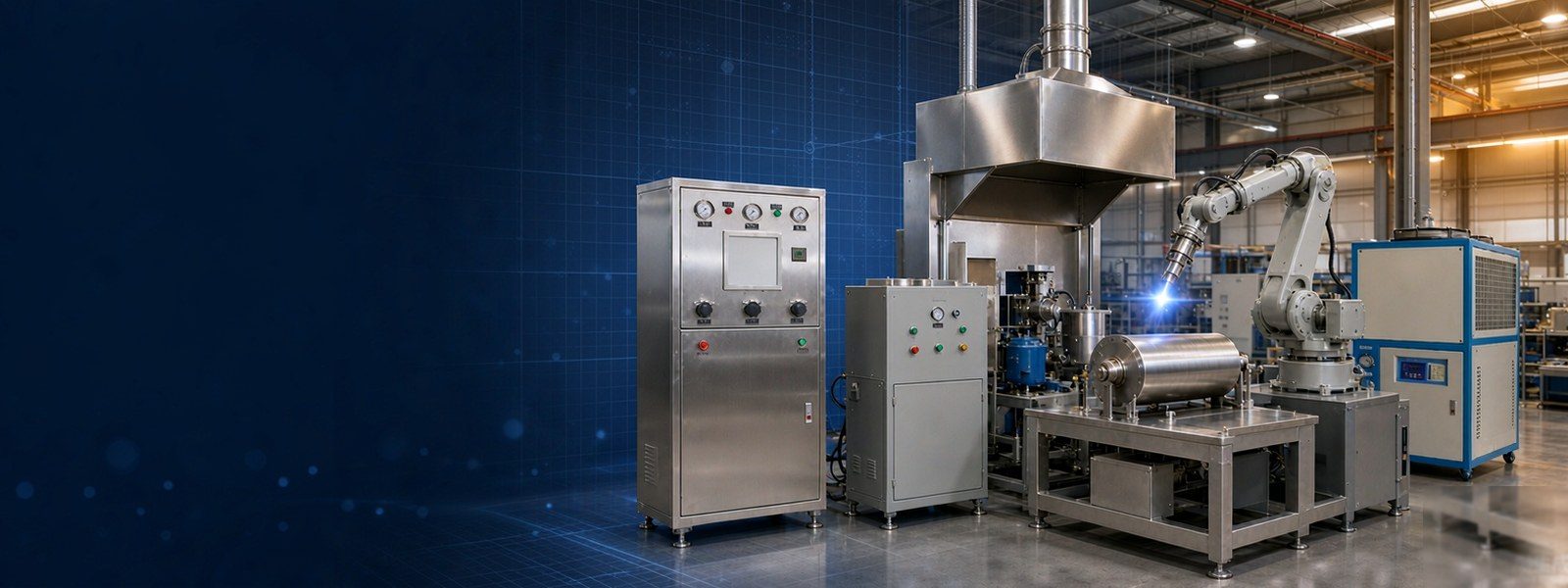
Send a photo or drawing of the part together with the working condition. We propose the coating system and process parameters, spray, finish-machine and inspect, and can also supply complete plasma spraying equipment for in-house production.
Coating selection by medium
| Coating | Hardness | Max service temperature | Best against |
|---|---|---|---|
| Al2O3 (alumina) | 900-1,100 HV0.3 | 1,000 °C | Abrasive wear, electrical insulation, acid media |
| Al2O3-TiO2 | 800-1,000 HV0.3 | 900 °C | Tougher alumina for impact and sliding wear |
| Cr2O3 (chromia) | 1,100-1,400 HV0.3 | 800 °C | Fine particle abrasion, print and metering rolls, low friction |
| ZrO2-8Y2O3 (YSZ) | 700-900 HV0.3 | 1,200 °C | Thermal barrier, thermal shock, molten metal contact |
| AT (alumina-titania composite) | 850-1,000 HV0.3 | 900 °C | Severe abrasive wear with moderate impact |
Critical process controls
- Bond coat. NiAl or NiCrAl at 0.08-0.12 mm gives the ceramic a mechanical key and absorbs thermal mismatch.
- Graded transition. Metal-ceramic blends over 2-3 passes reduce the interfacial stress that drives spalling of thick layers.
- Substrate preheat. 100-150 °C for steel, higher for castings that need outgassing.
- Cooling control. Forced air with the part rotating; never quench after spraying.
- Sealing. Silicone or epoxy sealer on any coating that will see voltage, acid or fine slurry.
Frequently asked questions
How do I choose between alumina and chromia?
Alumina for insulation and general abrasion at lower cost; chromia where the surface must stay smooth against fine particles, such as metering and print rolls, because it holds a finer finish and resists polishing wear.
Will the ceramic chip under impact?
Thin ceramic layers resist moderate impact, but sustained hammering will crack them. Where impact dominates, an HVOF carbide is the correct choice.
Can the coating be repaired locally?
Small damaged areas can be stripped and re-sprayed, but a partial repair leaves a visible boundary. For rollers and sealing faces we normally recoat the full surface.
Further reading: why ceramic coatings fail on rollers.