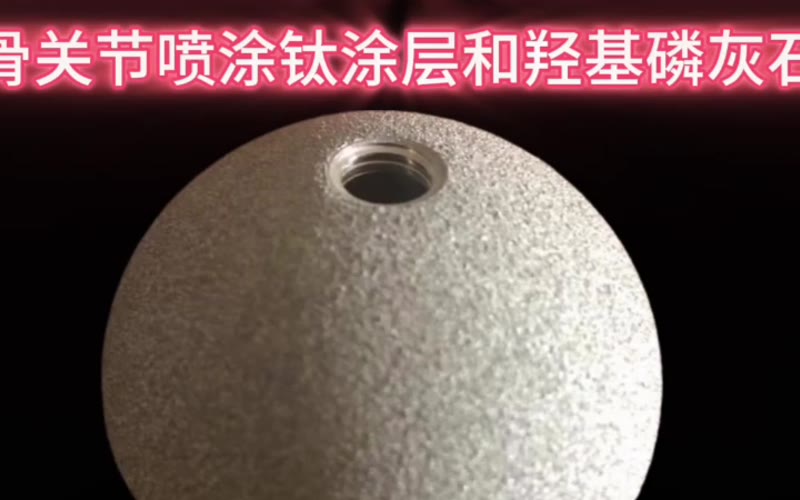
Three different materials, one family
"Titanium powder" covers several distinct products, and confusing them is a common and expensive mistake. The three that matter in thermal spraying behave differently and are used for different reasons.
Metallic titanium (Ti)
Sprayed in vacuum or under inert gas, titanium deposits as a corrosion-resistant metal layer. It is difficult to spray in air because titanium oxidises aggressively at temperature, so air plasma produces a hard, brittle, oxygen-rich layer rather than a ductile metal coating. Where a genuine titanium metal coating is needed, vacuum plasma or cold spray is the correct route.
Its main use in coating work is as a bond layer for hydroxyapatite on orthopaedic implants: a thin, rough titanium layer gives the HA something to grip and provides a stable interface to the Ti-6Al-4V substrate.
Titanium dioxide (TiO2)
Sprayed TiO2 gives a hard, chemically inert ceramic used for corrosion resistance in oxidising media, and for photocatalytic surfaces where the coating breaks down organic contamination under UV. It is also used as an electrically insulating layer. Rutile is the stable phase to aim for; anatase has higher photocatalytic activity but is less stable at spraying temperature.
Titanium sub-oxide (Ti4O7 / Magneli phases)
This is the interesting one for electrochemical work. Titanium sub-oxide is electrically conductive and extremely corrosion resistant - it survives in environments that dissolve graphite and corrode stainless steel. It is used for electrodes in water treatment, electrochlorination and cathodic protection, and for dimensionally stable anodes.
It is also used to make Raney nickel catalyst mesh more effective, where a plasma-sprayed titanium layer is subsequently leached to create a high-surface-area structure.
Selection table
| Product | Key property | Typical application |
|---|---|---|
| Ti metal | Corrosion resistance, biocompatibility | HA bond layers on implants; cold-sprayed repairs |
| TiO2 (rutile) | Hard, inert, insulating, photocatalytic | Corrosion barriers, self-cleaning surfaces, insulation |
| Ti sub-oxide | Electrically conductive, corrosion resistant | Electrodes, water treatment, catalyst substrates |
Process notes
Titanium metal requires vacuum plasma or cold spray to avoid oxidation; TiO2 and sub-oxide spray well by air plasma. Particle size cuts follow the process - finer for vacuum plasma to control roughness on medical parts, coarser for structural corrosion coatings. Thickness runs 0.05-0.30 mm for medical and electrode work, thicker for corrosion barriers.
For implant coatings the crystallinity and phase composition of the TiO2 matter as much as thickness, and customers working to a medical specification will define both. We spray to the customer's coupon and supply the phase analysis with the batch.
What we need to quote
Which of the three materials you actually need (this is worth a conversation), substrate, service environment, required thickness, and any electrical or medical specification. For implant work, tell us the standard you are qualifying against - it determines the process, not just the powder.
Why crystallinity matters on medical parts
On an orthopaedic implant, hydroxyapatite is sprayed over a titanium bond layer, and the crystallinity of the HA - not just its thickness - decides how the implant behaves in the body. Amorphous HA dissolves faster than crystalline HA, so a coating with a low crystalline fraction can lose thickness and release particles in the first months after implantation.
Vacuum plasma spraying typically produces a higher crystalline fraction than air plasma, because the particle stays cooler and there is less decomposition. Customers working to a medical specification will state a minimum crystallinity and a phase composition, and those numbers are checked by X-ray diffraction on a coupon from the same batch.
That is the level of control a medical customer is buying - not a powder grade, but a verified coating on a verified coupon.
A note on the electrode market
The sub-oxide electrode business is small but growing, driven by water treatment and by the replacement of lead and mercury systems. A titanium sub-oxide anode lasts years in chlorinated water where a graphite anode erodes in months, and it does not contaminate the treated water with the metal ions a sacrificial anode releases.
The coating is applied to a titanium substrate by plasma spraying, and the adhesion and the phase composition of the sub-oxide both matter for electrode life. Customers in this field usually qualify a coupon by accelerated life testing rather than by a specification number, which is why we supply trial coatings before a production order.
Frequently asked questions
Can titanium metal be sprayed in air?
It can be sprayed, but you do not get a ductile metal coating. Titanium oxidises aggressively at temperature, so air plasma produces a hard, brittle, oxygen-rich layer. For a genuine titanium metal coating use vacuum plasma or cold spray.
What is titanium sub-oxide used for?
Electrodes. It is electrically conductive and highly corrosion resistant, so it is used for water treatment, electrochlorination and cathodic protection anodes, and as a substrate for Raney nickel catalyst structures.
Why use a titanium bond layer under hydroxyapatite?
Because HA does not bond well directly to Ti-6Al-4V at a controlled roughness. A plasma-sprayed titanium layer provides both the mechanical key and a stable interface, and it is what most orthopaedic implant specifications call for.