What this video shows
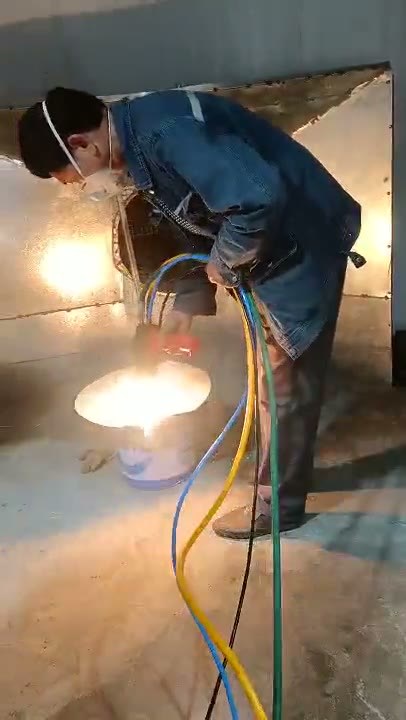
A long screw is mounted between centres and rotated while an HVOF torch traverses along its length. The bright supersonic flame is visible at the gun exit as tungsten carbide powder is deposited on the screw flights. Because the part rotates, every point on the helix passes the jet at the same angle and standoff distance - the key to an even coating on a helical surface.
The whole run is shown in real time: the gun starts at one end, travels steadily along the shaft, and the coated band follows it. Cooling and rotation speed are held constant so heat does not build up in one section of the part.
Process notes
- Process: high-velocity oxy-fuel (HVOF) spraying with WC-Co or WC-Co-Cr powder
- Motion: part rotation plus linear torch traverse, with standoff held constant across the flight tips and root
- Why HVOF: high particle velocity produces a dense, hard, low-porosity coating with limited heat input to the shaft
- Preparation: clean and grit-blast the screw, mask journals and threads, then preheat lightly before spraying
- Finishing: as-sprayed or ground and polished to the specified surface finish and final diameter
Typical applications
Injection-moulding and extrusion screws, screw conveyors and spiral shafts in ceramic, chemical and battery-material handling all suffer abrasive wear on the flight faces. A tungsten carbide coating extends service life sharply, and worn screws can often be rebuilt to size instead of replaced - which is usually the cheaper option on large or long-lead-time shafts.
We coat new and used screws, supply the complete HVOF system for customers who want to do it in-house, and provide sample trials with thickness, hardness and adhesion reports. Tell us the screw diameter, length, material and the abrasive medium it handles, and we will recommend a powder grade and finishing route.
Frequently asked questions
Why use HVOF rather than plasma spraying for a screw?
HVOF gives higher particle velocity, so the carbide coating is denser, harder and less porous, with less heat input to a long shaft that could otherwise distort.
Can a worn screw be reclaimed?
Often yes. The worn surface is cleaned, ground back to sound material, built up with tungsten carbide and finished to the target diameter; we assess each shaft before quoting.
How do you keep the coating even on a helix?
The screw rotates at a fixed speed while the torch traverses at a matched feed, keeping standoff and spray angle constant at both the flight tips and the root.
What powder grades are used?
WC-Co is the standard choice for abrasive wear; WC-Co-Cr is used where corrosion resistance also matters. The grade is selected from the service temperature and the medium being handled.
Do you offer sample coating trials?
Yes. We coat a sample or a cut section and report thickness, hardness and adhesion before a full production run or equipment order.