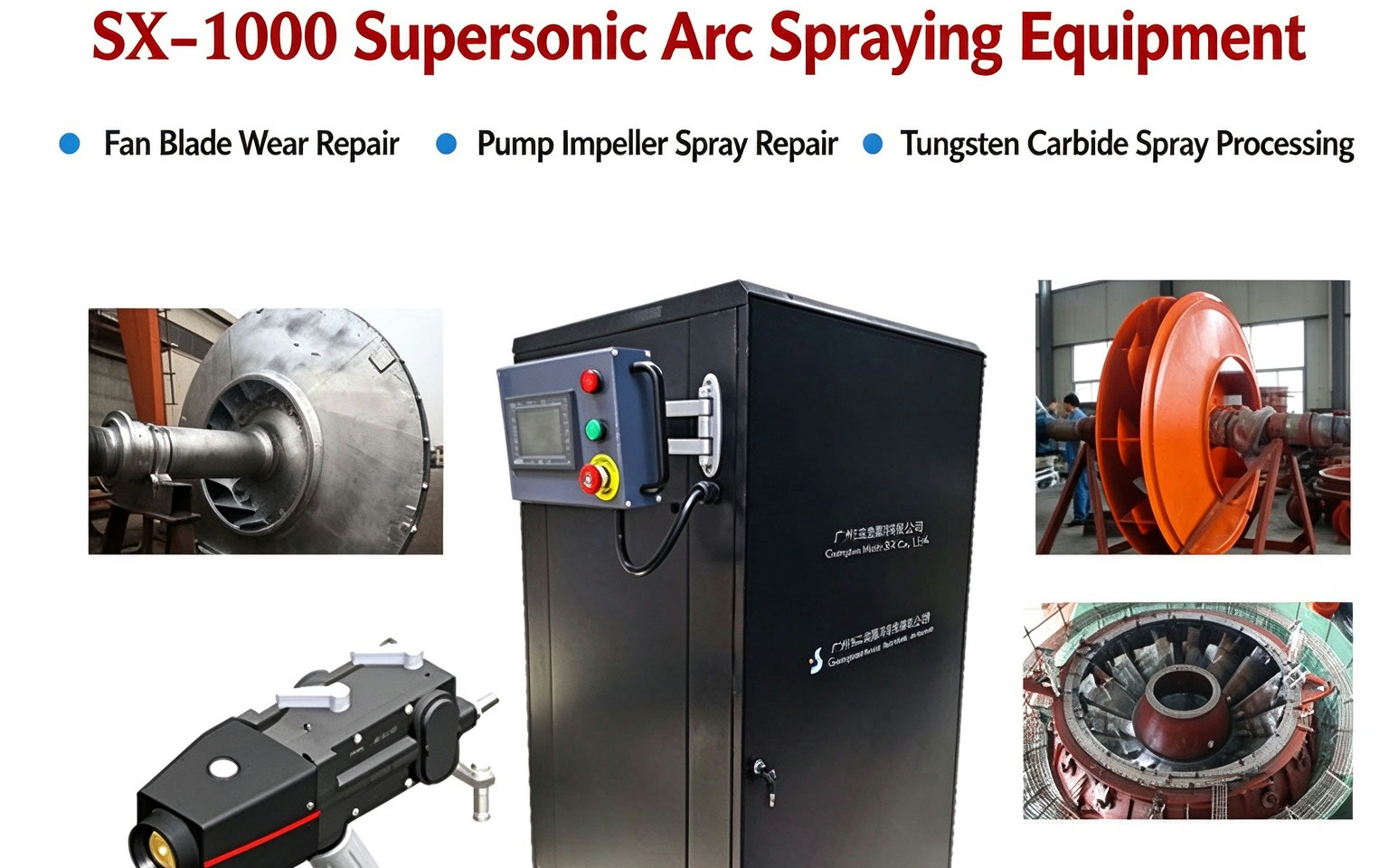
The SX-1000 is a high-power, intelligent arc spray system built for batch production and large-area anti-corrosion work. A 36 kW / 1000 A flat-characteristic power supply melts wires more completely than smaller units, while a Siemens PLC and industrial touch screen provide closed-loop control of voltage, current, air pressure and wire feed. Optional robot integration turns the SX-1000 into a fully automatic coating cell.
Key Specifications
- Power: 36 kW / 1000 A
- Wire diameter: 1.2 – 3.0 mm
- Air consumption: 4.6 m³/min
- Typical spray rates: Zn 46 kg/h, Al 20 kg/h, Cu 41 kg/h, carbon steel 43.5 kg/h, stainless steel 43.5 kg/h
- Control: Siemens touch screen + PLC with data logging and fault alarm
- Gun options: push/pull feed, including imported atomizing gun
- Automation ready: 6-axis robot + AGV + rotary table integration
Applications
- Large-area zinc/aluminum anti-corrosion for bridges, towers and steel structures
- Batch processing of pre-stressed anchors, transition pipes and flanges
- Automatic production lines with robot, rotary table and dust collection
- Repair and protection of shafts, cylinders and large rotating parts
When 36 kW is the right answer
Power in arc spraying buys deposition rate and wire range, not coating quality by itself. The SX-1000 melts 3.0 mm wire completely at rates around 46 kg/h for zinc, 41 kg/h for copper and 43.5 kg/h for carbon steel, which is roughly three times a 16 kW machine. On a large tank, a bridge section or a production line, that difference decides whether the job takes three days or nine.
It also handles wires that a smaller supply cannot melt cleanly. Copper and carbon steel wire draw more current per kilogram, and an under-powered unit running at its limit produces unmelted particles - visible as a rough, gritty surface and measurable as porosity.
The cost of going big
- Air. 4.6 m3/min at pressure is not a small compressor; many workshops discover at commissioning that their ring main cannot hold it.
- Power. Confirm the supply and cable size before delivery, not after.
- Heat and fume. Three times the deposition rate means roughly three times the fume; the extraction has to be sized for it.
- Operator exposure. A high-power arc is louder and brighter; the helmet and screens need to suit the output.
Automation
With a robot or a positioner the SX-1000 becomes a coating cell rather than a tool: the PLC holds the recipe, the robot holds the path, and the two are interlocked so the arc cannot strike before the motion is in position. This is the configuration used for long shafts, rolls and repeated parts where per-piece time is the cost driver.
Before you order
Required area per shift, the wire mix, the largest part, available air and power, and whether the machine will be hand-held or automated. Send the part drawing and we will estimate deposition time and wire consumption rather than quote a machine and leave you to discover the throughput.
A throughput estimate you can check
Take a 200 m2 tank interior, 150 um of zinc, and 43.5 kg/h deposition at 90% duty. Zinc at 150 um weighs about 1.07 kg per m2, so the job needs roughly 214 kg of zinc and about 5.5 hours of arc time - before preparation, masking and handling. On a 16 kW machine at 30 kg/h the same job takes about 8 hours. That difference, multiplied across a contract, is what pays for the larger supply.
Treat the figure as an estimate with assumptions stated, not a promise: wire yield, overspray losses and operator efficiency move it by 20% either way. We will run the calculation against your actual part and wire before quoting, so the throughput number in the quotation has a basis.
Frequently asked questions
When should I choose the SX-1000 over the SX-1080?
When the work is batch production or large-area anti-corrosion and deposition rate matters. The 36 kW / 1,000 A supply melts wire more completely and sustains a higher output than the smaller unit.
Can the SX-1000 be automated?
Yes. Robot integration is available, turning it into a fully automatic coating cell with the PLC handling voltage, current, air and wire feed while the robot handles motion.
What air supply does it need?
About 4.6 m3/min at the gun for the high-power configuration. That is the main site requirement to check before ordering - many workshops need a larger compressor.