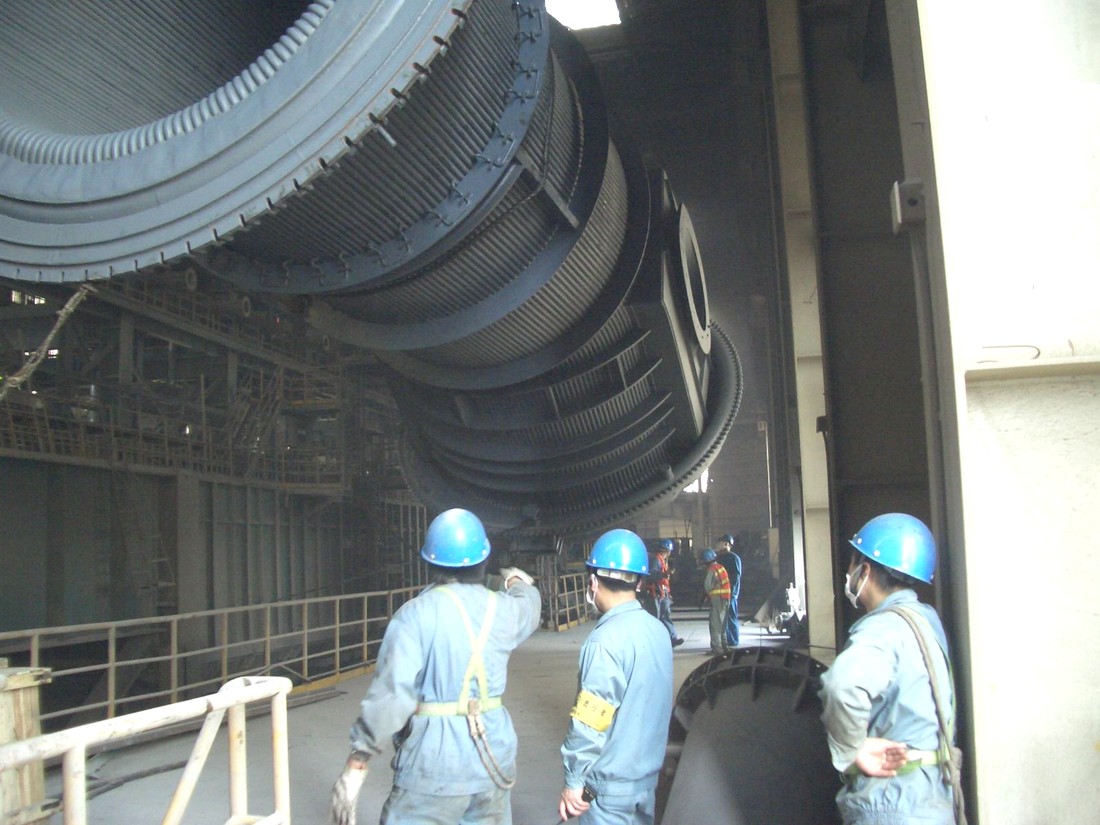
Why an FGD scrubber is one of the hardest corrosion environments
In a wet limestone-gypsum flue gas desulfurization (FGD) system, flue gas enters the scrubber at around 160 C and leaves at 50-65 C - close to the dew point of sulfuric and sulfurous acid. Acid therefore condenses in the outlet duct, dampers, expansion joints and chimney rather than staying in the tower. Under normal operation the condensate is roughly 26-55% sulfuric acid; where a bypass lets untreated gas through, it can exceed 80%.
The chemistry is just as aggressive. Limestone slurry is held slightly acidic, usually pH 4.5-5.5, to control calcium sulfite scaling. Chlorides from the coal and the scrubbing water concentrate as water evaporates and is recycled: in single-loop systems they can exceed 100,000 ppm. Fluoride in coal can reach 3,000 ppm and collects under deposits, where it drives crevice corrosion. Add fly-ash fouling, wet-dry interfaces and shutdown condensation, and a carbon steel duct with an organic lining has a short and unpredictable life.
PREN: the number that ranks the alloys
The corrosion resistance of stainless steels and nickel alloys comes from a thin chromium-rich passive oxide film that reforms when damaged. Molybdenum is what makes that film resist pitting in chloride and SO2 environments; nitrogen helps; nickel stabilises the film and improves weldability. The usual way to rank that resistance is the Pitting Resistance Equivalent Number:
PREN = %Cr + 3.3 %Mo + 16 %N (with tungsten: + 1.65 %W)
The higher the PREN, the better the resistance to pitting and crevice corrosion. Plain 316L and 317L sit low on that scale; 317LM with 4.0-4.5% molybdenum sits higher; 6% Mo superaustenitic grades higher still; and nickel-chromium-molybdenum alloys of the C-276 family are at the top. Published material-selection charts for FGD service plot pH from 1 to 6.5 against chloride concentrations up to 200,000 ppm and divide conditions from "mild" to "very severe" - high-chloride, low-pH zones are where Ni-Cr-Mo is specified.
One caveat: PREN ranks bulk wrought alloys. It is a sound way to choose a spray wire chemistry, but it is not a coating qualification. A sprayed coating has porosity, oxide lamellae and a bond interface that a solid C-276 plate does not, so the application system matters as much as the alloy.
Where arc spraying fits - and where it does not
Three ways to protect an absorber shell or outlet duct are solid nickel-alloy construction, alloy-clad plate, and a non-metallic lining on carbon steel. Life-cycle studies by the Nickel Institute compared a system built from C-276 alloy and C-276 clad panels with carbon steel plus neoprene lining: even the most expensive all-alloy option came out cheaper over the service life, because a lining that fails takes the plant down. Cost can be cut further by zoning - using the highest alloy only in the quench and outlet zones, where chlorides and acid concentrate - or by thin-sheet linings.
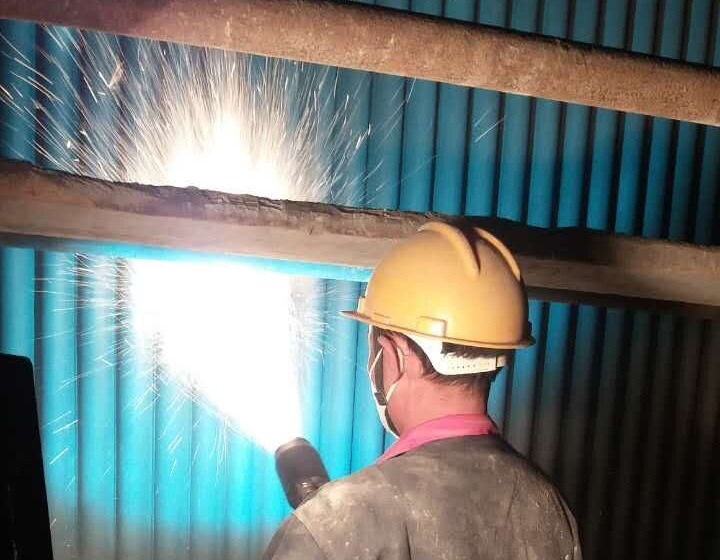
Arc spraying extends that logic to existing plant. A Ni-Cr-Mo wire can be sprayed in situ onto a prepared carbon steel duct, damper or absorber wall during an outage, without replacing the shell and without the weld dilution problems that come with patch plates and plug welds. At typical FGD service temperatures the difference in thermal expansion between the steel and the overlay is not a design problem.
It is not a pressure-boundary repair, and it is not structural. It is also not the right answer everywhere: atmospheric steelwork is better served by a sacrificial zinc or Zn-Al 85/15 coating, and surfaces dominated by abrasion need a carbide coating instead. For acidic chloride service with some erosion, Ni-Cr-Mo plus a sealer is the usual choice.
How the coating is applied
- Survey and record. Map the pH, chloride level, temperature and deposit pattern by zone. Two scrubbers on the same site rarely have the same environment, and a single "worst case" specification wastes money while a single "average" one fails at the outlet.
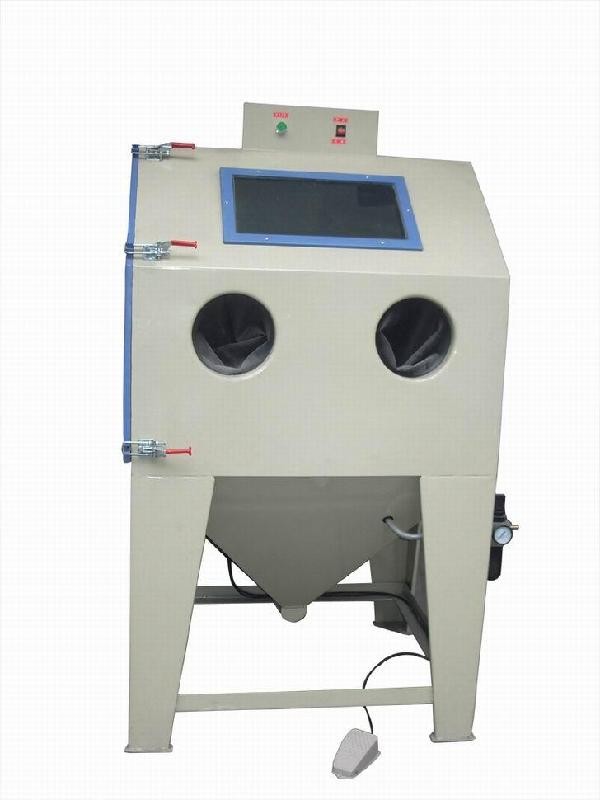
- Prepare the steel. Blast to Sa 2.5-3 with a 40-70 micron anchor profile, remove all soluble salts and dust, and keep the surface dry. Arc spray bonds mechanically; a smooth or damp substrate fails at the interface regardless of the wire chemistry.
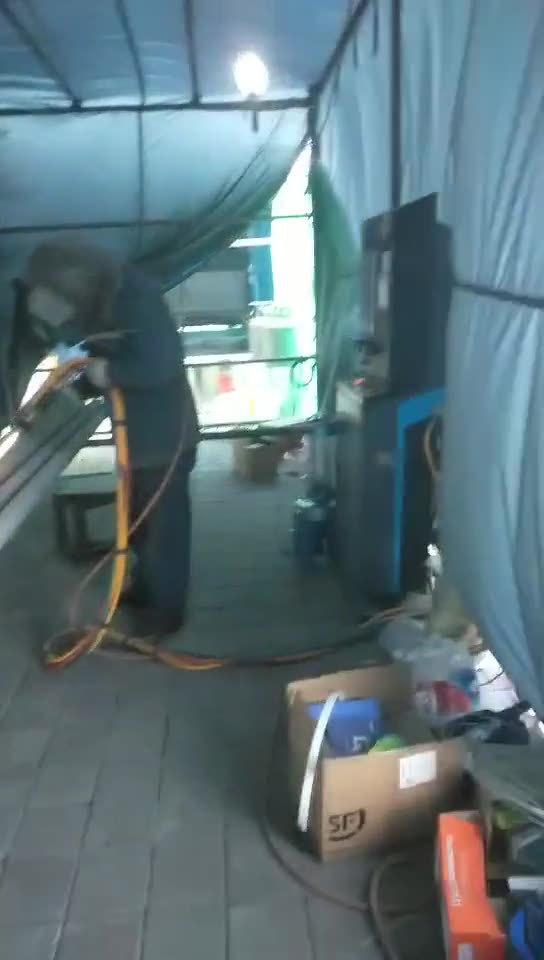
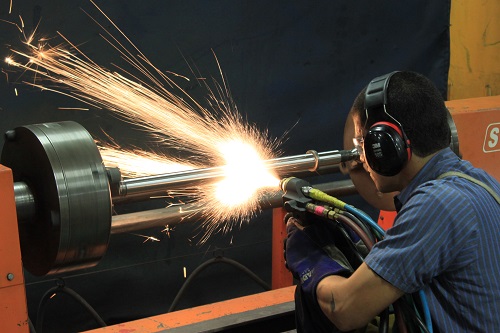
- Spray. A twin-wire arc system such as the SX-600 with the wire-type arc spray gun deposits Ni-Cr-Mo cored wire in controlled passes. Keep each pass thin, maintain stand-off and traverse speed, and cover welds and plug welds with the same overlay so that weld metal dilution cannot leave a weak spot.
- Seal. An arc-sprayed coating is inevitably porous. For a corrosion barrier the pores must be sealed with a compatible chemically resistant sealer and cured before service. This step is not optional: an unsealed high-alloy coating is a network of pathways to the steel beneath it.
- Inspect. Check dry-film thickness, adhesion, holiday detection on the sealed layer, and visual coverage at welds, corners and damper edges. Record the parameters so the next outage can be compared like for like.
What makes these coatings fail
- Unsealed or poorly cured porosity - the most common cause of early rust bleeding.
- Crevices, deposits and stagnant liquid left by the original design: chlorides concentrate beneath scale even when the bulk pH and chloride readings look acceptable.
- Condensation during shutdown, especially where no reheater is fitted. Keep the tube bundle warm, or drain and dry the duct before it cools.
- Bypass excursions that send hot untreated gas and >80% acid condensate into an outlet duct designed for normal operation.
- Fluoride plus chloride at very high concentration: these conditions call for the highest-molybdenum alloy, not a mid-range stainless wire.
- Poor blasting, wrong stand-off, or wire feed drift - all of which show up as a soft, oxide-rich, low-adhesion deposit.
Stress corrosion cracking of austenitic stainless steels is generally not a concern at the normal 50-65 C scrubber temperature, but becomes one above roughly 150-175 C, particularly where chlorides concentrate under deposits on heat-transfer surfaces. That is a substrate and weld issue to review during the survey, not something a sprayed overlay fixes.
Procurement and specification notes
If the work is being put out to tender, separate three things in the specification: the wire chemistry (Cr, Mo, Ni and any W content, with a PREN target), the application system and parameters (power source, air, stand-off, pass thickness, surface preparation standard), and the sealing system with its acceptance tests. A document that specifies only "Ni-Cr-Mo coating, 0.5 mm" leaves the two things that decide service life - preparation and sealing - undefined.
Tell us the zone conditions, the area to be coated, the outage window, and the access and power available on site. We will propose the wire, gun configuration and sealing system, and can supply the equipment, the wire and the operator training as a package. For the consumables that keep the gun running, see spray gun wear parts and our thermal spray wire series.
Frequently asked questions
Why not just use 316L or 317L stainless wire for an FGD duct?
Their PREN is too low for low-pH, high-chloride condensate. Chromium gives the passive film, but molybdenum is what resists pitting in chlorides and SO2; 317LM (4.0-4.5% Mo) and 6% Mo grades were developed for exactly that reason. Ni-Cr-Mo alloys rank higher still.
Does an arc-sprayed Ni-Cr-Mo coating need a sealer?
Yes for corrosion service. Arc spray deposits are porous by nature; without a chemically resistant sealer the electrolyte reaches the steel through the coating. Sealing, curing and holiday testing are part of the specification, not an optional extra.
Can the coating be applied without taking the duct out of service permanently?
Yes - that is the main reason to choose it. Spraying is done on site during a planned outage on the existing carbon steel, after blasting to Sa 2.5-3. It is a corrosion overlay, not a structural or pressure-boundary repair.
What operating data do you need before recommending a wire?
pH range, chloride and fluoride concentrations, normal and bypass temperatures, sulfur content of the fuel, deposit pattern and which zones are worst. The same scrubber can contain both mild and very severe zones, and the alloy should be zoned accordingly.
Is a sprayed overlay cheaper than a solid C-276 liner?
Usually on an existing structure, because the shell stays in place and only the surface is upgraded. Life-cycle comparisons also show that even full nickel-alloy construction beats carbon steel with neoprene lining once maintenance and downtime are counted.