Application fields:
Storage tanks and pressure vessels, chemical and water tanks, offshore and port steelwork, steel bridges and lock gates, pipelines, and structural steel in humid, coastal or chemical environments.
Technical principles and processes:
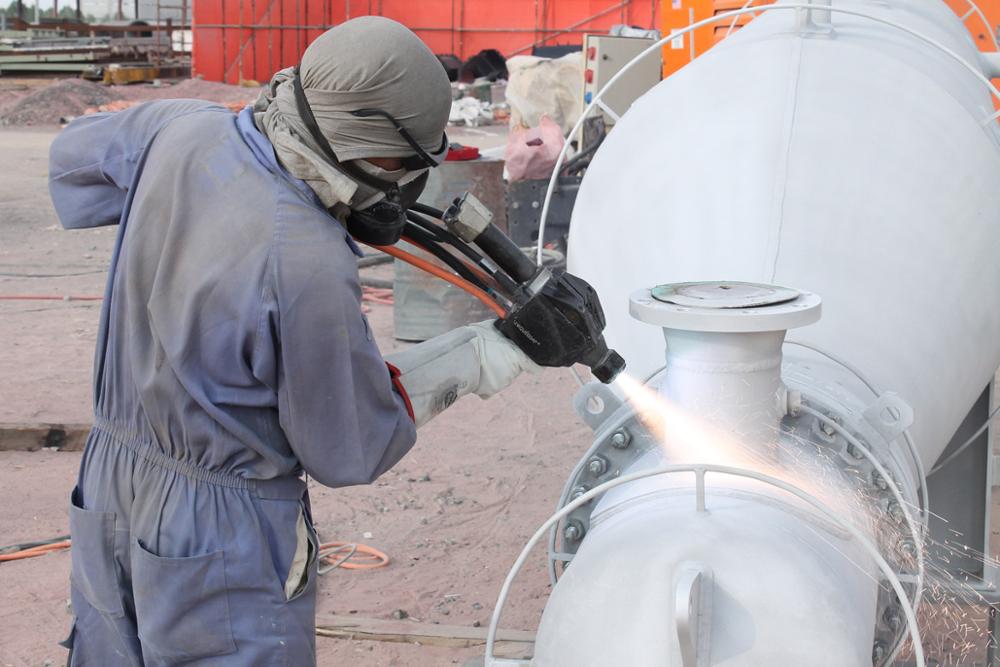
The steel surface is prepared to a high standard by dry abrasive blasting to reach the required cleanliness and roughness, because bond quality depends on it. Zinc-aluminum (typically 85/15) wire is then arc sprayed in overlapping passes to a specified thickness. A sealer or topcoat is normally applied to extend service life.
Coating performance:
- Sacrificial cathodic protection stops rust creep under the coating
- Typical thickness 100-300 microns, applied in one or more passes
- Bond strength suitable for immersion and atmospheric service
- Service life of 15 years and beyond in moderate environments
- Applicable on site or in the workshop for large fabrications
储罐与容器锌铝电弧喷涂防腐:双丝电弧喷涂锌铝涂层,具备牺牲阳极保护作用,适用于储罐、容器、海工与化工环境钢结构的长效防腐。
Coating system
| Layer | Material | Thickness |
|---|---|---|
| Base | Zn-Al 85/15 arc sprayed | 120-200 µm |
| Seal | Low-viscosity epoxy | 20-40 µm |
| Topcoat (external) | Polyurethane or epoxy MIO | 60-100 µm |
| Internal immersion | Epoxy, 2 coats | 200-250 µm total |
Why Zn-Al rather than pure zinc
Zinc alone protects steel sacrificially but corrodes relatively quickly in chloride environments. Aluminium is slower to corrode but provides less sacrificial current at the start. The 85/15 alloy combines both: it gives immediate protection while the aluminium-rich corrosion products form a stable, low-solubility layer that slows further attack. In coastal and marine tank service this is why Zn-Al 85/15 is the default rather than pure zinc.
Points that decide tank coating life
- Welds and corners. Coating is naturally thin there; stripe-coat welds before the full pass.
- Dehumidification. Blasting and spraying inside a tank needs controlled humidity or the substrate flash-rusts before the gun arrives.
- Sealing. The sealer is what turns a porous spray layer into a barrier; skip it and the coating fails at the first immersion cycle.
- Venting. Solvent from the sealer must escape; closed tanks need forced ventilation during cure.
Frequently asked questions
How long does a Zn-Al tank coating last?
Twenty years and beyond in atmospheric coastal service, and 15-25 years in immersion with a properly applied epoxy topcoat, based on ISO 12944 C5-M expectations.
Can it be applied to a tank that has already rusted?
Yes, after the rust is removed to Sa 2.5 and any pitting is assessed. Deep pitting may need weld repair before coating.
Is it suitable for potable water tanks?
Only with a certified topcoat system. The sprayed metal itself is not approved for potable contact; the specified lining is what provides compliance.
Further reading: What drives coating cost per part.