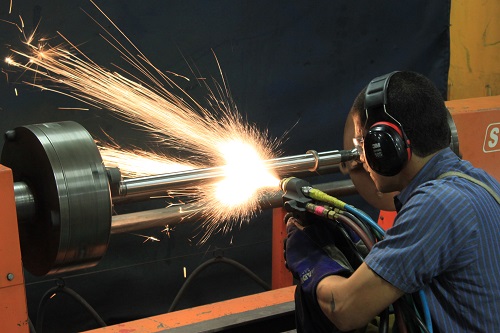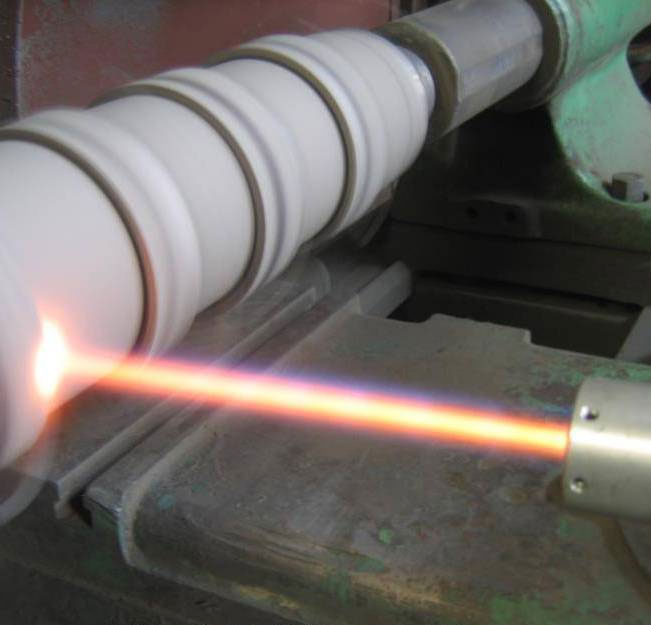
Both are "carbide coatings", both are sprayed by HVOF, both are hard and wear resistant. On a quotation they can look like the same product at different prices. In service they behave so differently that choosing on hardness alone is the fastest way to lose a component early.
The deciding variable is almost always temperature. The second is corrosion. Everything else is a refinement.
The short answer
| WC-Co / WC-CoCr | Cr3C2-NiCr | |
|---|---|---|
| Hardness | 1,000-1,300 HV0.3 | 800-950 HV0.3 |
| Maximum continuous service temperature | About 450 °C (oxidation starts earlier) | 800-900 °C |
| Oxidation resistance | Poor above 500 °C | Good - the NiCr matrix forms a protective oxide |
| Corrosion resistance | Moderate; WC-10Co-4Cr is the corrosion grade | Good, chloride and acid service |
| Toughness and impact resistance | High | Moderate |
| Thermal conductivity | High - dissipates frictional heat | Lower |
| Powder cost | Moderate | Higher, often two to three times |
| Typical use | Hydraulic rods, pump shafts, seals, rolls, blades | Exhaust parts, hot rolls, furnace rolls, turbine hardware |
Why cobalt content matters in WC-Co
The cobalt is the matrix that holds the carbide grains. More cobalt means a tougher, slightly softer coating:
- WC-12Co and WC-17Co - impact and cavitation duty. Used where the part sees shock loading, particle impact or bending. Hardness drops but cracking resistance rises sharply.
- WC-10Co - the general-purpose wear grade, the default for hydraulic rods and pump shafts.
- WC-10Co-4Cr - chromium added to the matrix. Hardness is essentially unchanged, but corrosion resistance improves markedly, which is why offshore and marine specifications call for it.
- WC-6Co - maximum hardness for fine abrasion with light load, such as doctor blades and textile contact parts.
Cobalt is also the weakness. Above roughly 450-500 °C it oxidises, the oxide is voluminous, and the coating lifts from the substrate. A WC-Co coating that fails at temperature does not wear out - it spalls off in patches.
Why Cr3C2-NiCr owns the hot end
Chromium carbide is thermally stable to a much higher temperature, and the nickel-chromium matrix is oxidation resistant by design. At 700-850 °C a Cr3C2-NiCr coating keeps its structure while WC-Co has already begun to break down. In hot wear service it commonly lasts three to five times longer, which more than covers the powder price.
The cost of that stability is lower hardness and lower toughness. On a room-temperature sliding wear part with impact, Cr3C2-NiCr is not the better coating just because it is more expensive.
Selection by application
| Application | Recommendation | Reason |
|---|---|---|
| Hydraulic cylinder rods, marine environment | WC-10Co-4Cr, 0.15-0.25 mm | Wear plus chloride corrosion, low substrate heating |
| Slurry pump shafts and sleeves | WC-10Co or WC-12Co | Fine particle abrasion with some impact |
| Boiler and furnace rolls, 700-900 °C | Cr3C2-NiCr | Oxidation resistance dominates |
| Exhaust valve stems, turbo hardware | Cr3C2-NiCr | Hot sliding wear |
| Fan blades with particle erosion | WC-CoCr, or Cr3C2-NiCr if hot | Depends on gas temperature |
| Paper and film rolls, doctor blades | WC-6Co or WC-10Co, thin and ground | Fine abrasion, surface finish critical |
What we check before recommending
Four questions decide it: what is the surface temperature at the contact point (not the bulk component temperature), is there chlorides or acid in the environment, is the load sliding or impacting, and what surface finish can the drawing tolerate. Where the answers straddle both materials, we spray both on coupons and run an abrasion test rather than guess.
Both coatings are sprayed in-house by HVOF, ground to your tolerance and reported with bond strength, porosity and hardness. Send a drawing and we will come back with a process and material recommendation within one working day.
Frequently asked questions
Can I use WC-Co at 600 °C?
Only with a short service life. Oxidation of the cobalt matrix becomes significant above 450-500 °C. For continuous duty at 600 °C and above, Cr3C2-NiCr is the appropriate choice.
Is Cr3C2-NiCr harder than tungsten carbide?
No. Typical hardness is 800-950 HV0.3 against 1,000-1,300 HV0.3 for WC-Co. Its advantage is retaining that hardness at high temperature, not exceeding it at room temperature.
Which one is better against seawater corrosion?
WC-10Co-4Cr, provided the coating is dense and sealed. Cr3C2-NiCr also performs well in chloride environments but is normally reserved for hot sections.
How thick should the coating be?
0.10-0.25 mm for most sliding wear parts, up to 0.4 mm for severe abrasion. HVOF carbide beyond 0.5 mm builds residual stress and is rarely economical.