Almost every coating enquiry we receive ends with the same question: HVOF or plasma? The two processes are often treated as interchangeable "high-end thermal spray", but they behave very differently on the part. Choosing the wrong one is the most common reason a coating underperforms - not poor spraying, but a process that was never suited to the job.
This guide compares them on the properties that actually decide service life, and gives the selection rules our engineers apply when quoting.
Two processes that use energy in opposite ways
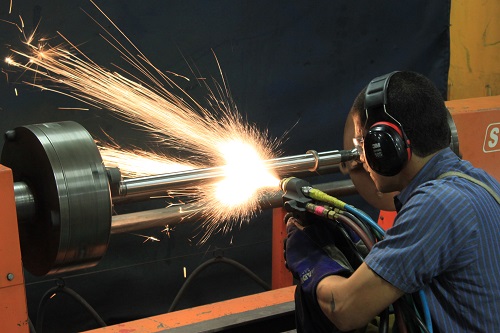
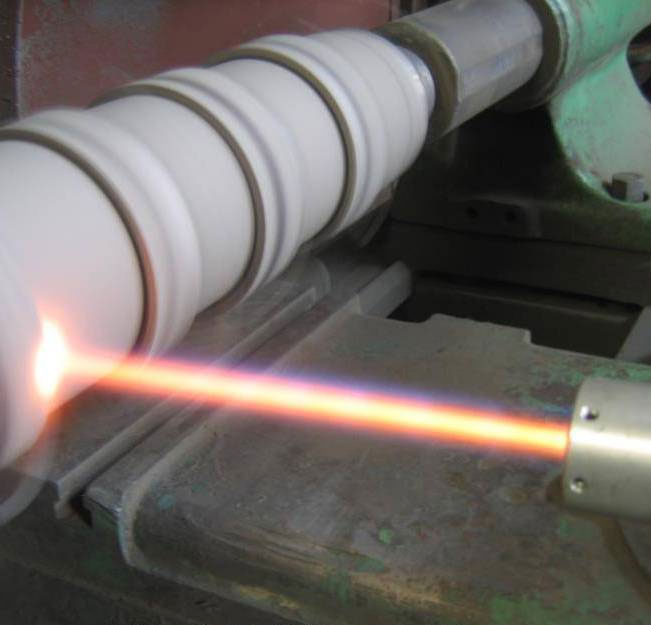
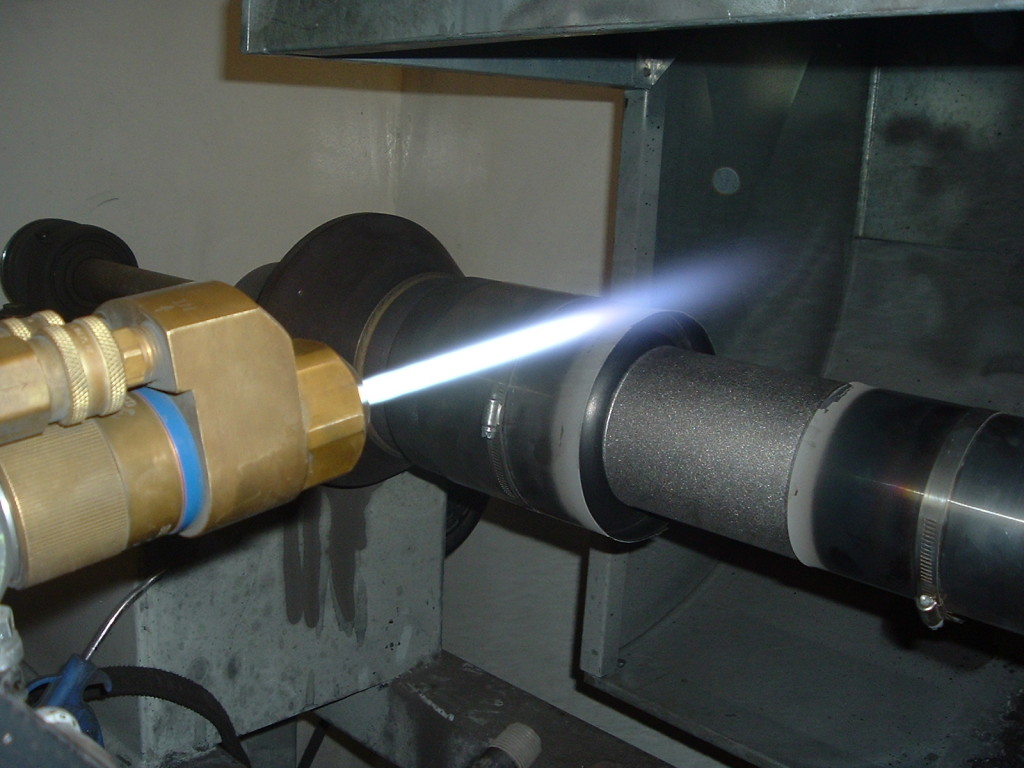
HVOF (high-velocity oxygen fuel) burns kerosene or hydrogen with oxygen in a chamber and accelerates the combustion jet through a long barrel. Particles leave the gun at very high speed with a comparatively low flame temperature. Plasma spraying strikes an arc inside a nozzle, ionises the gas into a plasma at 10,000 °C or more, and melts particles that would be impossible to melt in a flame - but the particles travel far slower.
Speed produces density and bond strength. Temperature produces the ability to melt ceramics. Nearly every difference below follows from that single trade-off.
Direct comparison
| Property | HVOF | Plasma (APS) |
|---|---|---|
| Heat source | 2,700-3,200 °C combustion jet | 10,000-15,000 °C plasma arc |
| Particle velocity | 600-1,000 m/s | 200-600 m/s |
| Typical porosity | Below 1% | 1-5% (under 1% with high-energy guns) |
| Bond strength (ASTM C633) | 70-90 MPa | 40-70 MPa |
| Carbide decarburisation | Very low | Significant - not recommended for WC-Co |
| Practical thickness | 0.05-0.5 mm (1 mm maximum) | 0.10-2.0 mm |
| Substrate heating | Low with air cooling, typically under 200 °C | Higher, 100-300 °C typical |
| Best materials | WC-Co, WC-CoCr, Cr3C2-NiCr, Inconel, Stellite | Al2O3, Cr2O3, ZrO2/YSZ, TiO2, NiAl bond coats |
| Typical parts | Hydraulic rods, pump shafts, rolls, valve gates | Corona rollers, plungers, seals, dielectric and thermal barrier layers |
When HVOF is the right answer
Choose HVOF when the failure mode is mechanical - abrasion, sliding wear, erosion, cavitation - and the part runs at moderate temperature.
- Tungsten carbide coatings. WC-Co and WC-CoCr only reach their full hardness (1,000-1,300 HV0.3) if the carbide grains survive the process. HVOF keeps particle temperature low enough to avoid decarburisation; plasma does not.
- Thin, dense layers. If the drawing allows 0.1-0.3 mm, HVOF gives a near-sealed coating without any post-sealing step.
- Heat-sensitive substrates. With air cooling, HVOF keeps most steel parts below 200 °C, so pre-hardened or thin-walled parts do not distort.
- Wear plus corrosion. WC-10Co-4Cr adds chromium to the matrix and is the standard choice for hydraulic rods in marine and offshore service.
Its limits are equally clear: it is a line-of-sight process with a narrow spray spot, deposition rates are modest (roughly 2-5 kg/h), process gases are expensive, and internal bores below about 100 mm are difficult without special tooling.
When plasma wins
Choose plasma when the requirement is thermal, electrical or chemical rather than pure abrasion resistance - or when the coating has to be thick.
- Oxide ceramics. Alumina, chromia, zirconia and titania melt well above what an HVOF flame can deliver. This is plasma territory by physics, not preference.
- Dielectric and insulating layers. Corona rollers, coating-machine shielding and plasma-chamber parts rely on a thick, sealed alumina layer - typically 0.5-1.8 mm, far beyond practical HVOF thickness.
- Thermal barrier coatings. YSZ at 0.3-1.0 mm with a NiCrAlY bond coat.
- Internal bores and large areas. Extended and rotating plasma guns reach inside cylinders and tubes; the higher deposition rate of oxide powders also keeps large-area cost reasonable.
The trade-off is porosity. A plasma ceramic is inherently a network of splats with sub-micron gaps, and on an insulating part those gaps are exactly where electrical breakdown starts. Sealing and thickness control are not optional extras in plasma work - they are part of the process.
Decision rules we actually use
| If the problem is... | Process and coating |
|---|---|
| Abrasive wear from hard particles, up to about 450 °C | HVOF WC-Co or WC-CoCr |
| Wear at 500-900 °C, hot sliding contact, exhaust components | HVOF Cr3C2-NiCr |
| Electrical insulation, dielectric strength, ozone exposure | Plasma Al2O3 with bond coat and sealing |
| Thermal barrier, heat shielding | Plasma YSZ over NiCrAlY |
| Heavy dimensional build-up on a large shaft | Arc spray or plasma, then grind to size |
| Internal bore under 100 mm | Plasma with extended or rotating gun |
| Impact loading that chips brittle ceramics | HVOF carbide, not ceramic |
How we settle it before quoting
Because both processes run under the same roof, we do not have to steer a customer toward one of them. For any part where the choice is genuinely open, we spray coated coupons with both candidates and test them - bond strength to ASTM C633, porosity by metallography, microhardness, and where relevant a dielectric withstand test. The result is a process recommendation supported by numbers rather than a preference.
Send a drawing with the working conditions - temperature, counter-material, load type, duty cycle - and we will tell you which process we would put on it, and why. Request a coating review.
Frequently asked questions
Can HVOF spray ceramics?
Not in production. An HVOF flame cannot fully melt alumina or zirconia, so the particles arrive semi-molten and produce a porous, weakly bonded layer. For oxide ceramics, plasma is the correct process.
Is a plasma coating weaker than HVOF?
Bond strength is lower, 40-70 MPa against 70-90 MPa, but for a dielectric ceramic layer bond strength is rarely the limiting factor. Thickness uniformity, porosity and sealing decide whether the part survives, and those are controlled by the spray programme and post-treatment.
Which lasts longer on a hydraulic rod?
In sliding abrasion, HVOF WC-CoCr typically outlasts a plasma ceramic by a factor of two to four, and it does not chip under impact. Ceramic is used on rods only where electrical insulation or chemical inertness is also required.
Can the two processes be combined?
Yes. A common build is an HVOF carbide base layer for toughness with a plasma ceramic top layer for insulation or heat resistance. The interface has to be designed, not improvised, but it is a routine job for us.