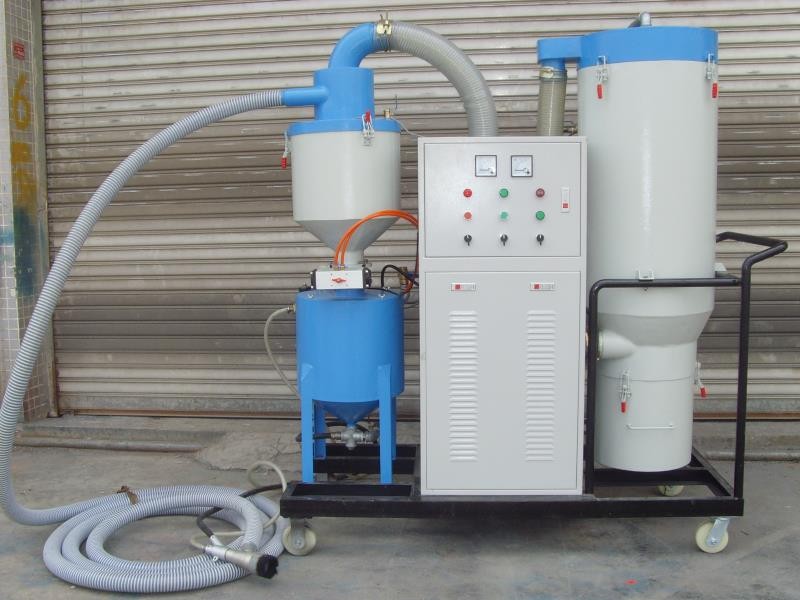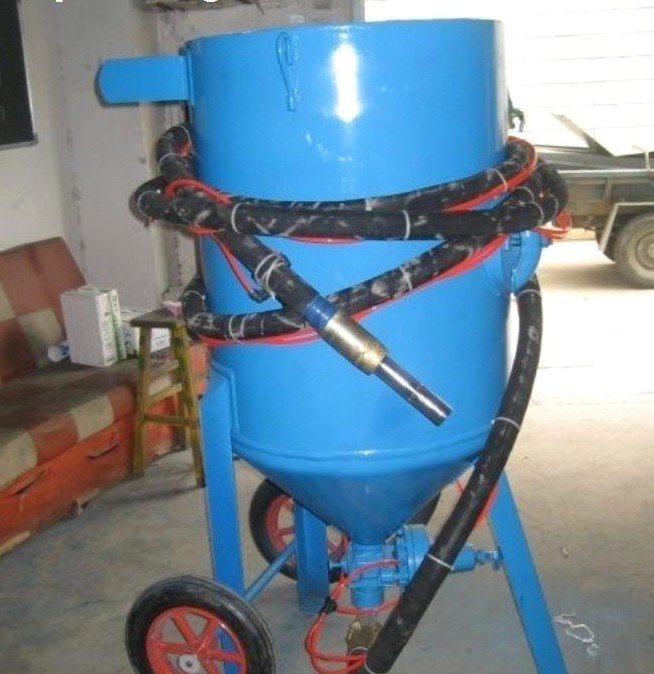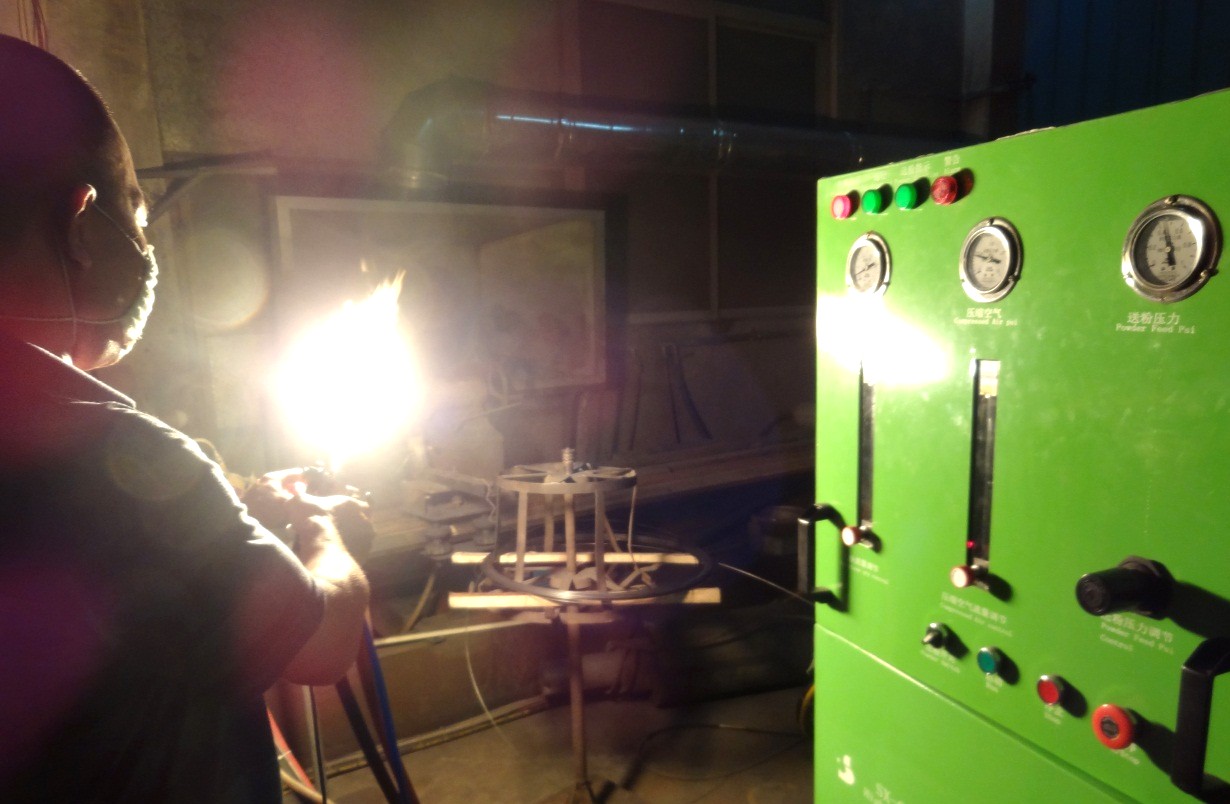
The gun makes the coating, the power source only feeds it
A wire arc spray system has three parts: a DC power source, a wire feeder and the gun. All of the physics happens in the last 150 mm of the gun. Two current-carrying wires are pushed through insulated contact tubes until they meet; the arc melts the wire tips, and a stream of compressed air strips off the molten metal and throws it at the workpiece. There is no flame, no powder hopper and no combustion gas, which is why the process is portable enough for bridge decks, boiler tubes and tank shells.
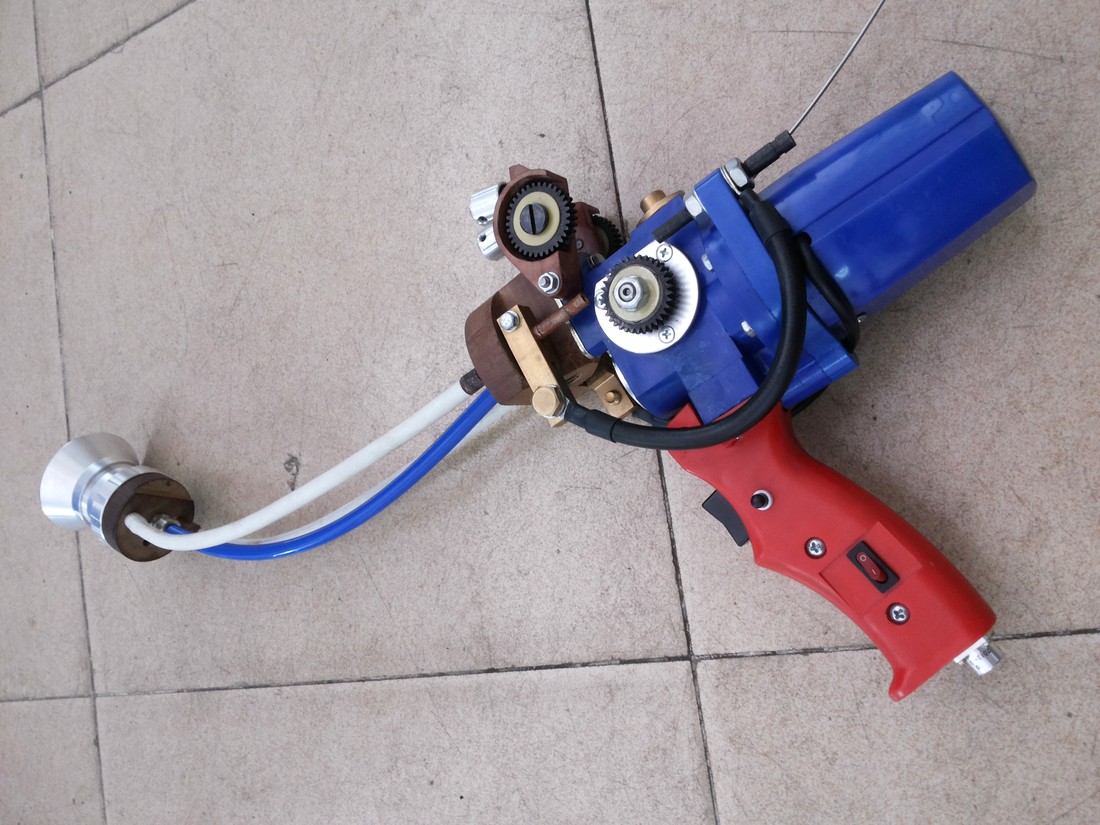
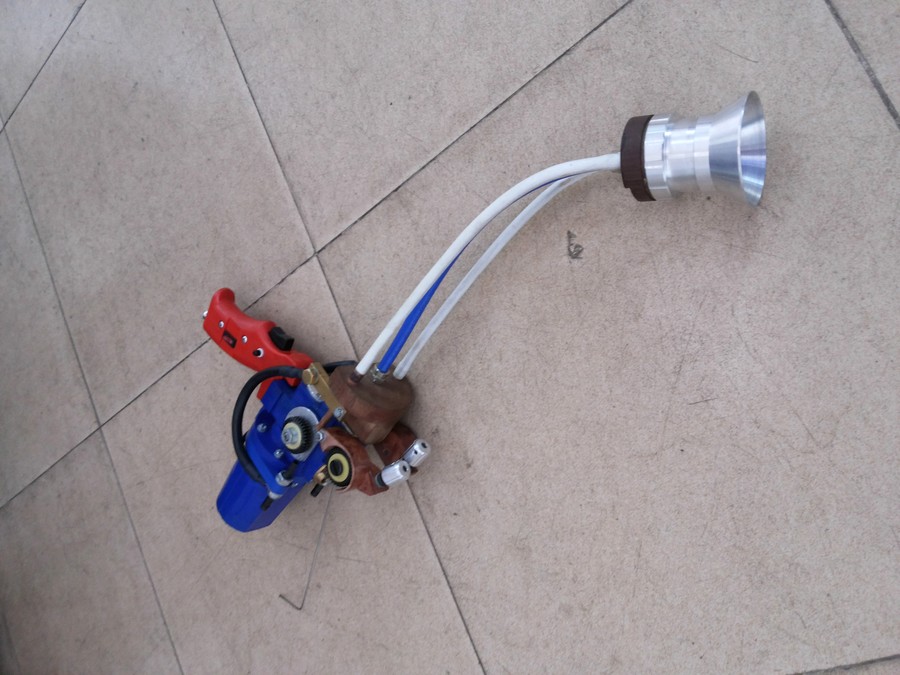
This is the handheld wire-type arc spray gun we supply with the SX-400 and SX-600 systems. It integrates the gas and electrical controls into one head, so the operator has one trigger for wire, arc and air. The photograph shows the gun fitted with an internal-bore extension head, the version used when the arc has to be taken inside a pipe or duct rather than up to its outside surface.
What the numbers mean on site
| Item | Value |
|---|---|
| Gun weight | 2.65 kg (handheld head) |
| Arc voltage / current | 18 - 44 V DC, stepless; matched to an 80 - 400 A source |
| Control voltage | 24 V DC or less at the trigger |
| Compressed air | > 0.5 MPa, > 1.85 m3/min, dry and oil-free |
| Air / particle velocity | Axial airflow up to 600 m/s; particles above 420 m/s |
| Deposition efficiency | > 75% with zinc or aluminium wire |
| Wire diameter | 1.2 - 3.0 mm, two wires, stepless speed control |
| Wire-feed pull | Adjustable; push-pull versions available for long hoses |
| Power source | 380 V, three-phase, 50 Hz; 16 kW; 460 x 480 x 670 mm, 178 kg |
Two figures matter more than the rest. The first is 2.65 kg: an arc gun is held at arm's length for hours on a boiler wall or a bridge bearing, and a kilogram saved at the head is worth more than an extra kilowatt at the source. The second is 1.85 m3/min at 0.5 MPa. That air is not just for atomising - it sets particle speed, coating density and oxide content. A compressor that sags when the trigger is pulled produces a soft, porous coating even when every electrical reading looks correct.
The 18-44 V range is the working arc voltage, not the mains supply. Low voltage with high current is what makes arc spray safe on site: the power source is 380 V three-phase, but the gun itself runs on low-voltage DC through an isolated circuit.
Where guns actually fail: consumables, not electronics
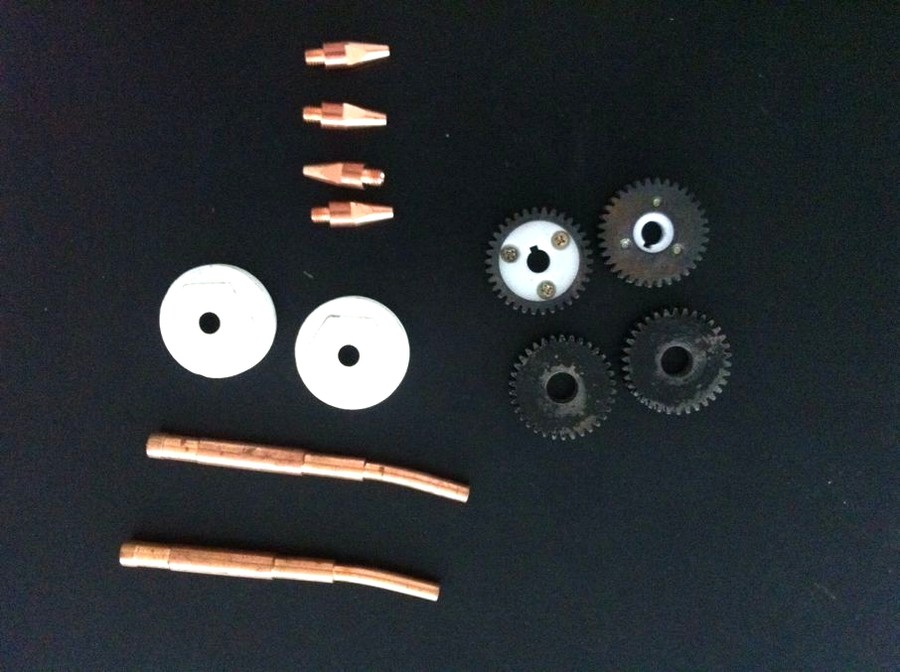
Almost every "the gun is spraying badly" call ends in a wear part. The contact tubes erode where the wire leaves them, the air cap and nozzle go oval, the wire guide liner collects copper dust, and the feed rollers lose their grip. Any one of these moves the arc point by a millimetre and turns a fine, even spray into a coarse, spitting one.
The visible signs are a wider, softer spray pattern, unstable arc noise, wire stubbing at the head, a deposit that is heavier on one side, and a coating that powders when wiped. Our spray gun wear parts and consumables page lists what to hold in stock and the tolerances that matter. A spare contact tube and air cap kit costs a fraction of a day's lost production on a shut-down plant.
Configurations
- Standard handheld head - general Zn, Al and Zn-Al anti-corrosion work, the default for workshops and site steelwork.
- Push-pull wire feed - a driven motor in the gun plus the feeder at the console keeps wire feed constant over the 30 m remote cable used with the SX-600. Without it, long hoses cause wire drag and arc flutter.
- Internal-bore extension - the arc head is carried on a narrow extension with its own air and wire lines, for pipe and duct interiors that a standard head cannot reach.
- Twin-atomisation / robot-mounted heads - for production lines, robot cells and large rolls where the gun is traversed by machine rather than held.
Matching the gun to the machine and the wire
The gun has to be matched to the source it will run on. The SX-400 is the 15 kW, lightweight option for small batches and work at height; the SX-600 is 22 kW, 80-400 A with a 30 m remote cable and up to 30 kg/h of zinc, and is the usual choice for mixed workshop and site work; the SX-1000 and SX-1080 are PLC-controlled production units at up to 1000 A. Tell us the power source you have and we will match the connector, wire-feed drive and control voltage before shipping.
Wire choice decides what the coating does: zinc and Zn-Al 85/15 for sacrificial protection of steel, aluminium for high-temperature and marine atmospheres, Ni-Al as a bond coat, stainless and nickel alloys for wear and corrosion, and Ni-Cr-Mo cored wire for acidic chloride environments. Our thermal spray wire series covers the range. For one of the hardest of those environments, see the guide to arc-sprayed Ni-Cr-Mo coatings in flue gas desulfurization systems.
Before you order
Send us the wire material and diameter, the distance from the power source to the work, the available three-phase supply and compressor, whether the work is external or inside a bore, and the model of the arc machine the gun must fit. We then quote the head, the cable and hose set, and a recommended spare kit - so the first shutdown is not spent waiting for a contact tube.
Frequently asked questions
Can this gun be fitted to an arc spray machine from another manufacturer?
Often yes, but not by plugging it in. The wire-feed drive, control voltage, arc voltage range and hose connectors have to be matched. Send us the model plate and a photo of the connectors and we will confirm before quoting.
What spare parts should I keep for an arc spray gun?
At minimum: contact tubes, air caps and nozzles, wire guide liners and a set of feed rollers. These are the parts that erode in normal service; the gun body and electronics rarely fail. See our spray gun wear parts page for the full kit.
How far can the gun work from the power source?
The SX-600 is supplied with a 30 m remote cable and a push-pull wire feed for that distance. Longer runs are possible with a driven gun head, but air pressure drop in the hose then becomes the limiting factor.
Which wire diameters does the gun accept?
1.2 to 3.0 mm in two wires, with stepless feed-speed adjustment. 2.0 mm zinc or aluminium wire is the most common general anti-corrosion choice; 3.0 mm is used when deposition rate matters more than surface finish.
Can it spray inside a pipe or duct?
Yes, with the internal-bore extension head shown in the photographs. Send the bore diameter and length: the extension needs clearance for the head and for the atomising air, so reach has to be checked against the drawing rather than assumed.